- Animals
- ›Arthropods
- ›Hexapods
- ›Insects
- ›Winged and Once-winged Insects
- ›Butterflies and Moths
- ›Tortricid Leafroller Moths and Allies
- ›Tortricid Leafroller Moths
- ›Tortricine Leafroller Moths
- ›Archipini
- ›Philocryptica
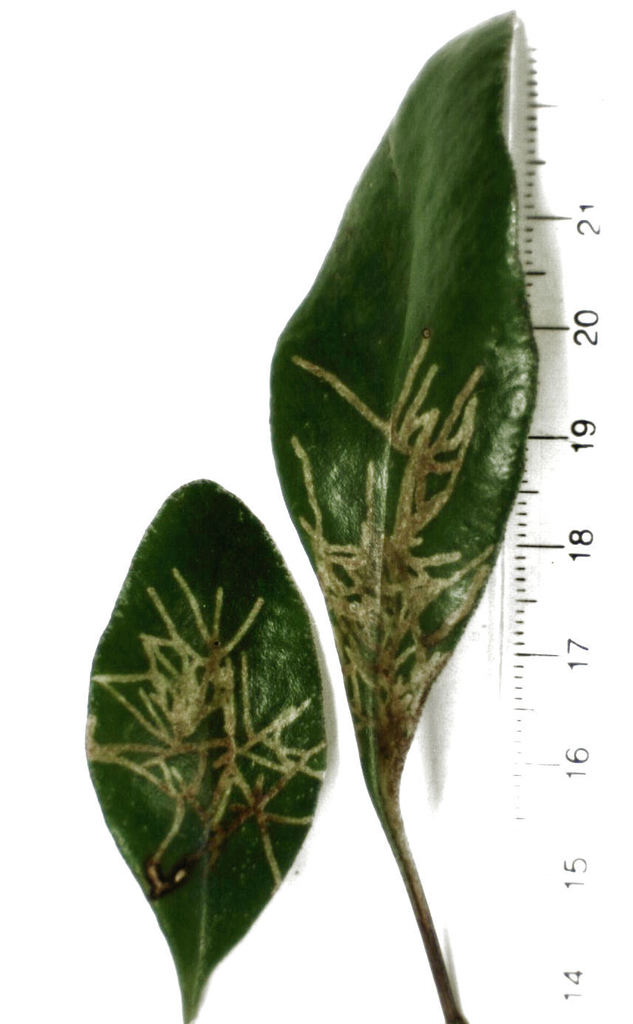
Leather-leaf star-miner
Philocryptica polypodii
Philocryptica is a monotypic genus of moths belonging to the subfamily Tortricinae of the family Tortricidae. It contains only one species, Philocryptica polypodii, the leather-leaf star-miner, which is endemic to New Zealand. This species has been recorded in both the North Island and the South Island, as far south as Banks Peninsula. The preferred habitat of this species is native forest where its larval host plant is present. The larvae feed on Pyrrosia eleagnifolia, mining the leaves. P. polypodii pupates within the final blotch-mine. Adults are on the wing in November and December and are attracted to light.
From the article Philocryptica on Wikipedia (CC BY-SA), quoted section by section
Description
The genus was described by Edward Meyrick as follows:
Antennae in ♂ rather strongly ciliated. Palpi rather short, obliquely ascending, second joint with tolerably appressed scales. Thorax with strong double posterior crest. Forewings 7 and 8 separate, 7 to termen. Hindwings without cubital pecten, 3 approximated at base to 4, 4 and 5 short-stalked, 6 and 7 stalked. The larvae of P. polypodii were described by Watts as follows:
Length when full-grown about 12-14 mm. Cylindrical; ground-colour bright green, head and prothoracic shield dark grey-brown; skin transparent, disclosing a bright -green alimentary canal and dorsal vessel. Tubercles small, green; setae light grey. Skin covered with minute pile except in vicinity of tubercles. Thoracic legs normally developed; prolegs on segments 3-6 inclusive and 10; ventral prolegs possess complete circles of 16-18 crochets each, the anal prolegs possess only a semicircle of 10-12 crochets each. Spiracles small, circular. Hudson described the pupa of the species as follows:
The pupa is enclosed in a cylindrical cocoon of thin white silk, constructed within the final blotch-mine, the larva having prepared an exit through which the pupa protrudes its anterior portions prior to emergence. Hudson described the adults of the species as follows:
The expansion of the wings is about 1⁄2 inch. …
Range & habitat
This species is endemic to New Zealand. It has been recorded in both the North Island and the South Island, as far south as Banks Peninsula.
Wikipedia: “Distribution”
What it does
The larva will produce black coloured liquid from its mouth if disturbed. The larva will exude a silken thread if shaken from the leaf which they then use to return to their host. When the adult moth is disturbed it runs about in an unpredictable directions adding pauses to its activity. In flight this moth moves erratically and rapidly. The adult moth is on the wing from November to December and is attracted to light.
Wikipedia: “Behaviour”
In human culture
It is assumed that the eggs of this species are laid on the host plant. The larvae feed over winter and spring on P. eleagnifolia, mining the leaves. Young larvae create a number of mines radiating from the base creating a star shape. These mines are filled with frass. After the leaf withers, the larva moves on to another leaf. As the larva grows, the size of the mine also increases. At the final stage of larval development, the older larvae create a large blotch mine in which it pupates. Larvae have been collected in August and September. These larvae pupated in October and emerged as adult moths from the 20th of October until the 1st of December.
Wikipedia: “Life history and larval host plant”
Listen
Looking for field recordings…
Where it lives
Recorded sightings
—
geo-referenced records in GBIF, from museums, herbaria and field observers.
Drag the globe to turn it. Dots are where records exist, not a range map; darker means more records.
In the stacks
Searching the stacks…
Every page naming Philocryptica polypodii in the Biodiversity Heritage Library →
This page is assembled live from iNaturalist, GBIF, Wikipedia, the Source Library and the Internet Archive. It is not yet part of the hand-edited codex. iNaturalist taxon 408946.