- Animals
- ›Chordates
- ›Vertebrates
- ›Mammals
- ›Therians
- ›Placental Mammals
- ›Ungulates, Carnivorans, and Allies
- ›Bats
- ›Yinpterochiroptera
- ›Pteropodoidea
- ›Old World Fruit Bats
- ›Flying-foxes, Monkey-faced Bats and allies
- ›Flying-foxes and allies
- ›Pteropus
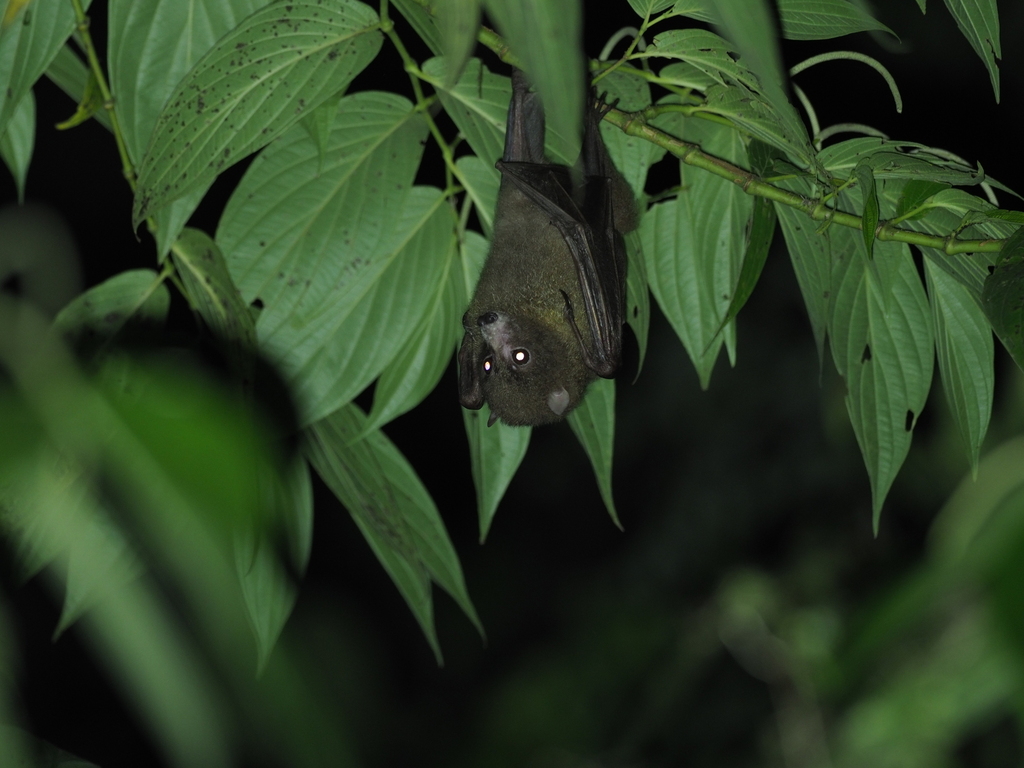
Seram Flying-fox
Pteropus ocularis
The Seram flying fox (Pteropus ocularis) is a species of flying fox in the family Pteropodidae. It is endemic to the mountainous forests of two of the Maluku Islands, Buru and Seram, including the Manusela National Park on Seram. They were once present on the nearby Ambon Island, but probably not anymore. The habitat has an area of less than 20,000 km2 (7,700 mi2), and is decreasing due to logging. For this reason, and because of hunting by the local population, these species are listed as vulnerable by the IUCN since 1996.
From the article Seram flying fox on Wikipedia (CC BY-SA), quoted section by section
Description
The Seram flying fox is similar in appearance to the spectacled flying fox (Pteropus conspicillatus) due to the ring-like pattern of reddish-brown fur around its eyes. It is much smaller, though. The forearm length ranges from 130–145 mm (5.1–5.7 in). It is an infrequently encountered species, but a subadult male and an adult female had weights of 400 g (14 oz) and 220 g (7.8 oz), respectively.
Range & habitat
The Seram flying fox has a restricted range, and has only been documented on the Indonesian islands of Ambon, Buru, and Seram. Its range likely no longer includes Ambon Island. It has been documented at a range of elevations from 0–900 m (0–2,953 ft) above sea level in old-growth and mangrove forests.
Wikipedia: “Range and habitat”
Listen
Looking for field recordings…
Where it lives
Recorded sightings
—
geo-referenced records in GBIF, from museums, herbaria and field observers.
Drag the globe to turn it. Dots are where records exist, not a range map; darker means more records.
In the stacks
Searching the stacks…
Every page naming Pteropus ocularis in the Biodiversity Heritage Library →
This page is assembled live from iNaturalist, GBIF, Wikipedia, the Source Library and the Internet Archive. It is not yet part of the hand-edited codex. iNaturalist taxon 40893.