On eBird ↗
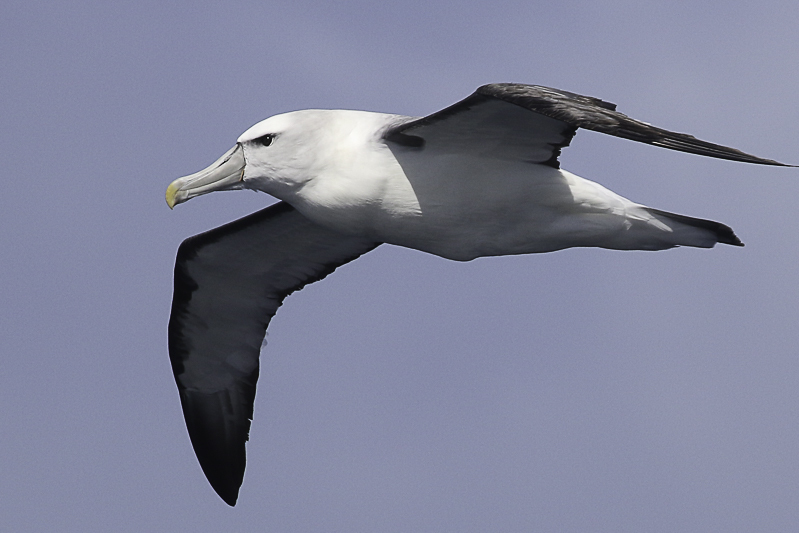
White-capped Albatross
Live sightings near you, the range map, bar charts of when it is seen, and Macaulay Library photos and recordings.
Shy Albatross
Thalassarche cauta
The shy albatross (Thalassarche cauta), also known as the shy mollymawk, is a medium-sized albatross that breeds on three remote islands off the coast of Tasmania, Australia, in the southern Indian Ocean. Its lifespan is about 60 years, and it has been seen as far afield as South Africa and the Pacific coast of the United States. As of June 2020, the species is listed as "Endangered" in Australia; there are thought to be 15,000 pairs of shy albatross left. It is Australia's only endemic albatross.
Some authorities call this species the white-capped albatross, but that name is more commonly applied to Thalassarche cauta steadi.
From the article Shy albatross on Wikipedia (CC BY-SA), quoted section by section
Description
The shy albatross averages 90 to 99 cm (35–39 in) in length, 220 to 256 cm (87–101 in) wingspan, and 4.1 kg (9.0 lb) in weight. Alongside its similarly sized sister species, the Salvin's albatross, this species is considered the largest of the mollymawks or the small albatrosses. It is a black, white and slate-grey bird with the characteristic black thumb mark at the base of the leading edge of the underwing. Adults have a white forehead and a crown, which is bordered on the bottom with a dark eyebrow and pale grey face. Its mantle, tail and upperwing are grey-black, and the rest is white. Its bill is grey-yellow with a prominent yellow culmen and yellow tip. It has a lifespan of about 60 years.
Range & habitat
The shy albatross is endemic breeder to Australia and it breeds on three island colonies off Tasmania, in the southern Indian Ocean: Albatross Island, Pedra Branca, and the Mewstone. It is the only albatross endemic to Australia. Juvenile birds are known to fly as far as South Africa; otherwise, non-breeding birds can be found throughout the southern oceans, but specifics are hard to determine due to their similarity to the other species. It is sometimes found off the Pacific coast of the United States.
Wikipedia: “Range and habitat”
What it does
The shy albatross feeds by a combination surface-seizing and some pursuit diving – it has been recorded diving as deep as 5 m (16 ft). Fish, cephalopods, crustacea, and tunicates are the sustenance for this species.
Wikipedia: “Feeding”
Listen
Looking for field recordings…
Where it lives
Recorded sightings
—
geo-referenced records in GBIF, from museums, herbaria and field observers.
Drag the globe to turn it. Dots are where records exist, not a range map; darker means more records.
In the stacks
Searching the stacks…
Every page naming Thalassarche cauta in the Biodiversity Heritage Library →
This page is assembled live from iNaturalist, GBIF, Wikipedia, the Source Library and the Internet Archive. It is not yet part of the hand-edited codex. iNaturalist taxon 4088.