- Animals
- ›Arthropods
- ›Hexapods
- ›Insects
- ›Winged and Once-winged Insects
- ›Butterflies and Moths
- ›Curved-horn Moths
- ›Timber Moths
- ›Hierodoris
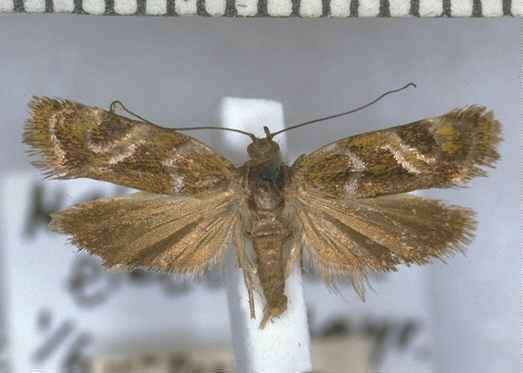
Hierodoris electrica
Hierodoris electrica is a moth of the family Oecophoridae. It was described by Edward Meyrick in 1889. It is endemic to New Zealand, where it has been reported from the northern and southern parts of the South Island. The larva of H. electrica has yet to be described. The wingspan is between 15 and 16.5 mm. The ground colour of the forewings is dark brown, with narrow yellow scales overlaying this base colour. The hindwings are brown. The known larval host species is Olearia nummulariifolia.
From the article Hierodoris electrica on Wikipedia (CC BY-SA), quoted section by section
Description
Meyrick described the adults of this species as follows:
♀. 16–17mm. Head, palpi, thorax, and abdomen dark fuscous, slightly sprinkled with yellowish. Antennae and legs dark fuscous, posterior tibiae yellow-whitish. Forewings elongate, moderate, costa gently arched, apex rounded, hind-margin obliquely rounded; dark fuscous, strewn with ochreous-yellow hair-scales in irregular patches; a leaden-metallic line from 1⁄3 of costa to 2⁄5 of inner margin, angulated outwards in middle; a sinuate leaden-metallic line from above middle of disc to anal angle; a leaden-metallic line from middle of costa-obliquely outwards more than half across wing, thence curved round to touch a whitish dot on costa at 3⁄4, and continued in a strong curve near and parallel to costa and hindmargins to anal angle; space between first and second lines, and within first curve of third line, less strewn with yellow scales and therefore darker than rest of wing: cilia light grey, rather shining. Hindwings rather dark fuscous, somewhat bronzy; cilia light shining grey.
Range & habitat
This species is endemic to New Zealand and has been found in the northern and southern areas of the South Island. However this species has not been collected in Buller, Westland, or Canterbury.
Wikipedia: “Distribution”
What it does
Adults of this species are on the wing from mid December until the end of February. This moth is day flying and has been seen on hot, sunny days. It was regarded by George Hudson as being rare and Robert Hoare states it appears to be rarer than its sister species H. s-fractum.
Wikipedia: “Behaviour”
Listen
Looking for field recordings…
Where it lives
Recorded sightings
—
geo-referenced records in GBIF, from museums, herbaria and field observers.
Drag the globe to turn it. Dots are where records exist, not a range map; darker means more records.
In the stacks
Searching the stacks…
Every page naming Hierodoris electrica in the Biodiversity Heritage Library →
This page is assembled live from iNaturalist, GBIF, Wikipedia, the Source Library and the Internet Archive. It is not yet part of the hand-edited codex. iNaturalist taxon 408140.