- Animals
- ›Arthropods
- ›Hexapods
- ›Insects
- ›Winged and Once-winged Insects
- ›Butterflies and Moths
- ›Curved-horn Moths
- ›Momphidae
- ›Zapyrastra
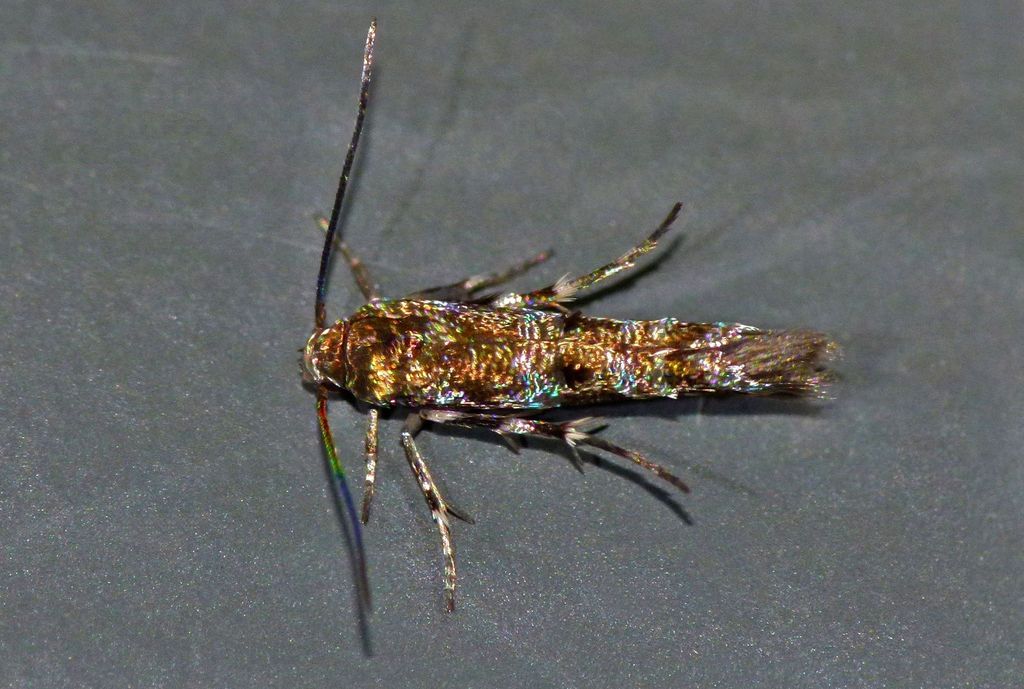
Zapyrastra calliphana
Zapyrastra calliphana is a species of moth of the family Momphidae. It was first described by Edward Meyrick in 1889. It is found throughout New Zealand including at the Manawatāwhi / Three Kings Islands as well as at the Norfolk Islands. The preferred habitat of this species are native forest clearings, shrubland or coastal habitat such as scrub or dunes. The larvae of this species are leaf miners and are hosted by Muehlenbeckia species. There are likely several generations during the New Zealand summer and one generation overwinters as pupae. This species is a day flying moth and adults can be observed on the wing from October to March.
From the article Zapyrastra calliphana on Wikipedia (CC BY-SA), quoted section by section
Description
Meyrick described this species as follows:
♂♀. 9. 5-8mm. Head, palpi, antennae, thorax, abdomen, and legs dark shining bronze, face whitish-bronze, legs spotted with white. Forewings lanceolate; bright dark golden-bronze; markings pale violet-golden-metallic; a fascia near base, often ill-defined; a nearly perpendicular fascia before middle; a dot in disc beyond middle, beneath which is a black dot or small spot on fold; an inwardly-oblique fascia at 3⁄4; a small spot on anal angle; a streak along hindmargin from apex; a triangular snow-white spot on costa near apex : cilia fuscous-grey, round apex with two blackish lines, and a minute white dot above apex. Hindwings dark fuscous; cilia fuscous-grey.There are two species that are very similar in appearance to Z. calliphana. Firstly Z. stellata which only occurs in the eastern parts of the South Island. The other species is undescribed and can be found in the North Island where its larvae mine leaves of species in the genus Haloragis.
Range & habitat
This species is found throughout New Zealand including at the Manawatāwhi / Three Kings Islands as well as at the Norfolk Islands.
Wikipedia: “Distribution”
What it does
This species forms mines in Muehlenbeckia leaves and pupates within the leaf mine forming a cocoon. It are likely there are several generations of this species during summer with one overwintering as pupae. Adults are on the wing mainly during the spring and summer months, from October to January. However adults have been observed as late as March and in captivity have emerged in July. This species is a day flying moth and can be observed flying around their larval host plants in sunshine, though their small size does make them more difficult to observe. Z. calliphana have been collected via malaise traps.
== References ==
Wikipedia: “Life cycle and behaviour”
Listen
Looking for field recordings…
Where it lives
Recorded sightings
—
geo-referenced records in GBIF, from museums, herbaria and field observers.
Drag the globe to turn it. Dots are where records exist, not a range map; darker means more records.
In the stacks
Searching the stacks…
Every page naming Zapyrastra calliphana in the Biodiversity Heritage Library →
This page is assembled live from iNaturalist, GBIF, Wikipedia, the Source Library and the Internet Archive. It is not yet part of the hand-edited codex. iNaturalist taxon 407932.