- Plants
- ›Vascular Plants
- ›flowering plants
- ›Dicots
- ›Sunflowers, Bellflowers, Fanflowers, and Allies
- ›Sunflowers, Daisies, Asters, and Allies
- ›Asteroideae
- ›asters and allies
- ›Celmisiinae
- ›Olearia
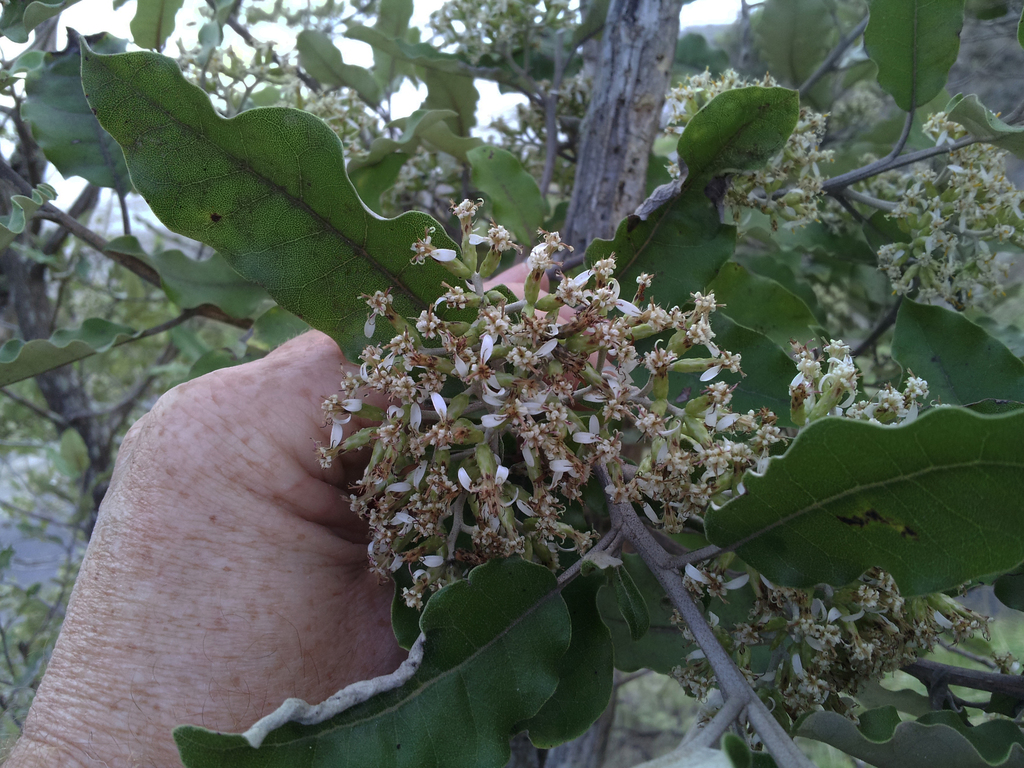
Olearia albida
Olearia albida, also known by the name tanguru or tree daisy, is a species of flowering plant in the family Asteraceae. The plant was first described by Joseph Dalton Hooker in 1864, and is endemic to the northern North Island of New Zealand, often found in coastal areas.
From the article Shawia albida on Wikipedia (CC BY-SA), quoted section by section
Description
Hooker's 1864 type description of the species is as follows:
A small tree, very like O. fosteri in habit and foliage, but the leaves are not evidently reticulate on either surface, the under surface is rather softer and very white, the panicles larger, more effuse. Heads quite different, pedicelled, 0.2 in (5.1 mm). long, subcylindric; involucral scales imbricate, short, obtuse, pubescent; florets 2 or 3, one often ligulate; pappus white, unequal. Achene pubescent. The species has grooved, flaky bark and light green leaves with a white underside, that are typically wavy. The species has white flowers that typically form in clusters. The species can grow to a height of up to 5 m (16 ft) tall.
Range & habitat
The species is endemic to New Zealand, found on the North Island as far south as northern Taranaki, as well as on offshore islands of the Hauraki Gulf. Some hotspot locations for the species include Tāpapakanga Regional Park and the northern shores of the Matakana River mouth. The species is found in coastal areas, typically headlands and areas with loose soil (such as slip scars).
Wikipedia: “Distribution and habitat”
Where it lives
Recorded sightings
—
geo-referenced records in GBIF, from museums, herbaria and field observers.
Drag the globe to turn it. Dots are where records exist, not a range map; darker means more records.
In the stacks
Searching the stacks…
Every page naming Olearia albida in the Biodiversity Heritage Library →
This page is assembled live from iNaturalist, GBIF, Wikipedia, the Source Library and the Internet Archive. It is not yet part of the hand-edited codex. iNaturalist taxon 404264.