- Plants
- ›Vascular Plants
- ›flowering plants
- ›Dicots
- ›Mints, Plantains, Olives, and Allies
- ›Mint Family
- ›Nepetoideae
- ›Mentheae
- ›balms, mints, and thymes
- ›Mentha
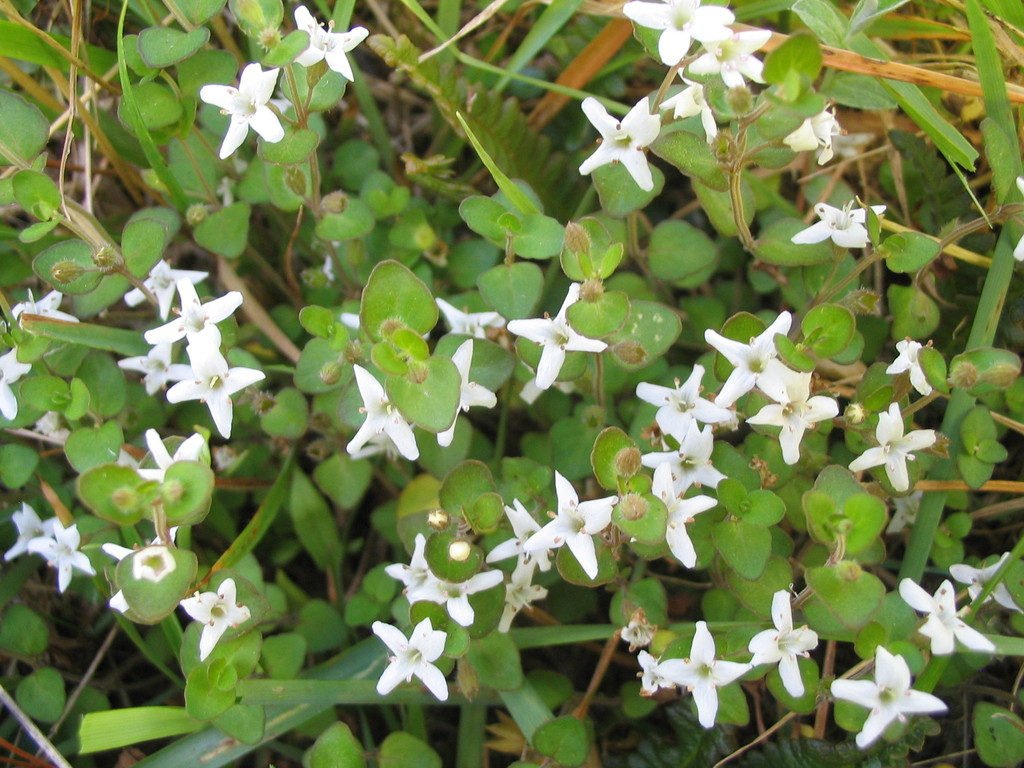
Hioi
Mentha cunninghamii
Mentha cunninghamii, known commonly as New Zealand mint or Māori mint, is a species within the Mentha (mint) genus, endemic to New Zealand.
From the article Mentha cunninghamii on Wikipedia (CC BY-SA), quoted section by section
Description
Mentha cunninghamii shares a mint odor with other species within the Mentha (mint) genus, but in appearance is very distinct from many other mints. It has been suggested that it may actually be more closely related to members of the Micromeria genus. It is a slender, wiry, prostrate perennial plant, with a creeping rhizome. The plant is much branched, often matted, with numerous stems arising from the rhizome, diffusely branched, pubescent, growing from two to twelve inches long. Its leaves are shortly petiolate or nearly sessile, 1/6 to 1/2 inches long, broadly ovate or almost orbicular, obtuse, entire or with an obscure notch on each side, and glandular-dotted. Its flowers are small, white, axillary, usually solitary but sometimes with two to three in each axil. Its peduncles are slender and variable in length. Its calyx are about 1/8 inches long, tubular-campanulate in shape, densely hairy, with teeth villous within. Its corolla-lobes are almost equal, flat and spreading, with the upper one shortly bifid. Its stamens protrude equally with the corolla or are slightly exserted.
Range & habitat
Mentha cunninghamii is endemic to the four islands of North Island, South Island, Chatham Island and Stewart Island in New Zealand. It is found sparsely in grassy fields and open land generally. It inhabits an elevation range from coastal to alpine, within a range of sea level to 4,500 feet (1,400 metres). Sources variously describe its flowering season as beginning in the Southern Hemisphere in either September or November, ending in April. As of 2018, New Zealand's Department of Conservation New Zealand Threat Classification System (NZTCS) assesses Mentha cunninghamii's conservation status as "At Risk: Declining." The system uses the Declining status to indicate populations that currently possess large populations, but are experiencing declines that could eventually lead to a listing as "Threatened."
Wikipedia: “Distribution”
Where it lives
Recorded sightings
—
geo-referenced records in GBIF, from museums, herbaria and field observers.
Drag the globe to turn it. Dots are where records exist, not a range map; darker means more records.
In the old herbals & bestiaries

Introductio Generalis in Rem Herbariam
Augustus Quirinus Rivinus · 1690 · p.93

Introductio Generalis in Rem Herbariam
Augustus Quirinus Rivinus · 1690 · p.94

Hortus Eystettensis
Basilius Besler · 1640 · p.33

Introductio Generalis in Rem Herbariam
Augustus Quirinus Rivinus · 1690 · p.92

Six Groups of the History of Plants
Rembert Dodoens · 1583 · p.83

Six Groups of the History of Plants
Rembert Dodoens · 1583 · p.83

Description of Less Known and Rare Plants
Fabio Colonna · 1616 · p.449

Description of Less Known and Rare Plants
Fabio Colonna · 1616 · p.195

Elements of Botany
Joseph Pitton de Tournefort · 1719 · p.236

Coloured Figures of English Fungi or Mushrooms
James Sowerby · 1797 · p.510

Illustrated Compendium of Materia Medica (Vol. 8)
吳其濬 · 1848 · p.69
In the stacks
Searching the stacks…
Every page naming Mentha cunninghamii in the Biodiversity Heritage Library →
This page is assembled live from iNaturalist, GBIF, Wikipedia, the Source Library and the Internet Archive. It is not yet part of the hand-edited codex. iNaturalist taxon 403844.