- Animals
- ›Arthropods
- ›Hexapods
- ›Insects
- ›Winged and Once-winged Insects
- ›Butterflies and Moths
- ›Curved-horn Moths
- ›Feather-legged Moths
- ›Stathmopodinae
- ›Stathmopoda
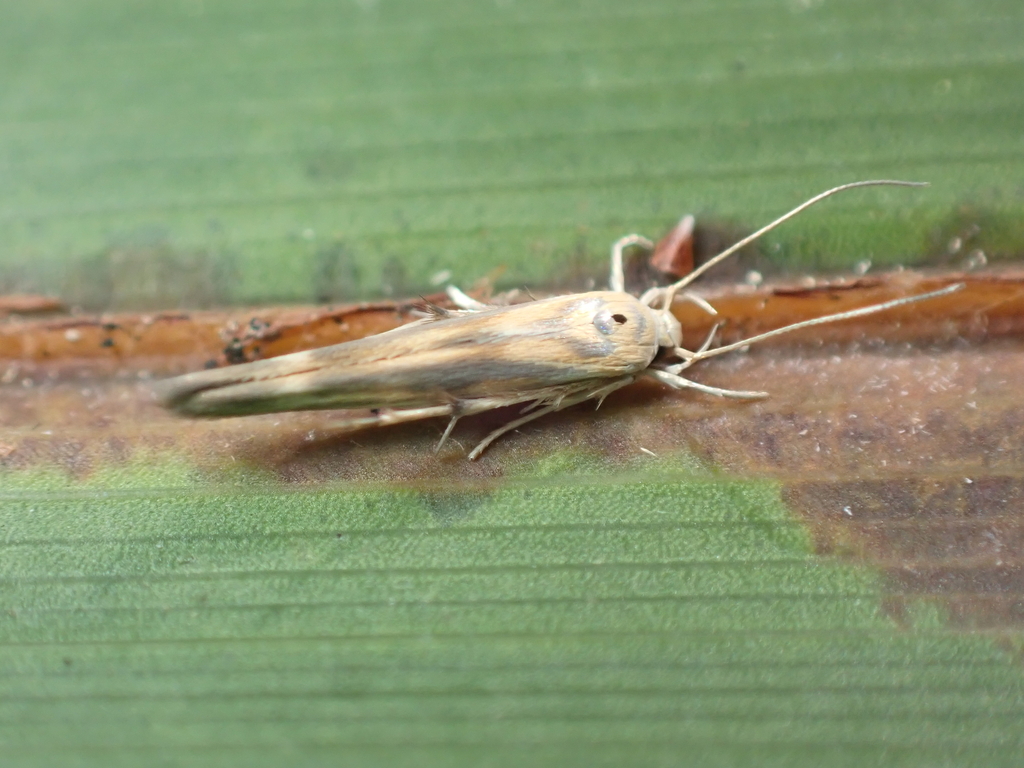
Orchard Featherfoot
Stathmopoda horticola
Stathmopoda horticola, the orchard featherfoot, is a species of moth in the Stathmopodidae family. It was described by John S. Dugdale in 1988. It is endemic to New Zealand and is found in the North, South and Stewart Islands. This species inhabits native forests and adults are on the wing from September until April.
From the article Stathmopoda horticola on Wikipedia (CC BY-SA), quoted section by section
Description
Dugdale stated that S. horticola differs from the similar Stathmopoda skelloni in both the male and female patterns of colour as well as the shape of genitalia of each sex. Hudson described S. horticola under the name S. skelloni as follows:
The expansion of the wings is slightly over 1⁄2 inch. The fore-wings are silvery-white with four cloudy elongate dusky grey marks on the termen and dorsum, and one or two very indistinct longitudinal streaks near the middle of the wing. The hind-wings are dark brownish-grey, and all the cilia pale brownish-grey. The dusky markings are variable and frequently almost obsolete. This species has been confused with Stathmopoda caminora and Stathmopoda aposema.
Range & habitat
This species is endemic to New Zealand. It has been observed in the North, South and Stewart Islands.
Wikipedia: “Distribution”
What it does
Adults of this species are on the wing from September until April. The moth rests with closed wings which are slightly elevated posteriorly. The antennae are extended, slightly curved outwards and backwards. Both hind legs are usually elevated and pushed out sideways with the moth standing on the fore and middle leg pairs. The palpi are generally held with their tips almost in contact.
== References ==
Wikipedia: “Behaviour”
Listen
Looking for field recordings…
Where it lives
Recorded sightings
—
geo-referenced records in GBIF, from museums, herbaria and field observers.
Drag the globe to turn it. Dots are where records exist, not a range map; darker means more records.
In the stacks
Searching the stacks…
Every page naming Stathmopoda horticola in the Biodiversity Heritage Library →
This page is assembled live from iNaturalist, GBIF, Wikipedia, the Source Library and the Internet Archive. It is not yet part of the hand-edited codex. iNaturalist taxon 397429.