- Animals
- ›Arthropods
- ›Hexapods
- ›Insects
- ›Winged and Once-winged Insects
- ›Butterflies and Moths
- ›Tortricid Leafroller Moths and Allies
- ›Tortricid Leafroller Moths
- ›Tortricine Leafroller Moths
- ›Archipini
- ›Pyrgotis
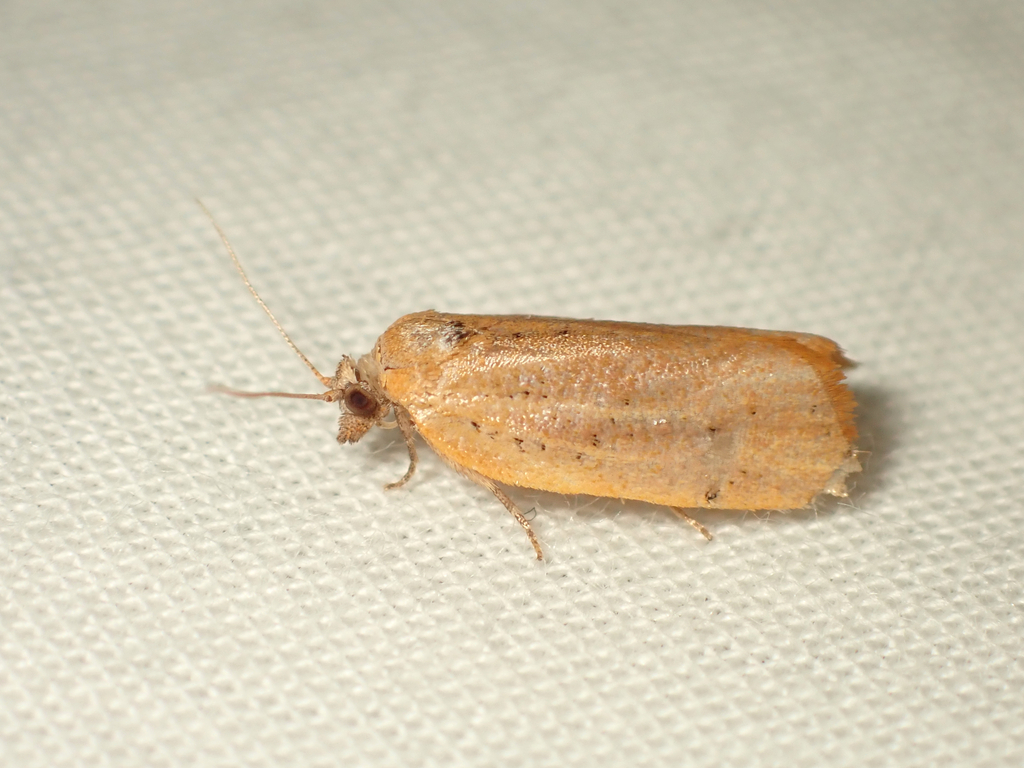
Pyrgotis chrysomela
Pyrgotis chrysomela is a species of moth of the family Tortricidae. This species was first described by Edward Meyrick in 1914. It is endemic to New Zealand and has been observed in the North and South Islands. This species is associated with Mānuka as well as species in the genus Podocarpus. Larvae web together the leaves of their host species and then feed on new growth. Larvae have been reared on Podocarpus laetus and Podocarpus totara. Adults are on the wing most months of the year.
From the article Pyrgotis chrysomela on Wikipedia (CC BY-SA), quoted section by section
Description
The wingspan is about 17 mm. The forewings are very bright, glossy orange-brown with several rows of extremely faint purplish spots in the disc, only visible in a strong light. The hind-wings are grey, tipped with orange-brown at the apex. It has been hypothesised that there is a grey form of the male of this species although further investigation is needed to confirm that these specimens are a form of P. chrysomela.
Range & habitat
P. chrysomela is endemic to New Zealand. It has been observed in both the North and South Islands.
Wikipedia: “Distribution”
What it does
The larvae of this species web together the leaves of species in the genus Podocarpus and then feed on the new growth. Adults have been observed on the wing most months of the year but are most commonly observed from October until March.
Wikipedia: “Behaviour”
Listen
Looking for field recordings…
Where it lives
Recorded sightings
—
geo-referenced records in GBIF, from museums, herbaria and field observers.
Drag the globe to turn it. Dots are where records exist, not a range map; darker means more records.
In the stacks
Searching the stacks…
Every page naming Pyrgotis chrysomela in the Biodiversity Heritage Library →
This page is assembled live from iNaturalist, GBIF, Wikipedia, the Source Library and the Internet Archive. It is not yet part of the hand-edited codex. iNaturalist taxon 396131.