- Animals
- ›Arthropods
- ›Hexapods
- ›Insects
- ›Winged and Once-winged Insects
- ›Beetles
- ›Water, Rove, Scarab, Long-horned, Leaf, and Snout Beetles
- ›Cucujiform Beetles
- ›Longhorn Beetles and Allies
- ›Longhorn Beetles
- ›Tooth-necked and Aberrant Longhorn Beetles
- ›Meroscelisini
- ›Prionoplus
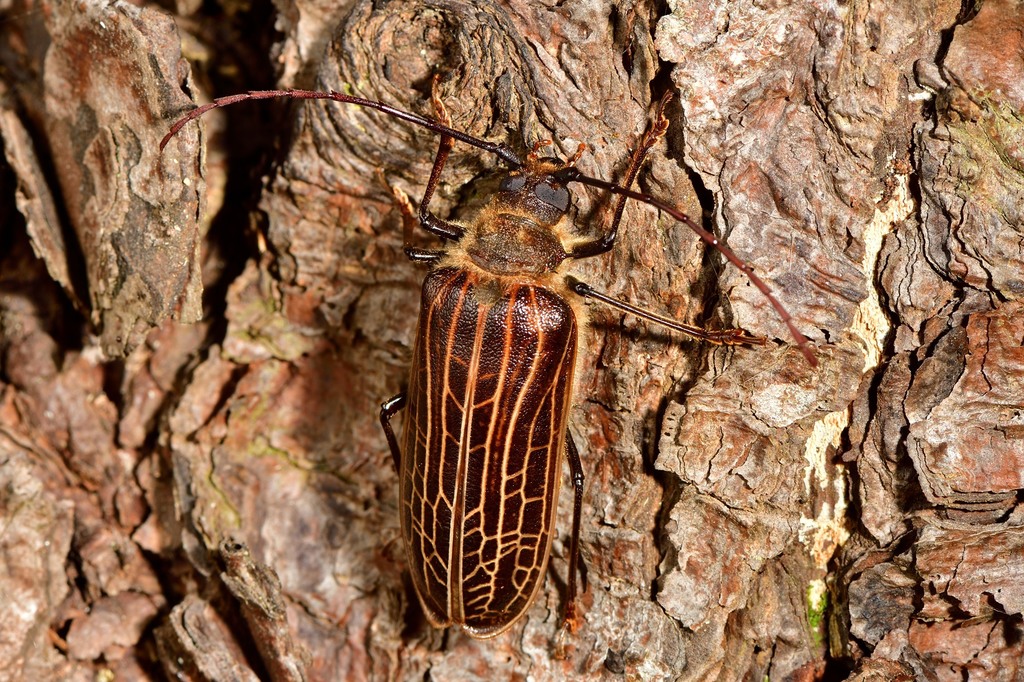
Huhu
Prionoplus reticularis
The huhu beetle (Prionoplus reticularis) is a longhorn beetle endemic to New Zealand. It is a large, visually distinctive species whose adults reach up to five cm (2 in) in length. It is widespread throughout New Zealand, occurring up to 1,400 m (4,600 ft) at altitude. Although the adult is unable to eat, the larva feeds and burrows in the dead wood of trees, almost entirely feeding on gymnosperms such as rimu and Monterey pine. As a larva, it can grow to sizes of 50–70 mm (2.0–2.8 in) and has a cylindrical appearance with a creamy colour. During this stage, in which the insect is high in protein and fat, it is edible and has been described as tasting similar to peanut butter. It has a history of consumption by the Māori, with the larva being consumed either raw or traditionally cooked in a hāngī.
The adult lives for roughly two weeks. It is nocturnal and is strongly attracted to light, such as that produced by human habitation. The female appears to produce olfactory cues to attract the male. During its larval stage, the beetle can potentially take one to two years to reach maturity, although this has been achieved more quickly in laboratory conditions. The intestinal tract of the larva hosts a diverse range of microorganisms that may assist in digestion of wood. Because the larva burrows into logs, New Zealand has to treat logs before exporting them to prevent the beetle spreading to other countries. This is done by fumigating or heating the logs, which is done by government-approved third parties.
From the article Huhu beetle on Wikipedia (CC BY-SA), quoted section by section
Range & habitat
The huhu beetle is endemic to New Zealand where it is widespread throughout the main islands, occurring from sea level up to altitudes of 1,400 m (4,600 ft). There is a single record of a huhu beetle caught in the Kermadecs on Raoul Island. Visiting researchers have searched rotting wood for signs of huhu beetle larvae, but none were found, indicating that it has not established on the island. Because of this, it has been assumed that the specimen was from untreated wood brought to the island and used for construction. Before Europeans settled in New Zealand, the beetle was mainly associated with podocarp (trees from the Podocarpaceae group) and kauri tree forests, but has subsequently spread more widely due to the introduction of exotic conifers.
Wikipedia: “Distribution and habitat”
What it does
The huhu beetle deposits clutches of 10–50 eggs (sometimes up to 100) in cracks and crevices in or under bark. One study has reported that it can lay 250–300 eggs. From eggs collected in the wild, 94–98% will hatch. In laboratory conditions of roughly 20 °C (68 °F) with a humidity of 75%, eggs hatched in 23 ± 2 days. Before hatching, the larva can be seen moving inside the egg and will break free from the egg using its mandibles to pierce the chorion of the egg and then enlarge the opening by chewing, although the chorion itself is not ingested. Setae that are found on the first to sixth abdominal segments assist in providing support as the larva leaves the egg and excavates the initial gallery (tunnel). During the first instar (developmental stage), the larva burrows into logs and digs longitudinally along the wood's grain, where it makes a small chamber for its first moult. The larva, at various life stages, burrows into the logs, forming a series of galleries that vary in structure depending on the size and age of the log. In more freshly fallen logs, the galleries formed are fairly straight and do not go very deep. However, as the log rots and more larvae feed on the log, the galleries become deeper and more complex in nature, with the tunnels beginning to intersect with those of other larvae. The larval stages last one to two years in the wild. …
Wikipedia: “Life cycle”
At the table
The huhu larva is eaten by humans, with a long history of consumption by Māori. Its flavour has been described as like peanut butter. The fully grown larva (called tātaka in Māori) is the most prized because they no longer contain undigested wood pulp. Huhu grubs may be consumed either raw or traditionally cooked in a hāngī. It has been proposed that huhu larva could potentially be farmed as a food source, but challenges such as maintaining genetic diversity and uncovering optimal growing conditions need to be investigated to see if this would be viable. P. reticularis contains substantial amounts of nutrients. The larva and pupa are relatively high in fat (up to 45% and 58% dry weight in large larvae and pupae respectively). The fat in the larva is mostly oleic acid and palmitic acid. The second most abundant nutrient is protein, which is present at 30% dry weight in the large larvae, and close to 28% dry weight in the pupae. The ash content (representing minerals) is 1.8% dry weight in the large larva, and 2.2% in pupa. The minerals include manganese, magnesium, phosphorus, iron, copper, and zinc. One study found that the wild caught larva have very low levels of heavy metals and thus are safe for consumption.
Wikipedia: “As food”
In human culture
The Māori name huhu is ultimately Austronesian in origin from the root form *bukbuk. Cognates, words in different languages derived from a common ancestor, in the more closely related Malayo-Polynesian languages (like Tagalog bukbok) refer to weevils that infest wood and rice across tropical Southeast Asia. In Māori, huhu has semantically evolved to also refer to its larval form (also tunga haere, tunga rākau). As the larva reaches maturity, it ceases to bore in wood and sheds its skin. This stage is known in Māori as tātaka. It then develops wings and legs, and while it is still white, it is known as pepe or pepe te muimui. Finally, it emerges and flies off to reproduce in its adult stage and is known as tunga rere.
Wikipedia: “Etymology”
Listen
Looking for field recordings…
Where it lives
Recorded sightings
—
geo-referenced records in GBIF, from museums, herbaria and field observers.
Drag the globe to turn it. Dots are where records exist, not a range map; darker means more records.
In the old herbals & bestiaries

In the stacks
Searching the stacks…
Every page naming Prionoplus reticularis in the Biodiversity Heritage Library →
This page is assembled live from iNaturalist, GBIF, Wikipedia, the Source Library and the Internet Archive. It is not yet part of the hand-edited codex. iNaturalist taxon 395569.