On eBird ↗
Marbled Godwit
Live sightings near you, the range map, bar charts of when it is seen, and Macaulay Library photos and recordings.
Marbled Godwit
Limosa fedoa
The marbled godwit (Limosa fedoa) is a large shorebird. On average, it is the largest of the 4 species of godwit. The total length is 40–50 cm (16–20 in), including a large bill of 8–13 cm (3.1–5.1 in), and wingspan is 70–88 cm (28–35 in). Body mass can vary from 240 to 510 g (8.5 to 18.0 oz).
From the article Marbled godwit on Wikipedia (CC BY-SA), quoted section by section
Description
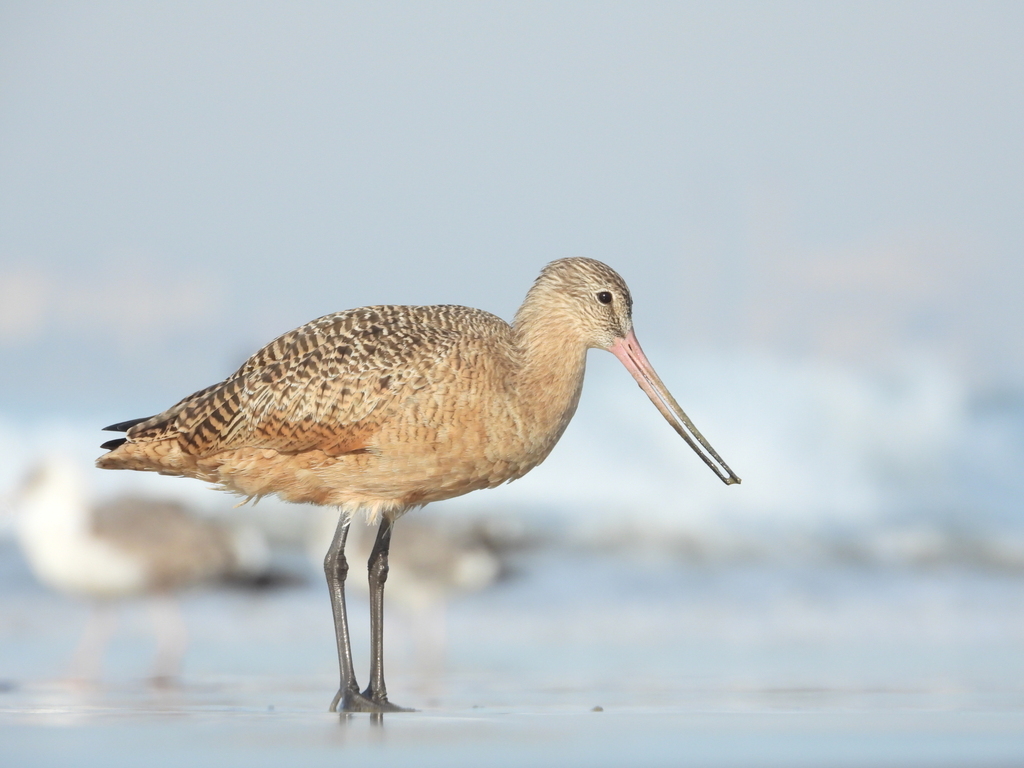
The total length is 40–50 cm (16–20 in), including a large bill of 8–13 cm (3.1–5.1 in), and wingspan is 70–88 cm (28–35 in). Body mass can vary from 240 to 520 g (8.5 to 18.3 oz). The average weight of 40 males was 326 g (11.5 oz) and that of 45 females was 391 g (13.8 oz). Bill length is from 73.9 to 131 mm (2.91 to 5.16 in). Among all the members of the sandpiper family, only the curlews attain sizes that significantly exceed this species. Adults have long blue-grey legs and a very long pink bill with a slight upward curve and dark at the tip. The long neck, breast and belly are pale brown with dark bars on the breast and flanks. The back is mottled and dark. They show cinnamon wing linings in flight.
Range & habitat
Marbled godwits breed in three distinct areas with their own unique route. The vast majority occur in mid-continental North America, followed by eastern Canada and the Alaska Peninsula, USA. In addition, the largest winter ranges are the Atlantic, Pacific and Gulf coasts of the US and Mexico. Godwits breeding in the western USA and Canada follow a route through the Utah stopover site, with a final arrival in the winter sites of Mexico and the Caribbean. Species breeding in eastern Canada migrate across the US, and stopover at sites along the Gulf of California and Mexico. Furthermore, those breeding in North and South Dakota winter in coastal Georgia. The Bear River Migratory Bird Refuge located at Great Salt Lake in Utah (USA), is one of the most popular stopover sites for godwits in the spring and fall. Satellite tracking data from pairs breeding in Alberta revealed that male and female godwits appear to migrate and winter separately, with females from that population migrating down to the California coast and males stopping over at Great Salt Lake before wintering down in Baja California Sur.
Wikipedia: “Distribution and habitat”
What it does
These birds forage by probing on mudflats, in marshes, or at the beach (see picture below). When the tide is out, they eat. In short grass, they may pick up insects by sight. They mainly eat insects and crustaceans, but also eat parts of aquatic plants. When the tide is in, they roost. They often sleep by standing on one leg and tucking their bill into their body (see picture below).
Wikipedia: “Food and feeding”
Listen
Looking for field recordings…
Where it lives
Recorded sightings
—
geo-referenced records in GBIF, from museums, herbaria and field observers.
Drag the globe to turn it. Dots are where records exist, not a range map; darker means more records.
In the stacks
Searching the stacks…
Every page naming Limosa fedoa in the Biodiversity Heritage Library →
This page is assembled live from iNaturalist, GBIF, Wikipedia, the Source Library and the Internet Archive. It is not yet part of the hand-edited codex. iNaturalist taxon 3954.