On eBird ↗
Hudsonian Godwit
Live sightings near you, the range map, bar charts of when it is seen, and Macaulay Library photos and recordings.
Hudsonian Godwit
Limosa haemastica
The Hudsonian godwit (Limosa haemastica) is a large shorebird in the sandpiper family, Scolopacidae. It is an extreme long-distance migrant, breeding at remote sites in Subarctic North America and flying nonstop in the fall to wintering sites in southern South America. Due to its remote breeding and wintering grounds and rapid, direct migration, it was a poorly-known species and was considered very rare until the mid-20th century, when major staging sites were discovered around James Bay and breeding sites were found around Churchill, Manitoba. Since then, the Hudsonian godwit has become the target of conservation attention due to its fragmented and localized distribution and small population, as well as an important scientific system for migration biology research.
From the article Hudsonian godwit on Wikipedia (CC BY-SA), quoted section by section
Description
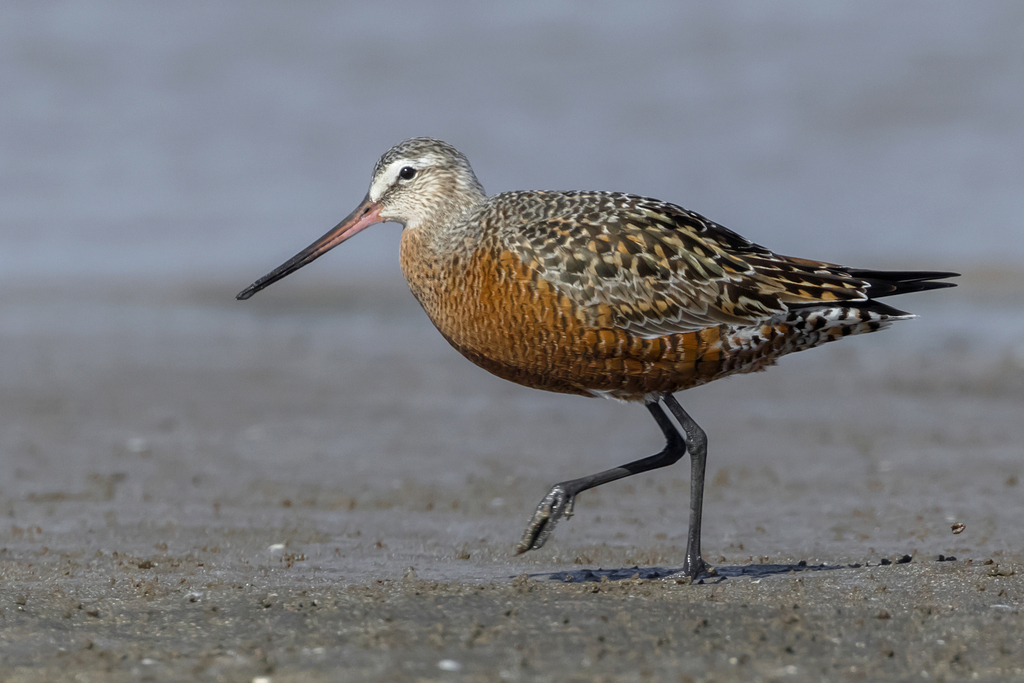
The Hudsonian godwit is a large, sexually dimorphic shorebird, with females (~250-360 g) generally heavier than males (~200-270 g). Structurally, like other godwits, Hudsonian godwits maintain an upright stance, with a longed, upwards-curved bill capable of rhynchokinesis and long, slender legs. The species exhibits a complex alternative moult strategy, with five distinct plumages; a juvenile plumage, a first-winter plumage, a first-summer plumage, an adult winter plumage, and an adult summer plumage; only the last of which is reliably different between the sexes. Adults have long dark legs and a long pink bill with a slight upward curve and dark at the tip. The upper parts are mottled brown and the underparts are chestnut. The tail is black and the rump is white. They show black wing linings in flight. The legs and feet are bluish-grey.
What it does
These birds forage by probing in shallow water. They eat invertebrates and plant material.
Wikipedia: “Food and feeding”
Listen
Looking for field recordings…
Where it lives
Recorded sightings
—
geo-referenced records in GBIF, from museums, herbaria and field observers.
Drag the globe to turn it. Dots are where records exist, not a range map; darker means more records.
In the stacks
Searching the stacks…
Every page naming Limosa haemastica in the Biodiversity Heritage Library →
This page is assembled live from iNaturalist, GBIF, Wikipedia, the Source Library and the Internet Archive. It is not yet part of the hand-edited codex. iNaturalist taxon 3950.