- Animals
- ›Chordates
- ›Vertebrates
- ›Reptiles
- ›Snakes and Lizards
- ›Lizards
- ›Glass, alligator, monitor lizards and allies
- ›Monitor Lizards
- ›Varanus
- ›Varanus
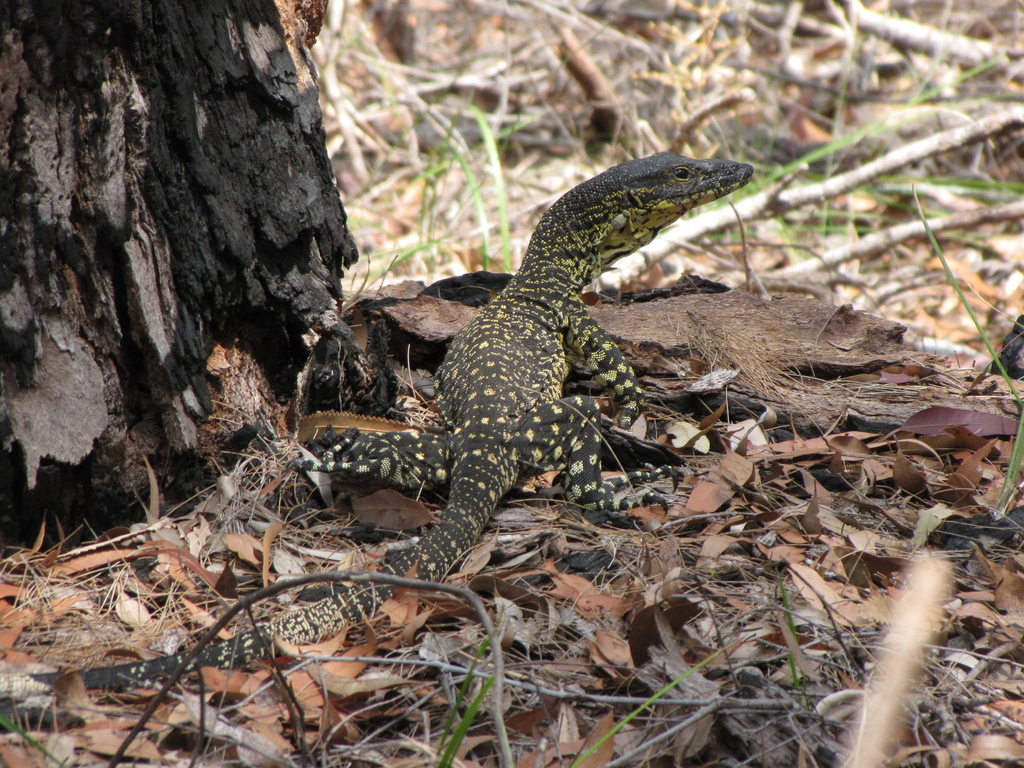
Lace Monitor
Varanus varius
The lace monitor (Varanus varius), also known as the tree goanna, is a member of the monitor lizard family native to eastern Australia. A large lizard, it can reach 2 metres (6.6 ft) in total length and 14 kilograms (31 lb) in weight. The lace monitor is considered to be a least-concern species according to the International Union for Conservation of Nature.
From the article Lace monitor on Wikipedia (CC BY-SA), quoted section by section
Description
The second-largest monitor in Australia after the perentie, the lace monitor can reach 2 m (7 ft) in total length, or 76.5 cm snout–vent length (SVL), and weigh up to 14 kg (30 lb). The male reaches sexual maturity when it has a SVL of 41.5 cm. Females are generally smaller than males, with a maximum SVL of 57.5 cm, and becoming sexually mature at a SVL of 38.5 cm. The tail is long and slender and about 1.5 times the length of the head and body. The tail is cylindrical at its base, but becomes laterally compressed towards the tip. Historically, it has been described as growing as much as 8 ft long. Regardless of the accuracy of these reports, lace monitors of such size likely no longer exist.
Patterning. Lace monitors are found in two forms. The main form is dark grey to dull bluish-black with numerous, scattered, cream-coloured spots. The head is black and the snout is marked with prominent black and yellow bands extending under the chin and neck. The tail has narrow black and cream bands, which are narrow and get wider towards the end of the tail. Juveniles have more defined and prominent banding, with five narrow black bands on the neck and eight bands on the body. The other type, known as Bell's form, is typically found in west of the Great Dividing Range from Woodgate, Eidsvold, and Mitchell in Queensland to Bourke, Macksville and Port Macquarie in New South Wales. …
Range & habitat
These common terrestrial and often arboreal monitors are found in eastern Australia and range from Cape Bedford on Cape York Peninsula to south-eastern South Australia. They frequent both open and closed forests and forage over long distances (up to 3 km (1.9 mi) a day). The lace monitor is considered to be a least-concern species according to the International Union for Conservation of Nature. They are mainly active from September to May, but are inactive in cooler weather and shelter in tree hollows or under fallen trees or large rocks.
Wikipedia: “Distribution and habitat”
What it does
Despite its large size and mass, the lace monitor is an adept climber. One was recorded climbing a brick wall to seek shelter in a thunderstorm. Young lace monitors are even more arboreal than adults. They often spend most of their adult lives in the same area; one individual was recorded living in the same tree for years. A field study in Burragorang, New South Wales found that males over 5 kg ranged over home territories of 65.5 ± 10.0 hectares. They moved around much less in winter.
Reproduction. In at least the temperate regions, the breeding season takes place in the summer.
Male lace monitors fight each other by grappling while standing on the hind legs in the breeding season, and up to six males may gather around a receptive female to try and court her. Mating takes several hours.Females lay an average of eight eggs in active termite nests either on the ground or in the trees, although they may lay as many as 12 eggs. When such nests are in short supply, females often fight over them or lay the eggs in burrows and perhaps hollow logs. The eggs overwinter to hatch 6–7 months later. Hatchlings remain around the nest for about a week or more before leaving its vicinity. Females may return to the same termite nest to lay their next clutch of eggs. These monitors can potentially live to reach over 20 years of age.
Feeding. …
Wikipedia: “Behaviour”
At the table
The lace monitor was eaten by the Wiradjuri people; local wisdom advised eating lace monitors that came down from trees as those that had eaten on the ground tasted of rotting meat. The Tharawal ate the species' eggs, collecting them in sand on riverbanks in the Nattai and Wollondilly. Goanna remains have been recovered in middens in what is now Sydney. The lace monitor is bred in captivity as an exotic pet.
Wikipedia: “Uses”
Toxicity
Venom glands in lace monitors have been confirmed. The venom is similar to that produced by snakes but not enough to cause serious harm. In late 2005, University of Melbourne researchers discovered that all monitors may be somewhat venomous. Previously, bites inflicted by monitors were thought to be prone to infection because of bacteria in their mouths, but the researchers showed that the immediate effects were more likely caused by envenomation. Bites on the hand by lace monitors have been observed to cause swelling within minutes, localised disruption of blood clotting, and shooting pain up to the elbow, which can often last for several hours. In vitro testing showed lace monitor mouth secretion impacts on platelet aggregation, drops blood pressure and relaxes smooth muscle; the last effect mediated by an agent with the same activity as brain natriuretic peptide. Liquid chromatography/mass spectrometry found ample proteins with molecular masses of 2-4 kilodaltons (corresponding with natriuretic peptide), 15 kilodaltons (type III Phospholipase A2), and 23-25 kilodaltons (cysteine-rich secretory proteins and kallikrein) in these secretions. Washington State University biologist Kenneth V. Kardong and toxicologists Scott A. Weinstein and Tamara L. …
Wikipedia: “Venom”
Where it lives
Recorded sightings
—
geo-referenced records in GBIF, from museums, herbaria and field observers.
Drag the globe to turn it. Dots are where records exist, not a range map; darker means more records.
In the stacks
Searching the stacks…
Every page naming Varanus varius in the Biodiversity Heritage Library →
This page is assembled live from iNaturalist, GBIF, Wikipedia, the Source Library and the Internet Archive. It is not yet part of the hand-edited codex. iNaturalist taxon 39469.