- Animals
- ›Arthropods
- ›Hexapods
- ›Insects
- ›Winged and Once-winged Insects
- ›Butterflies and Moths
- ›Pyralid and Crambid Snout Moths
- ›Crambid Snout Moths
- ›Grass-veneers and Allies
- ›Grass-Veneers
- ›Orocrambus
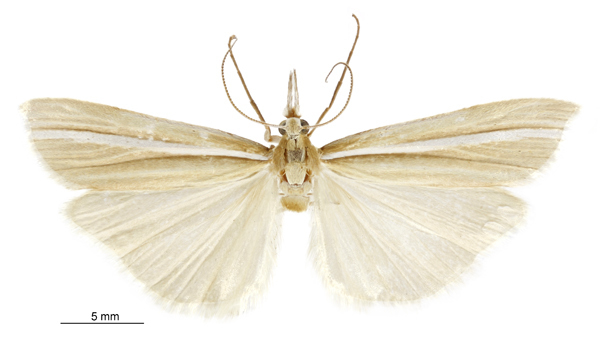
Orocrambus abditus
Orocrambus abditus is a moth of the family Crambidae. It was first described by Alfred Philpott in 1924. It is endemic to New Zealand and can be found in Marlborough, Arthur's Pass, and in Canterbury. The species inhabits grassland including tussock grassland and shrubland. Larvae have been collected in October and the adults of this species are on the wing from October to March.
From the article Orocrambus abditus on Wikipedia (CC BY-SA), quoted section by section
Description
Philpott described the female of the species as follows:
27 mm. Head ochreous-white. Labial palpi 4, ochreous-white. Maxilliary palpi white. Antemiae ochreous-white. TJjorax brassy-yellow. Abdomen and legs whitish-ochreous. Forewings moderate, costa evenly arched, apex acute, termen almost straight, very oblique; brassy-yellow; costa margined throughout with white; a straight well-defined white median longitudinal stripe, margined with fuscous above except near base, and more narrowly beneath on basal half; some obscure white terminal streaks above median streak : cilia white. Hindwings white, faintly tinged with ochreous : cilia white. The female species have forewings that are differently shaped than the male with the top part of the forewings being more acute. Both the male and the female of this species tend to be yellower than their closely related sister species but not consistently so. As a result this species can only be separated from O. simplex, O. lewisi, O. ordishi, or O. crenaeus by studying the genitalia of the specimens.
Range & habitat
This species is endemic to New Zealand. O. abditus has been recorded in Marlborough, Arthur's Pass, and in Canterbury in areas such as Porter's Pass, Kowhai River, Opuha, Gapes Valley, Birdling's Flat and Rakaia Island. Gaskin hypothesised that the distribution of this species may have come about as a result of O. abditus surviving in the eastern part of the Nelson/Marlborough during the Otiran glaciation. Gaskin suggested that the restriction in southernly spread of this species may be as a result of competition with its southerly sister species O.ordishi or alternatively as a result of an as yet unknown environmental factor.
Wikipedia: “Distribution”
What it does
Larvae have been collected in October. Adults have been recorded on wing from October to March. Gaskin hypothesised that the length of this flight period may suggest that this species has two broods in a year.
== References ==
Wikipedia: “Behaviour”
Listen
Looking for field recordings…
Where it lives
Recorded sightings
—
geo-referenced records in GBIF, from museums, herbaria and field observers.
Drag the globe to turn it. Dots are where records exist, not a range map; darker means more records.
In the stacks
Searching the stacks…
Every page naming Orocrambus abditus in the Biodiversity Heritage Library →
This page is assembled live from iNaturalist, GBIF, Wikipedia, the Source Library and the Internet Archive. It is not yet part of the hand-edited codex. iNaturalist taxon 394057.