- Animals
- ›Arthropods
- ›Hexapods
- ›Insects
- ›Winged and Once-winged Insects
- ›Butterflies and Moths
- ›Pyralid and Crambid Snout Moths
- ›Crambid Snout Moths
- ›Grass-veneers and Allies
- ›Grass-Veneers
- ›Orocrambus
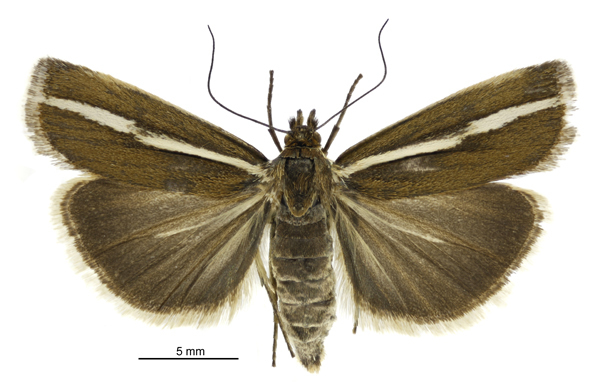
Orocrambus catacaustus
Orocrambus catacaustus is a moth in the family Crambidae. It was described by Edward Meyrick in 1885. This species is endemic to New Zealand and has been recorded from the South Island. This species can be found in the subalpine zones as well as in mountain valleys and frequents swampy or boggy habitat or open limestone valleys. Adult moths are day flying and have been observed from December until March.
From the article Orocrambus catacaustus on Wikipedia (CC BY-SA), quoted section by section
Description
The wingspan of the adults of this species is 21–27 mm. Hudson described O. catacaustus as follows:
The expansion of the wings is about 7⁄8 inch. The fore-wings are dark bronzy-brown with a rather narrow, cream-coloured, straight central longitudinal streak from the base to the termen; the costa is also very narrowly edged with white in the male; the cilia are dark grey with white tips. The hind-wings are very dark grey, with bronzy reflections; the cilia are grey tipped with white. O. catacaustus is similar in appearance to O. aethonellus but is of a larger size. The most reliable way to distinguish between these two species is via genitalia examination.
Range & habitat
This species is associated with swampy or boggy habitat or open limestone valleys. It can be found in subalpine habitat.
== Reference ==
Wikipedia: “Habitat”
What it does
Adults have been recorded on wing from December to March. They are day flying and are very active in hot sunshine.
Wikipedia: “Behaviour”
Listen
Looking for field recordings…
Where it lives
Recorded sightings
—
geo-referenced records in GBIF, from museums, herbaria and field observers.
Drag the globe to turn it. Dots are where records exist, not a range map; darker means more records.
In the stacks
Searching the stacks…
Every page naming Orocrambus catacaustus in the Biodiversity Heritage Library →
This page is assembled live from iNaturalist, GBIF, Wikipedia, the Source Library and the Internet Archive. It is not yet part of the hand-edited codex. iNaturalist taxon 394038.