On eBird ↗
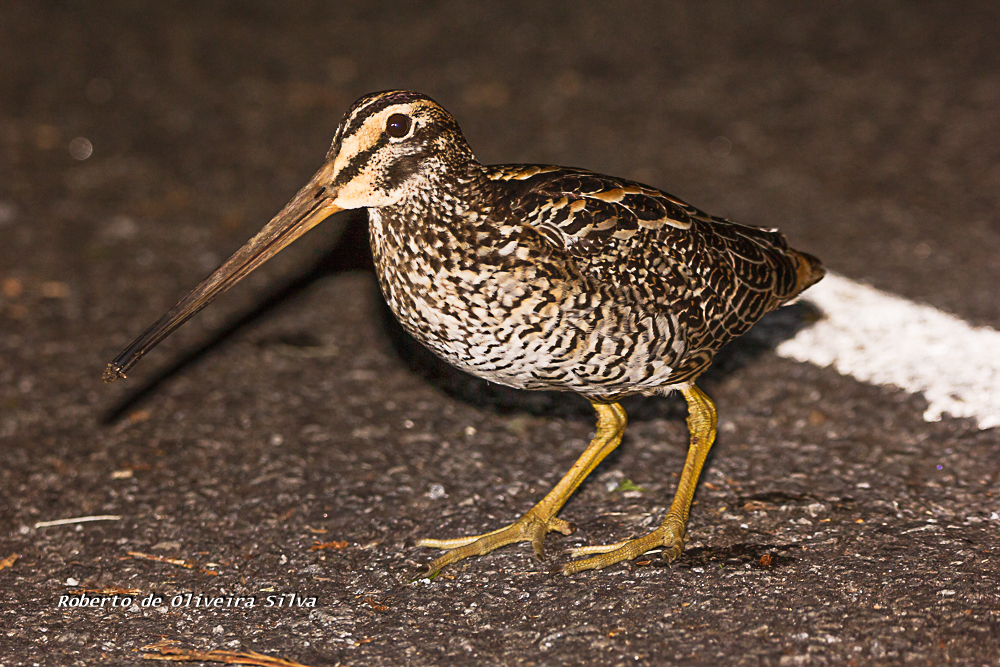
Giant Snipe
Live sightings near you, the range map, bar charts of when it is seen, and Macaulay Library photos and recordings.
Giant Snipe
Gallinago undulata
The giant snipe (Gallinago undulata) is a stocky wader. It breeds in South America. The nominate subspecies G. u. undulata occurs in two distinct areas, one in Colombia, and the other from Venezuela through Guyana, Suriname and French Guiana to extreme north-eastern Brazil. The southern subspecies G. u. gigantea is found in eastern Bolivia, eastern Paraguay and south-east Brazil, and probably also in Uruguay and north-eastern Argentina.
It occurs in tall vegetation in swamps and flooded grasslands, and occasionally in dry savannah. It ranges from the lowlands up to 2,200 m altitude.
From the article Giant snipe on Wikipedia (CC BY-SA), quoted section by section
Description
This is the largest snipe at 36 to 47 cm (14 to 19 in) in length. G. u. gigantea, as its name suggests, is larger than the nominate subspecies with little overlap in size; for example, its bill length is usually more than 12 cm (4.7 in), whereas G. u. undulata is usually less than 11.5 cm (4.5 in) and total length is up to about 43.5 cm (17.1 in). Body mass in the nominate subspecies is from 270 to 362 g (9.5 to 12.8 oz), averaging 294 g (10.4 oz) in males and 332 g (11.7 oz), while in G. u. gigantea, body mass is known to range from 420 to 500 g (15 to 18 oz). The giant snipe has a stocky body and relatively short legs for a wader. It has broad rounded wings like a woodcock and a very long bill. Its upperparts, head and neck are streaked and patterned with black and brown, and chestnut edges to the feathers form distinct lines down its back. The belly is white with brown barring on the flanks. The flight feathers are barred, a feature unique to this snipe. The horn-coloured bill is very long and straight. …
What it does
Nests of the southern race have been found in Brazil in September and from November to early January. They are placed on a hillock between swamps, and 2–4 eggs are laid. No nests of the nominate subspecies have been found. This species is rarely seen on the ground, and its habitat, reluctance to flush until almost trodden on, cryptic plumage, and nocturnal feeding mean its habits are almost unknown. Its diet apparently includes frogs. The giant snipe is usually seen alone when flushed. Other Gallinago snipes have an aerial display, which involves flying high in circles, followed by a powerful stoop during which the bird makes a drumming sound, caused by vibrations of modified outer tail feathers. This species displays at night, but it is not known whether it drums.
Wikipedia: “Behaviour”
Listen
Looking for field recordings…
Where it lives
Recorded sightings
—
geo-referenced records in GBIF, from museums, herbaria and field observers.
Drag the globe to turn it. Dots are where records exist, not a range map; darker means more records.
In the stacks
Searching the stacks…
Every page naming Gallinago undulata in the Biodiversity Heritage Library →
This page is assembled live from iNaturalist, GBIF, Wikipedia, the Source Library and the Internet Archive. It is not yet part of the hand-edited codex. iNaturalist taxon 3928.