On eBird ↗
Pantanal Snipe
Live sightings near you, the range map, bar charts of when it is seen, and Macaulay Library photos and recordings.
Pantanal Snipe
Gallinago paraguaiae
The Pantanal snipe (Gallinago paraguaiae) is a bird in tribe Scolopancinai and subfamily Scolopacinae of family Scolopacidae, the sandpipers and relatives. It is found on Trinidad and Tobago and in every mainland South American country (though only as a vagrant in Ecuador.)
From the article Pantanal snipe on Wikipedia (CC BY-SA), quoted section by section
Description
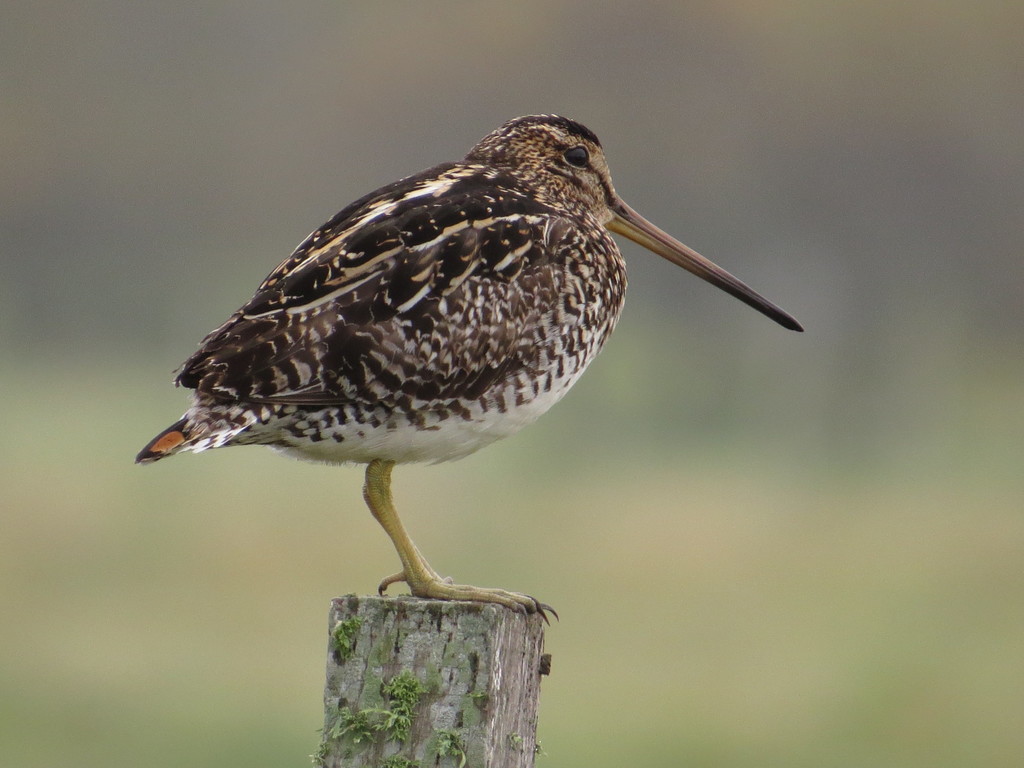
The adult Pantanal snipe is 26 to 30 cm (10 to 12 in) long. Males weigh about 105 to 140 g (3.7 to 4.9 oz) and females 115 to 185 g (4.1 to 6.5 oz). Females are slightly larger than males but otherwise the same. They have short greenish-gray legs and a very long straight dark bill. Their upperparts have a complex pattern of muted whitish, buffy, rufous, and black on a brown background. Their breast and flanks are buff with black markings and the rest of their underparts whitish. Their face has tan and darker brown stripes that blend into each other.
Range & habitat
The Pantanal snipe is found in almost every mainland South American country; it is absent from Chile and has been found in Ecuador only as a vagrant. It also occurs on Trinidad and the Falkland Islands. However, it is scarce in the Amazon Basin. It inhabits wet grassy savanna. In elevation it is known as high as 1,300 m (4,300 ft) in Venezuela, as high as 2,200 m (7,200 ft) in Peru, and perhaps as high as 2,600 m (8,500 ft) in Bolivia.
Wikipedia: “Distribution and habitat”
What it does
The Pantanal snipe forages by probing in mud. Their diet of invertebrates is not known in detail but includes insect larvae and earthworms.
Wikipedia: “Feeding”
Listen
Looking for field recordings…
Where it lives
Recorded sightings
—
geo-referenced records in GBIF, from museums, herbaria and field observers.
Drag the globe to turn it. Dots are where records exist, not a range map; darker means more records.
In the stacks
Searching the stacks…
Every page naming Gallinago paraguaiae in the Biodiversity Heritage Library →
This page is assembled live from iNaturalist, GBIF, Wikipedia, the Source Library and the Internet Archive. It is not yet part of the hand-edited codex. iNaturalist taxon 3927.