- Animals
- ›Arthropods
- ›Hexapods
- ›Insects
- ›Winged and Once-winged Insects
- ›Beetles
- ›Water, Rove, Scarab, Long-horned, Leaf, and Snout Beetles
- ›Cucujiform Beetles
- ›Leaf Beetles and Allies
- ›Leaf Beetles
- ›Skeletonizing Leaf and Flea Beetles
- ›Flea Beetles
- ›Longitarsus
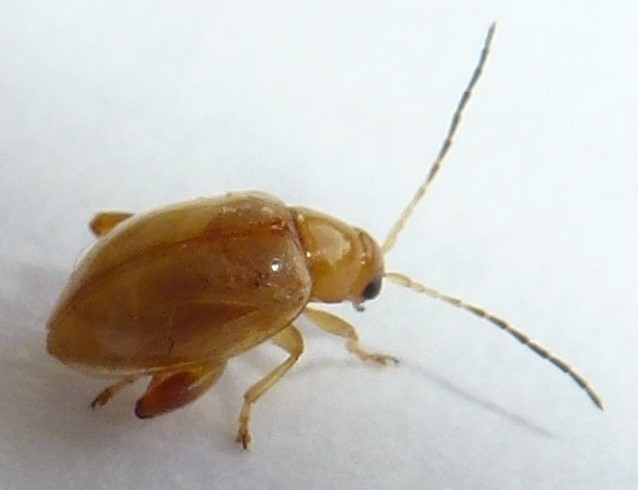
Ragwort Flea Beetle
Longitarsus jacobaeae
Longitarsus jacobaeae is a species of flea beetle known as the tansy ragwort flea beetle. It is used as an agent of biological pest control against the nectar-rich noxious weed known as ragwort (Senecio jacobaea reclassified as Jacobaea vulgaris).
The adult beetle is light golden brown in color and between 2 millimetres (0.079 in) and 4 millimetres (0.16 in) long. The female is larger than the male, especially when gravid. The beetle has enlarged femurs for its main locomotion method of hopping. The female lays eggs on or near the ragwort, its host plant. The larva emerges in about two weeks and burrows into the ground to feed on the roots. The larvae and adults are dually responsible for damage to the plant. The adult defoliates plants which are often already weakened by larval damage at the roots. This two-pronged attack is quite successful in preventing ragwort growth and development. The beetles have prevented entire populations of ragwort from reaching flowering stage at several monitored sites.
Listen
Looking for field recordings…
Where it lives
Recorded sightings
—
geo-referenced records in GBIF, from museums, herbaria and field observers.
Drag the globe to turn it. Dots are where records exist, not a range map; darker means more records.
In the stacks
Searching the stacks…
Every page naming Longitarsus jacobaeae in the Biodiversity Heritage Library →
This page is assembled live from iNaturalist, GBIF, Wikipedia, the Source Library and the Internet Archive. It is not yet part of the hand-edited codex. iNaturalist taxon 391861.