- Animals
- ›Arthropods
- ›Hexapods
- ›Insects
- ›Winged and Once-winged Insects
- ›Ants, Bees, Wasps, and Sawflies
- ›Narrow-waisted Wasps, Ants, and Bees
- ›Ants, Bees, and Stinging Wasps
- ›Bees and Apoid Wasps
- ›Bees
- ›Plasterer Bees
- ›Neopasiphaeinae
- ›Neopasiphaeini
- ›Leioproctus
- ›Leioproctus
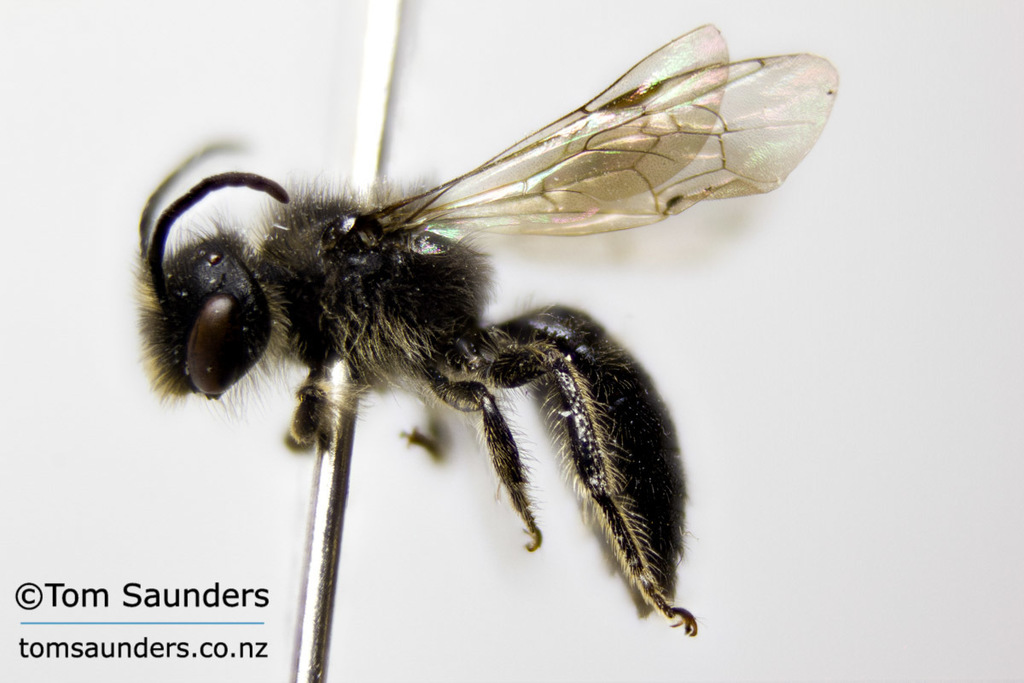
Pango Leioproctus
Leioproctus pango
Leioproctus pango is a solitary bee species belonging to the genus Leioproctus, and family Colletidae. It is native to New Zealand.
From the article Leioproctus pango on Wikipedia (CC BY-SA), quoted section by section
Description
Leioproctus pango is a small bee, measuring approximately 8-10 mm in length. Males are shorter in length than females. Its body is predominantly black with a slight metallic sheen. The thorax has sparse hair, while the ventral side is covered with denser hairs. The wings are translucent with a faint brownish tint, and the leg segments are mostly dark with pale joints. This species nests in soft soil and is commonly found in various regions of New Zealand.
Range & habitat
Leioproctus pango is a ground-nesting bee plays a crucial role as a key pollinator for certain native plants, often exhibiting specific flower visitation patterns. It is typically active during the warmer months, when its flight season occurs. Its nesting and foraging behaviors are essential for the pollination of a variety of plant species, contributing to the health of local ecosystems. Leioproctus pango typically nests in burrows it digs into the ground. As solitary bees, they excavate tunnels where they construct brood cells. Their nests mix pollen and nectar, shaping into a ball that sits in the base of the waterproof cell, which serve as food for the larva after the female lays an egg. Their nests are often located in sandy or loose soil environments.
Wikipedia: “Habitat”
What it does
Leioproctus pango carries pollen from Carmichaelia and the Myrtaceae. It is the most effective pollinator for Carmichaelia hollowayi. It shows a strong preference for Fabaceae. This preference has extended to introduced Lucerne (Medicago sativa) and white clover (Trifolium repens). It has also shown the ability to collect pollen from a wide range of different plant families, the most extreme example of which is the kiwi fruit. Despite the complete absence of nectar, both sexes eagerly forage for pollen.
Wikipedia: “Pollination”
Listen
Looking for field recordings…
Where it lives
Recorded sightings
—
geo-referenced records in GBIF, from museums, herbaria and field observers.
Drag the globe to turn it. Dots are where records exist, not a range map; darker means more records.
In the stacks
Searching the stacks…
Every page naming Leioproctus pango in the Biodiversity Heritage Library →
This page is assembled live from iNaturalist, GBIF, Wikipedia, the Source Library and the Internet Archive. It is not yet part of the hand-edited codex. iNaturalist taxon 391420.