- Animals
- ›Arthropods
- ›Hexapods
- ›Insects
- ›Winged and Once-winged Insects
- ›Ants, Bees, Wasps, and Sawflies
- ›Narrow-waisted Wasps, Ants, and Bees
- ›Ants, Bees, and Stinging Wasps
- ›Bees and Apoid Wasps
- ›Bees
- ›Plasterer Bees
- ›Neopasiphaeinae
- ›Neopasiphaeini
- ›Leioproctus
- ›Leioproctus
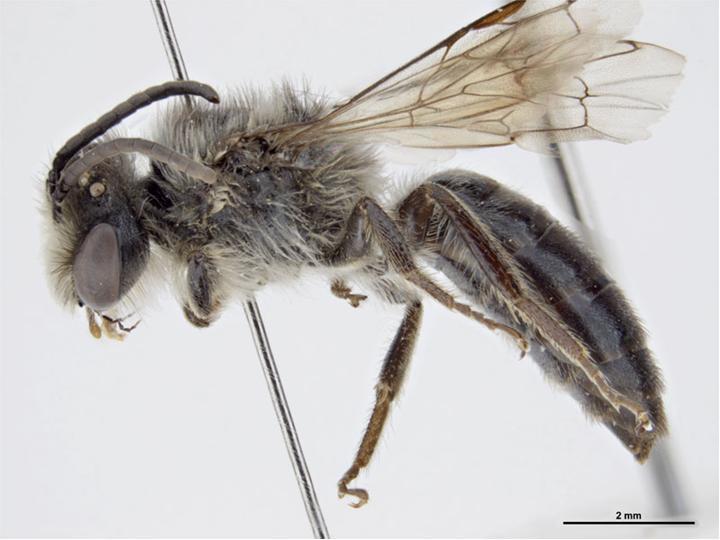
Leioproctus imitatus
Leioproctus imitatus is a species of plaster bee in the family Colletidae. It is a small, black, solitary bee that is endemic to New Zealand.
From the article Leioproctus imitatus on Wikipedia (CC BY-SA), quoted section by section
Description
Leioproctus imitatus is a black, hairy bee ranging from 5 –13.4 mm. The legs and thorax are covered in hairs ranging from black to yellow to white, although hair colour typically fades with age. The dorsal surface of the abdomen is mostly hairless showing the shiny black cuticle underneath. The clypeus and supraclypeus are typically hairy while the forehead is often mostly hairless, likely to avoid interference with the ocelli. Supraclypeus is almost completely flat and is densely punctured throughout. Hairs on young males are often orange, fading as they age. Females carry pollen externally on scopae.
Range & habitat
Leioproctus imitatus is endemic to New Zealand. L. imitatus is currently believed to be widely distributed across New Zealand and can be found in the North and South islands and many coastal islands including Stuart Island/Rakiura. Although there have been no formal nationwide population studies on L. imitatus or the Leioproctus genus, estimates can still be made using iNaturalist and local studies. This distribution map shown was created with all sightings of Leioproctus on iNaturalist. Because specific Leioproctus species can be difficult to identify, most sightings only go to genus, but there is high habitat similarity between species so this map still shows the national range of the genus. In 2007, a 3-year study done on Native bees in Whangārei found that 27% of the 782 bees collected were L. imitatus, showing it is one of the more common species in the genus.
Wikipedia: “Range”
What it does
Leioproctus imitatus will forage up to 2 hours in one session and prefer to stay within 10 m (33 ft) of the nesting site. They show almost no territorial behaviours, and often nest and feed within close proximity of each other.
Wikipedia: “Foraging behaviour”
At the table
All their nutrients come directly or indirectly from pollen and nectar. Pollen is the main source of protein, required for growth, so it is consumed mostly during the larval stage, while nectar provides sugar, which provides the energy adults and larvae need throughout their life. Leioproctus imitatus primarily forages on the flowers of native species in the Myrtaceae family, such as pōhutukawa (Metrosideros excelsa), kānuka (Kunzea ericoides) and mānuka (Leptospermum scoparium). This species also shows some foraging plasticity and will forage on introduced species if necessary. L. imitatus has been recorded visiting kiwifruit flowers, and agricultural studies have caught them in clover pastures and orchards.
Wikipedia: “Food”
Listen
Looking for field recordings…
Where it lives
Recorded sightings
—
geo-referenced records in GBIF, from museums, herbaria and field observers.
Drag the globe to turn it. Dots are where records exist, not a range map; darker means more records.
In the stacks
Searching the stacks…
Every page naming Leioproctus imitatus in the Biodiversity Heritage Library →
This page is assembled live from iNaturalist, GBIF, Wikipedia, the Source Library and the Internet Archive. It is not yet part of the hand-edited codex. iNaturalist taxon 391417.