- Animals
- ›Arthropods
- ›Hexapods
- ›Insects
- ›Winged and Once-winged Insects
- ›Butterflies and Moths
- ›Curved-horn Moths
- ›Cosmet Moths
- ›Cosmopteriginae
- ›Labdia
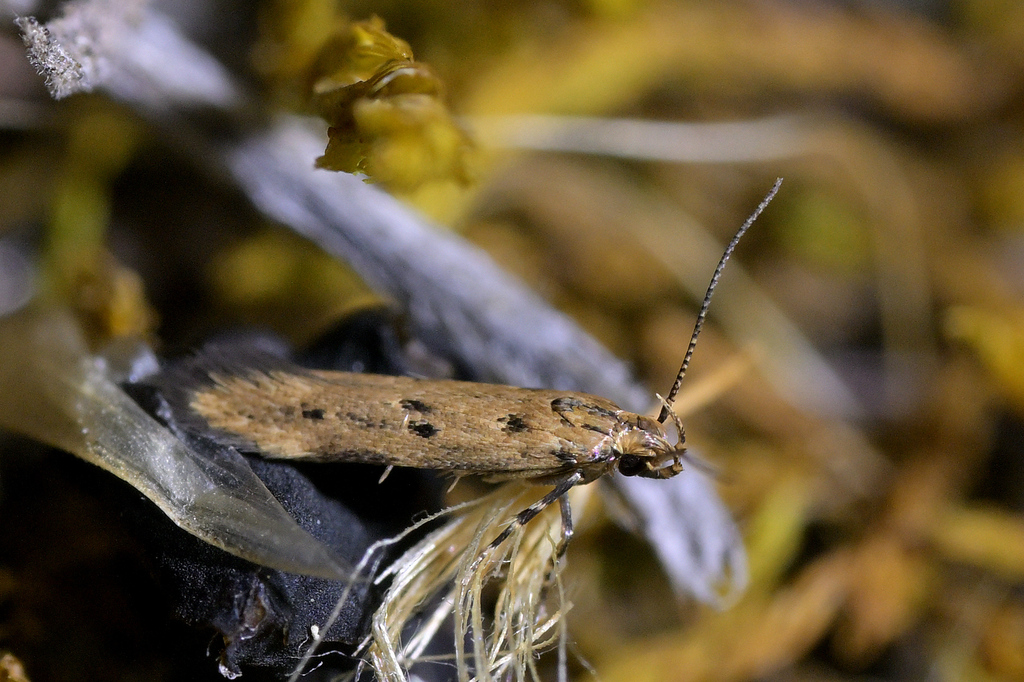
Labdia anarithma
Labdia anarithma is a moth of the family Cosmopterigidae. It was described by Edward Meyrick in 1888. It is found in New Zealand and throughout Australia. Adults are on the wing from December to March and are day flying. They have been collected by sweeping bracken fern.
From the article Labdia anarithma on Wikipedia (CC BY-SA), quoted section by section
Description
Meyrick first described this species as follows:
♂♀. 7-10 mm. Head and thorax brownish-ochreous, face ochreous-whitish. Palpi ochreous-whitish, second joint with basal half and a subapical ring suffusedly irrorated with black, terminal joint irrorated with dark fuscous. Antennae whitish-ochreous, ringed with dark fuscous. Abdomen grey-whitish, or grey. Legs dark grey, suffusedly ringed with whitish. Forewings lanceolate; vein 5 separate, 6 present; brownish-ochreous, sometimes more or less sprinkled with dark fuscous; a black dot on base of costa, sometimes obsolete, a second on costa near base, a third in disc beneath second, a fourth on base of inner margin, often obsolete, a fifth in disc before middle, a sixth on fold rather obliquely beyond fifth, and a seventh in disc at 2⁄3; generally two small indistinct whitish-ochreous spots on costa and inner margin opposite seventh dot : cilia light grey, darker round apex. Hindwings with veins 6 and 7 from a point; grey; cilia light-grey.
Range & habitat
This species is native to both New Zealand and Australia. In New Zealand this species has been observed in Taranaki, Napier. Palmerston North, Masterton, Wanganui and Wellington.
Wikipedia: “Distribution”
What it does
The adults of this species are on the wing from December until March and are day flying. George Hudson stated he had collected them by sweeping bracken fern in the late afternoon.
== References ==
Wikipedia: “Behaviour”
Listen
Looking for field recordings…
Where it lives
Recorded sightings
—
geo-referenced records in GBIF, from museums, herbaria and field observers.
Drag the globe to turn it. Dots are where records exist, not a range map; darker means more records.
In the stacks
Searching the stacks…
Every page naming Labdia anarithma in the Biodiversity Heritage Library →
This page is assembled live from iNaturalist, GBIF, Wikipedia, the Source Library and the Internet Archive. It is not yet part of the hand-edited codex. iNaturalist taxon 391277.