On eBird ↗
Jack Snipe
Live sightings near you, the range map, bar charts of when it is seen, and Macaulay Library photos and recordings.
Jack Snipe
Lymnocryptes minimus
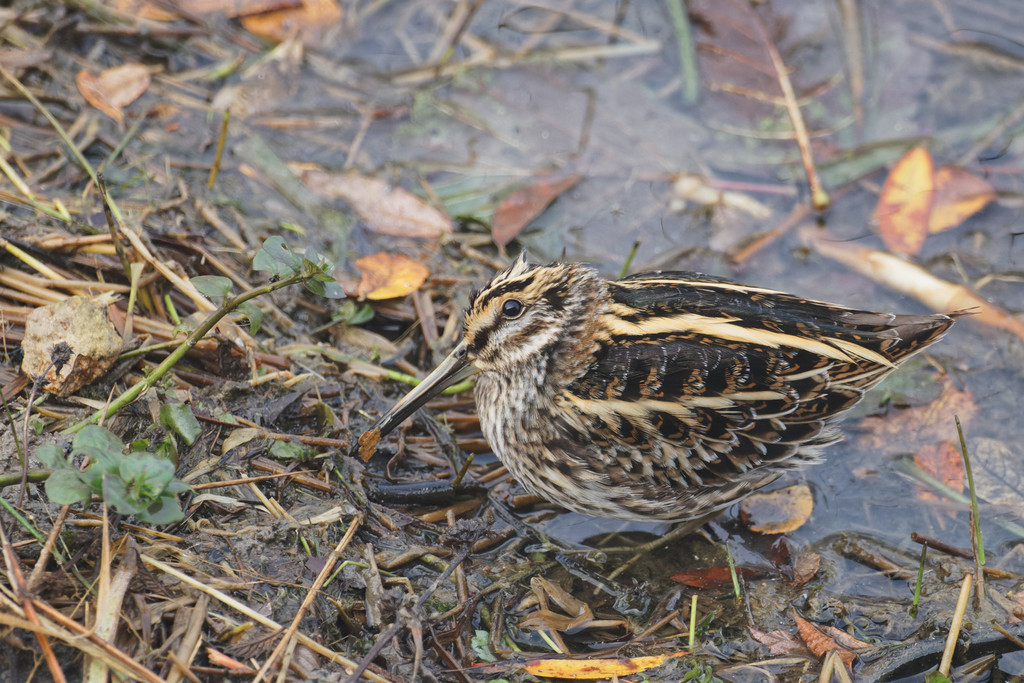
The jack snipe or jacksnipe (Lymnocryptes minimus) is a small stocky wader. It is the smallest snipe, and the only member of the genus Lymnocryptes. Features such as its sternum and its continuous 'bobbing up and down' make it quite distinct from other snipes or woodcocks.
From the article Jack snipe on Wikipedia (CC BY-SA), quoted section by section
Description
Adults are smaller than common snipes and have relatively shorter bills. The bird's length is 18–25 cm (7.1–9.8 in), wingspan is 30–41 cm (12–16 in) and weight is 33–73 g (1.2–2.6 oz). The body is mottled brown on top and pale underneath. Jack snipes have a dark stripe through the eye. The wings are pointed and narrow, and yellow back stripes are visible in flight. When seen, the distinctive bobbing movement, as if the bird is on springs, has an almost hypnotic quality. The head pattern of the jack snipe differs from the common snipe and other species in the genus Gallinago, in that there is no central crown-stripe; instead, there are two pale lateral crown-stripes, which are separated from the supercilium by an area of dark plumage.
Range & habitat
Jack snipes are migratory, spending the non-breeding period in Great Britain, Atlantic and Mediterranean coastal Europe, Africa, and India. The jack snipe is one of the species to which the Agreement on the Conservation of African-Eurasian Migratory Waterbirds (AEWA) applies. Their breeding habitat is marshes, bogs, tundra and wet meadows with short vegetation in northern Europe and northern Russia. They are rare vagrants in North America. There is also a record from Colombia in South America.
Wikipedia: “Distribution and habitat”
What it does
Jack snipes can be secretive in their non-breeding areas and are difficult to observe, being well camouflaged in their habitat. Consequently, birdwatchers have developed a specialised technique for finding them. This involves walking through its marshy habitat until a bird is disturbed and flies up. Jack snipes will squat down and not flush from cover until an intruder is quite close. They then quietly fly a short distance before dropping back into vegetation.
Feeding. They forage in soft mud, probing or picking up food by sight. They mainly eat insects and earthworms, also plant material.
Breeding. The male performs an aerial display during courtship, during which it makes a distinctive sound like a galloping horse. It is silent in winter. They nest in a well-hidden location on the ground, laying 3–4 eggs.
Wikipedia: “Behaviour”
Listen
Looking for field recordings…
Where it lives
Recorded sightings
—
geo-referenced records in GBIF, from museums, herbaria and field observers.
Drag the globe to turn it. Dots are where records exist, not a range map; darker means more records.
In the stacks
Searching the stacks…
Every page naming Lymnocryptes minimus in the Biodiversity Heritage Library →
This page is assembled live from iNaturalist, GBIF, Wikipedia, the Source Library and the Internet Archive. It is not yet part of the hand-edited codex. iNaturalist taxon 3911.