- Animals
- ›Arthropods
- ›Hexapods
- ›Insects
- ›Winged and Once-winged Insects
- ›Butterflies and Moths
- ›Fruitworm Moths
- ›Fruitworm Moths
- ›Heterocrossa
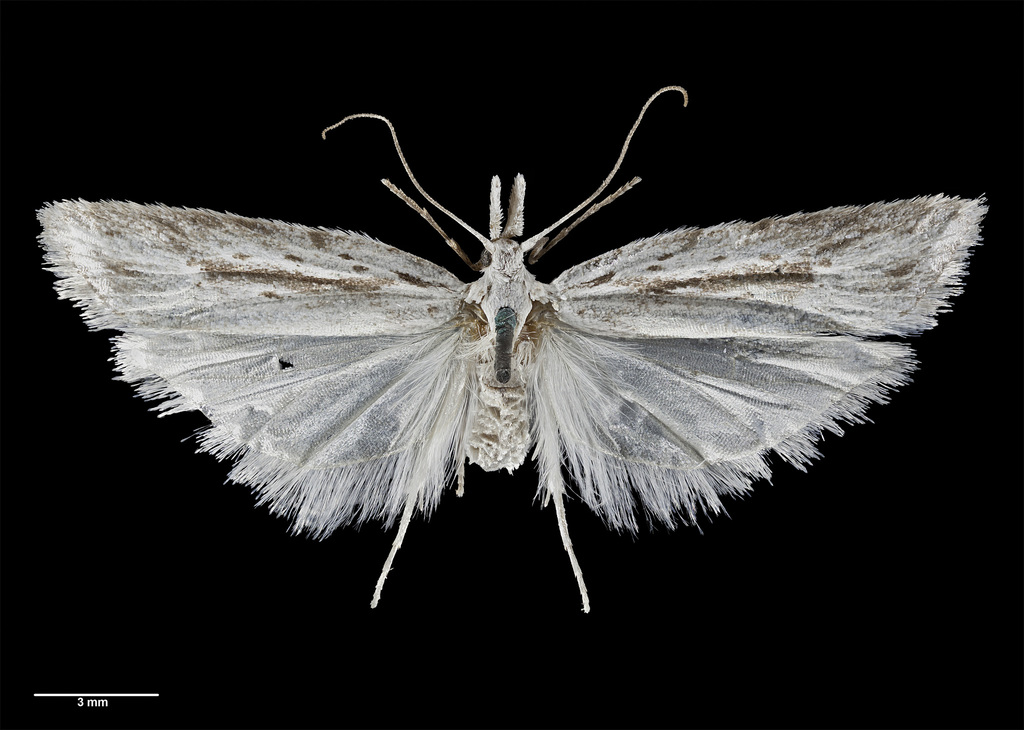
Heterocrossa sanctimonea
Heterocrossa sanctimonea is a moth of the Carposinidae family first described by Charles E. Clarke in 1926. It is endemic to New Zealand and can be found in the South Island at Arthur's Pass, in Fiordland and in Southland. Adults are on the wing in January and are nocturnal. They are attracted to light.
From the article Heterocrossa sanctimonea on Wikipedia (CC BY-SA), quoted section by section
Description
Clarke described this species as follows:
♂ ♀. 23 mm. Head whitish. Thorax grey-white. Palpi grey-white above with a few darker scales, fuscous below and near base. Antennae whitish, abdomen pale grey. Forewings elongate, posteriorly somewhat dilated, costa gently arched, apex bluntly acute, termen almost straight, oblique; pale grey-white with cloudy markings of dark fuscous; from base along costa a few scattered dark scales widening at about 3/1 to a cloudy diffusion and tapering again to apex; from near base at middle a dark line, widest at about middle of disc where it ends but is almost connected with the dark diffusion from costa; a row of several black dots from near base on costal side of this, and another dot nearer to costa at about ⅕; a black dot near anal angle; a blackish irroration with several dark spots subterminally and blackish along termen: cilia pale grey mixed with fuscous near apex. Hindwings pale grey-white: cilia grey-white. This species can be distinguished from other species within its genus by its mostly white colouring and that it is larger in size.
Range & habitat
This species is endemic to New Zealand. Other than the type locality of Arthur's Pass, this species has been observed around the Homer Tunnel in Fiordland and in Southland at the Longwood Range and in the Takitimu Mountains and Blue Mountains.
Wikipedia: “Distribution”
What it does
Adult species have been observed on the wing in January, are nocturnal and are attracted to light.
== References ==
Wikipedia: “Behaviour”
Listen
Looking for field recordings…
Where it lives
Recorded sightings
—
geo-referenced records in GBIF, from museums, herbaria and field observers.
Drag the globe to turn it. Dots are where records exist, not a range map; darker means more records.
In the stacks
Searching the stacks…
Every page naming Heterocrossa sanctimonea in the Biodiversity Heritage Library →
This page is assembled live from iNaturalist, GBIF, Wikipedia, the Source Library and the Internet Archive. It is not yet part of the hand-edited codex. iNaturalist taxon 390459.