- Animals
- ›Arthropods
- ›Hexapods
- ›Insects
- ›Winged and Once-winged Insects
- ›Butterflies and Moths
- ›Fruitworm Moths
- ›Fruitworm Moths
- ›Heterocrossa
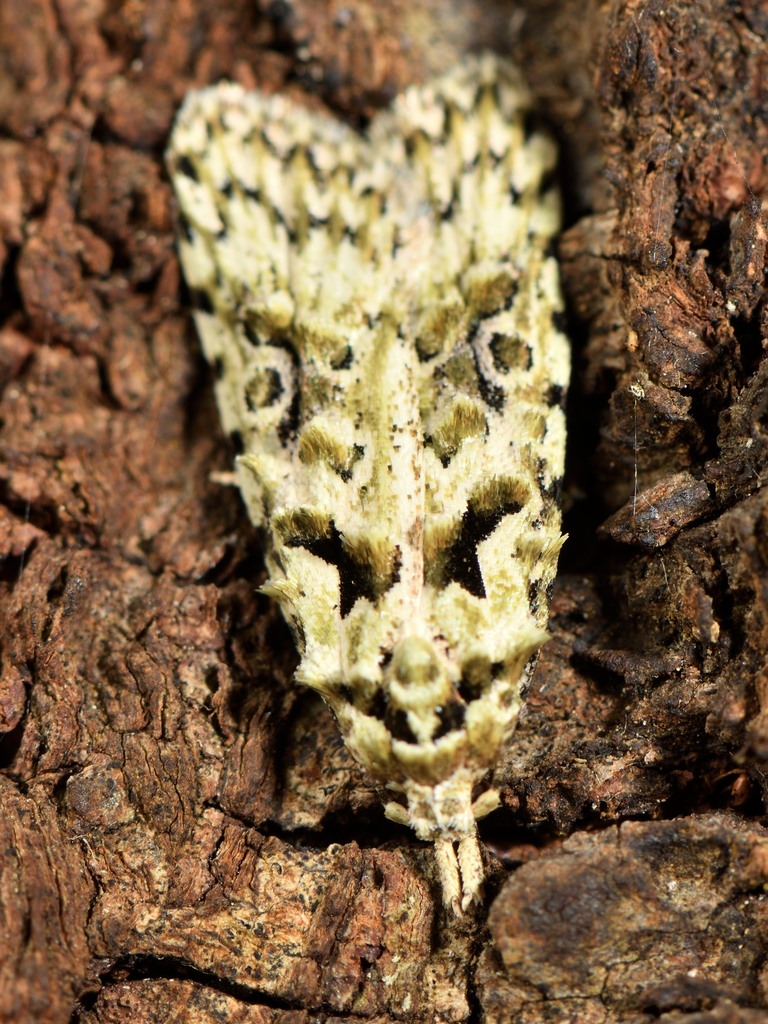
Lichen Snoutlet
Heterocrossa eriphylla
Heterocrossa eriphylla is a species of moth in the family Carposinidae. It is endemic to New Zealand and is found in the North Island and the northern parts of the South Island. This species is regarded as relatively uncommon and inhabits native forest. The larvae feed on the healing wounds of New Zealand beech trees Fuscospora fusca and Fuscospora truncata. It pupates at its feeding site and emerges from December onward. The adult moth is nocturnal and is attracted to light. During the day the moth rests on lichen covered tree trunks where their lichen mimicking colouration assists with their camouflage.
From the article Heterocrossa eriphylla on Wikipedia (CC BY-SA), quoted section by section
Description
Hudson described the larva of the species as follows:
Its length when full-grown is about 3⁄4 inch. Cylindrical, slightly tapering at each end with the segments deeply excised. The head is dark reddish-brown, the second segment with shining brown dorsal plate; back of rest of segments bright pink, slightly tinged with purple; ventral surface pale whitish, slightly tinged with blue; there is a row of rather large horny warts around segments 2, 3 and 4; a double series of sub-dorsal warts on the other segments, except the last, and three lateral lines of such warts. The legs and prolegs are well developed. The male adult of this species was described by Meyrick as follows:
Male. — 26 mm. Head and thorax whitish-greenish, shoulders olive-greenish. Palpi whitish-greenish, apex of basal joint and a band before middle of second fuscous. Antennae greyish-ochreous, basal joint dilated, whitish-greenish. Abdomen pale whitish-ochreous. Legs dark fuscous, apex of joints whitish, posterior pair pale whitish-ochreous. …
Range & habitat
This species is endemic to New Zealand. This species is found in the North Island and northern parts of the South Island. Specimens of this moth have been collected near the Wellington Botanic Gardens and at the Ōrongorongo Valley, as well as near Woodville in hill country. This moth has also been collected at Paroa. H. eriphylla is regarded as being relatively uncommon.
Wikipedia: “Distribution”
What it does
The larvae of this species feed on the callus tissue generated by their host trees as a result of damage caused by other insects including Aenetus virescens. Larvae are fully developed by October. The species pupates at their feeding site and have been observed emerging in December. The adult moths have been observed on the wing all year round but are most frequently seen from September to April. This moth is a night flier and is attracted to light. During the day the adult moths rest on tree trunks where their variable lichen mimicking colouration assists with their camouflage. W. P. Cohen stated that he collected his specimens during the day while they were at rest on the trunks of weeping-willows.
Wikipedia: “Biology and behaviour”
Listen
Looking for field recordings…
Where it lives
Recorded sightings
—
geo-referenced records in GBIF, from museums, herbaria and field observers.
Drag the globe to turn it. Dots are where records exist, not a range map; darker means more records.
In the stacks
Searching the stacks…
Every page naming Heterocrossa eriphylla in the Biodiversity Heritage Library →
This page is assembled live from iNaturalist, GBIF, Wikipedia, the Source Library and the Internet Archive. It is not yet part of the hand-edited codex. iNaturalist taxon 390447.