On eBird ↗
Far Eastern Curlew
Live sightings near you, the range map, bar charts of when it is seen, and Macaulay Library photos and recordings.
Far Eastern Curlew
Numenius madagascariensis
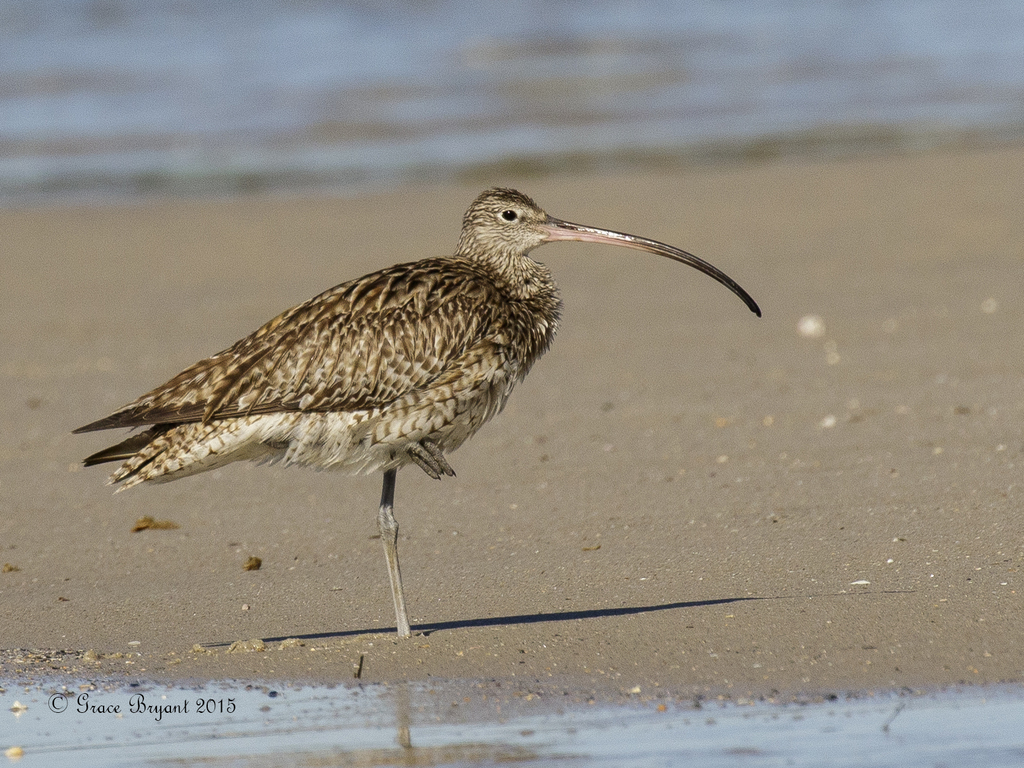
The Far Eastern curlew (Numenius madagascariensis) is a large wader most similar in appearance to the long-billed curlew, but slightly larger. It is mostly brown, differentiated from other curlews by its plain, unpatterned brown underwing, and brown rump. It is not only the largest curlew but probably the world's largest sandpiper, at 60–66 cm (24–26 in) in length and 110 cm (43 in) across the wings. The weight is 390–1,350 g (0.86–2.98 lb), which is equalled by the Eurasian curlew; females are on average about 100 g heavier than males. The extremely long bill, at 12.8–20.1 cm (5.0–7.9 in) in length, rivals the bill size of the closely related long-billed curlew as the longest bill for a sandpiper. It overlaps in range with the eastern subspecies of the Eurasian curlew Numenius arquata orientalis, from which it is most easily told by its brown rump and lower back, rather than white.
From the article Far Eastern curlew on Wikipedia (CC BY-SA), quoted section by section
Range & habitat
The Far Eastern curlew spends its breeding season in northeastern Asia, including Siberia to Kamchatka, and Mongolia. Its breeding habitat is composed of marshy and swampy wetlands and lakeshores. Most individuals spend the non-breeding season in coastal Australia, with some wintering in Indonesia, Thailand, Philippines and New Zealand, where they stay at estuaries, beaches, and salt marshes; a few winter as far north as southern China and Taiwan. During its migration the Far Eastern curlew commonly makes stopovers on the mudflats of the Yellow Sea and some on the coasts of Japan. It uses its long, decurved bill to probe for invertebrates in the mud. It may feed in solitary but it generally congregates in large flocks to migrate or roost. Its call is a sharp, clear whistle, cuuue-reee, often repeated.
Diet. On its breeding grounds the Far Eastern curlew consumes insects, such as larvae of beetles and flies, and amphipods. During migration it also feeds on berries. In the non-breeding season, it consumes marine invertebrates, preferring crabs and small molluscs but also taking other crustaceans and polychaetes.
Wikipedia: “Distribution and habitat”
Listen
Looking for field recordings…
Where it lives
Recorded sightings
—
geo-referenced records in GBIF, from museums, herbaria and field observers.
Drag the globe to turn it. Dots are where records exist, not a range map; darker means more records.
In the stacks
Searching the stacks…
Every page naming Numenius madagascariensis in the Biodiversity Heritage Library →
This page is assembled live from iNaturalist, GBIF, Wikipedia, the Source Library and the Internet Archive. It is not yet part of the hand-edited codex. iNaturalist taxon 3898.