- Animals
- ›Arthropods
- ›Hexapods
- ›Insects
- ›Winged and Once-winged Insects
- ›Butterflies and Moths
- ›Owlet Moths and Allies
- ›Cutworm Moths and Allies
- ›Cutworms and Dart Moths
- ›Noctuini
- ›Agrotina
- ›Euxoa
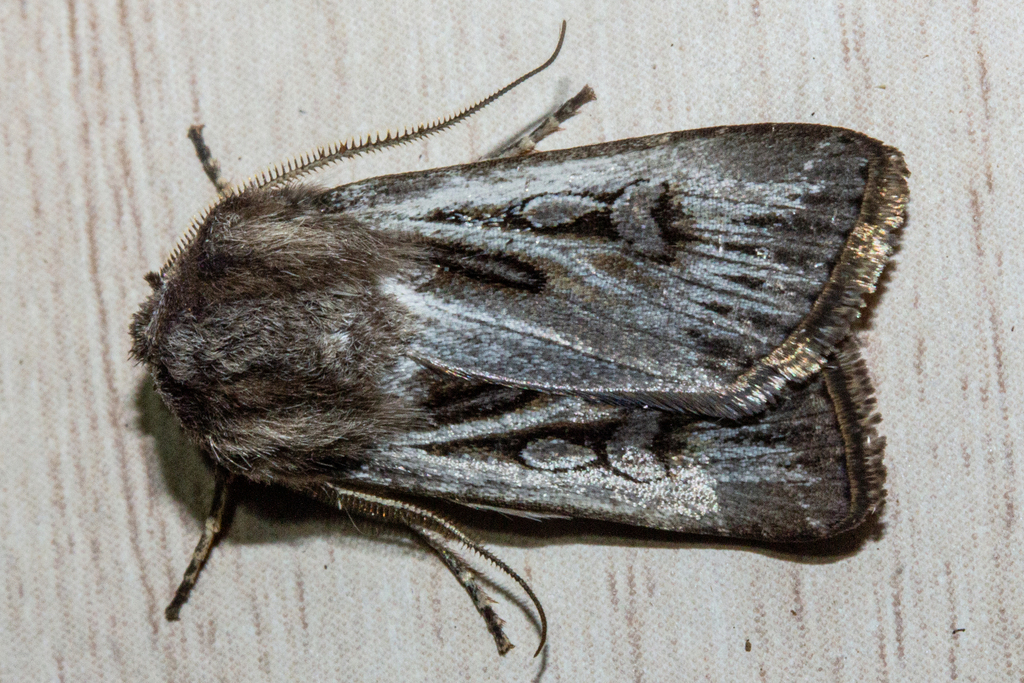
Fereday's Cutworm
Euxoa ceropachoides
Euxoa ceropachoides, commonly known as Fereday's cutworm, is a species of moth in the family Noctuidae. It is endemic to New Zealand. It is classified as Not Threatened by the Department of Conservation.
From the article Euxoa ceropachoides on Wikipedia (CC BY-SA), quoted section by section
Description
The larvae of this species are brown-grey in colour with a broad lateral white band. They grow to a length of 35mm. Guenée described this species as follows:
Superior wings somewhat dark grey, but entirely covered with long sulphur-coloured or greenish scales which obliterate all markings save the large black dots on the hinder margin; however, with attention, one is able to see traces of the reniform stigma, and it is possible that, in better marked individuals, the other markings would be visible; the fringe is long, grey, with the extremity white : the inferior wings are uniformly grey, with the fringes likewise long, whitish, divided by a dark line : beneath, all the wings are greenish-grey, powdered with black atoms on the costa; the superior have in addition, under the costa near the middle, a vague median cellular blotch, and a black dot at the base of the bristle. The thorax is broad, quadrate, darker grey than the wings, like the head, without any line. Palpi very hairy; the third joint thin, lost amid the hairs of the second. Antennae long, acute, and furnished with long ciliated laminae.When describing this species, Guenée used a dull grey colour morph for the holotype and Hudson used the same morph for his illustration in 1898. E. ceropachoides is variable in colour and the dull grey colour morph makes up less than 10 percent of the males of the species. …
Range & habitat
This species is endemic to New Zealand. It can be found in Canterbury and, other than its type locality of Rakaia, has also been found at Kaitorete Spit.
Wikipedia: “Distribution”
What it does
The larvae of this species are nocturnal and feed at night. During the day, they bury themselves in their sandy habitat. They also pupate in cocoons at a shallow depth in the sand. It has been hypothesised that the female of the species is short winged and flightless. This species is a winter to early spring emerging species and the males are on the wing from June to mid September. Adult male moths are attracted to light.
Wikipedia: “Biology and behaviour”
Listen
Looking for field recordings…
Where it lives
Recorded sightings
—
geo-referenced records in GBIF, from museums, herbaria and field observers.
Drag the globe to turn it. Dots are where records exist, not a range map; darker means more records.
In the stacks
Searching the stacks…
Every page naming Euxoa ceropachoides in the Biodiversity Heritage Library →
This page is assembled live from iNaturalist, GBIF, Wikipedia, the Source Library and the Internet Archive. It is not yet part of the hand-edited codex. iNaturalist taxon 389549.