- Animals
- ›Arthropods
- ›Hexapods
- ›Insects
- ›Winged and Once-winged Insects
- ›Butterflies and Moths
- ›Tortricid Leafroller Moths and Allies
- ›Tortricid Leafroller Moths
- ›Tortricine Leafroller Moths
- ›Archipini
- ›Epichorista
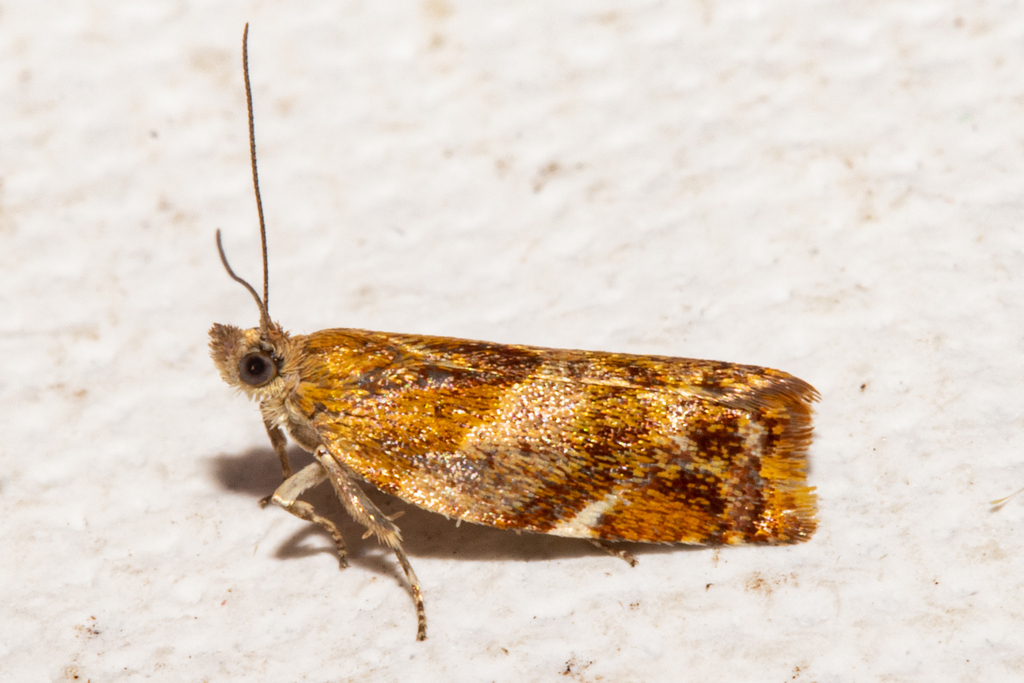
Beech Leafroller
Epichorista emphanes
Epichorista emphanes, the lesser beech leafroller, is a species of moth of the family Tortricidae. It was first described by Edward Meyrick in 1901. It is endemic to New Zealand and is found on the North and South Islands. This species inhabits native beech forests. Larvae feed on the emerging leaves and blossoms of trees in the genus Nothofagus, including Nothofagus mensiesii. The larvae are very active, fastening the leaves together with silk and living between them. The larvae of E. emphanes themselves play larval host to species of parasitic hymenoptera. When formed the pupa is enclosed between two joined beech leaves. Adults are on the wing commonly from November until February. They are day flying and are particularly active in hot sunshine, inhabiting open glades or flying amongst beech trees.
The male and female of this species are different in appearance and the females are also highly variable in appearance. This difference and variability had lead this species to be described by taxonomists on multiple occasions.
From the article Epichorista emphanes on Wikipedia (CC BY-SA), quoted section by section
Description
Meyrick described the adult female of this species as follows:
♀. 14mm. Head and thorax deep ferruginous. Abdomen dark grey. Forewings elongate-oblong, costa moderately arched anteriorly, apex obtuse, termen nearly straight, vertical, rounded beneath; deep ferruginous, irregularly strewn with reddish-ochreous; space between basal patch and central fascia forming an oblique band glossed with ashy-purplish; central fascia edged posteriorly by an oblique white bar from costa, not reaching half across wing, beyond which is a triangular ochreous-yellow costal spot; a purplish-leaden-metallic streak before tornus, reaching half across wing, and a similar sub- terminal streak from costa to tornus: cilia ferruginous, with a purplish basal line, becoming yellow-whitish towards tips beneath apex. Hindwings dark fuscous, rather lighter towards base. Meyrick described the adult male of this species as follows:
♂. 13 mm. Antennal ciliations 1+1⁄2. Forewings without costal fold; deep ferruginous, crossed by numerous oblique irregular series of very small subconfluent purplish-leaden-grey spots, without defined markings, but central fascia and costal patch sometimes indicated on costa. Hindwings blackish. Meyrick pointed out that the male of the species differs considerably in appearance from the female of the species. Also, the adult females are highly variable in appearance. …
Range & habitat
E. emphanes is endemic to New Zealand. It is found on the North and South Islands at a wide range of altitudes. Hudson states specimens can be found at the upper limit of native beech forest growth.
Wikipedia: “Distribution”
What it does
The larva is very active, fastening the leaves together with silk and living between them. The pupa is enclosed between two joined leaves. Adults of this species are on the wing commonly from November until February. They are day flying and are particularly active in hot sunshine.
Wikipedia: “Behaviour”
Listen
Looking for field recordings…
Where it lives
Recorded sightings
—
geo-referenced records in GBIF, from museums, herbaria and field observers.
Drag the globe to turn it. Dots are where records exist, not a range map; darker means more records.
In the stacks
Searching the stacks…
Every page naming Epichorista emphanes in the Biodiversity Heritage Library →
This page is assembled live from iNaturalist, GBIF, Wikipedia, the Source Library and the Internet Archive. It is not yet part of the hand-edited codex. iNaturalist taxon 389044.