- Animals
- ›Arthropods
- ›Hexapods
- ›Insects
- ›Winged and Once-winged Insects
- ›Butterflies and Moths
- ›Curved-horn Moths
- ›Long-horned Moths
- ›Compsistis
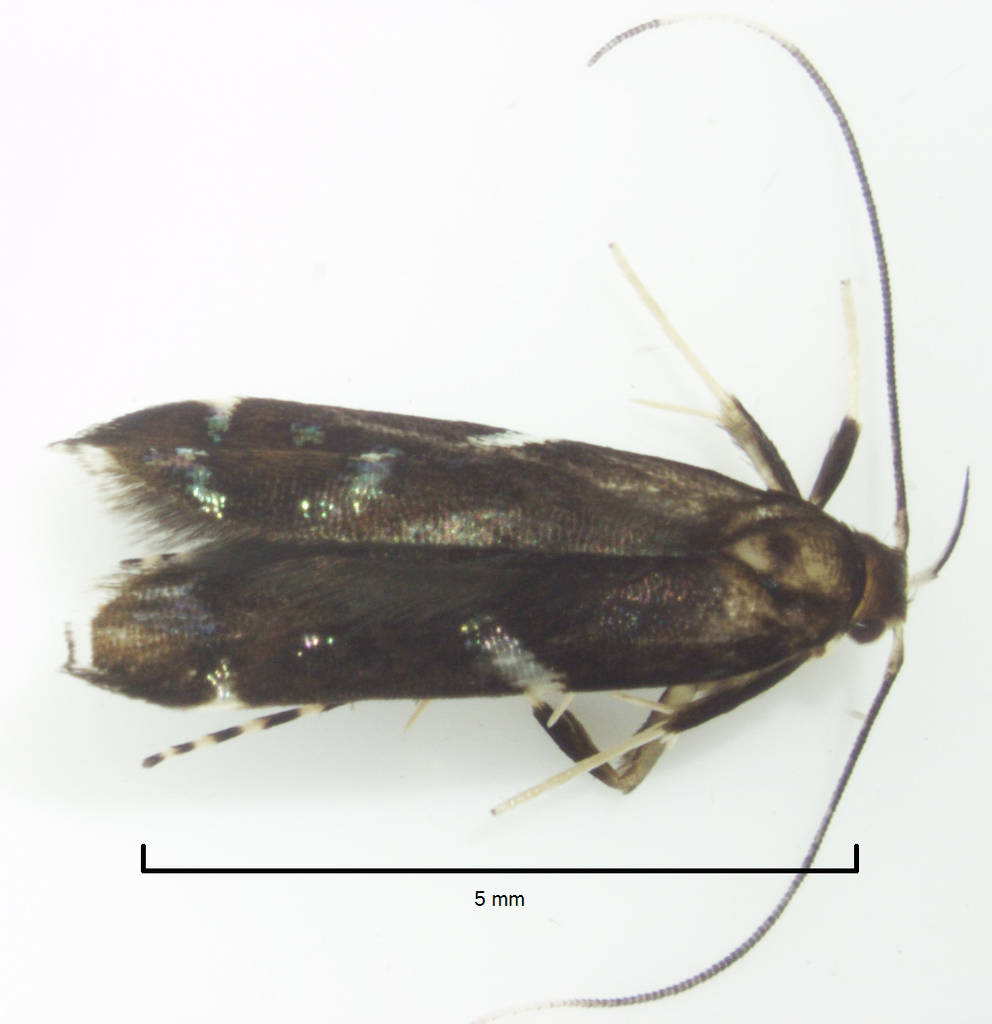
Compsistis bifaciella
Compsistis bifaciella is a moth of the family Lecithoceridae. It was first described by Francis Walker in 1864. It is endemic to New Zealand and is found throughout the North Island. C. bifaciella inhabit native forest. Larvae feed on leaf litter, live in a silk gallery either on the ground or in tree ferns.They pupate in a leaf litter coated, dome shaped, cocoon normally resting on a dead leaf. Adults are day flying and can be difficult to observe when on the wing. They are on the wing from October to February and are known to be active on sunny days. Adults have been observed swarming amongst Brachyglottis repanda during November and December, and bask on that plant's leaves in bright sunshine. This moth has been collected via sweeping of vegetation, blacklight and malaise traps.
From the article Compsistis bifaciella on Wikipedia (CC BY-SA), quoted section by section
Description
Dugdale described the larva of this species as follows:
Body with bands of short, stiff setulae on broad sclerites (pinacula) only; thoracic SV setal group (above foreleg base) with 6—10 short setulae arranged horizontally; head capsule ventrally with menrum simple (no concave sclerite, no paired dark slits); body length 10 mm Hudson described the adult moth as follows:
The expansion of the wings is about seven-sixteenths of an inch. The fore-wings are rather elongate, oblong, with the tornus considerably rounded; shining coppery-brown thinly sprinkled with black scales; there is a small silvery patch near the base, a broad oblique band on the costa at about 1⁄3 reaching half across the wing; an irregular patch near the middle and a curved sub-terminal band, broadest near the middle; all these silvery-white markings gleam with iridescent purple; the cilia near the apex are shining white tipped with black. The hind-wings are grey with coppery-brown reflections. The legs are black banded with shining white and the antennae have a broad white band immediately before the apex. Hudson described the adult moths as jewel like.
Range & habitat
This species inhabits native forest. They are also known to inhabit stands of Kunzea ericoides. Larvae feed on leaf litter, living in a silk gallery either on the ground or in tree ferns. They pupate in a leaf litter coated dome shaped cocoon normally resting on a dead leaf.
Wikipedia: “Habitat and hosts”
What it does
The adults of this species are on the wing from October to January, though occasionally they have also been recorded in February. It is a day flying moth and is difficult to observe when on the wing. Adults tend be active on sunny days and but can be observed when settled on leaves. Adults are known to swarm amongst Brachyglottis repanda during November and December, and bask on leaves in the sunshine. At rest adults have their fore portions slightly raised. The moth stands on all three pairs of legs which are placed backwards; the wings are slightly wrapped around the body, their posterior extremity touching the ground. The antennae are placed backwards, considerably divergent, usually not touching wings. This species has been collected via sweeping of vegetation and malaise traps. Adult moths are also attracted to blacklight traps.
== References ==
Wikipedia: “Behaviour”
Listen
Looking for field recordings…
Where it lives
Recorded sightings
—
geo-referenced records in GBIF, from museums, herbaria and field observers.
Drag the globe to turn it. Dots are where records exist, not a range map; darker means more records.
In the stacks
Searching the stacks…
Every page naming Compsistis bifaciella in the Biodiversity Heritage Library →
This page is assembled live from iNaturalist, GBIF, Wikipedia, the Source Library and the Internet Archive. It is not yet part of the hand-edited codex. iNaturalist taxon 387824.