- Animals
- ›Arthropods
- ›Hexapods
- ›Insects
- ›Winged and Once-winged Insects
- ›Butterflies and Moths
- ›Geometrid and Swallowtail Moths
- ›Geometer Moths
- ›Ennominae
- ›Chalastra
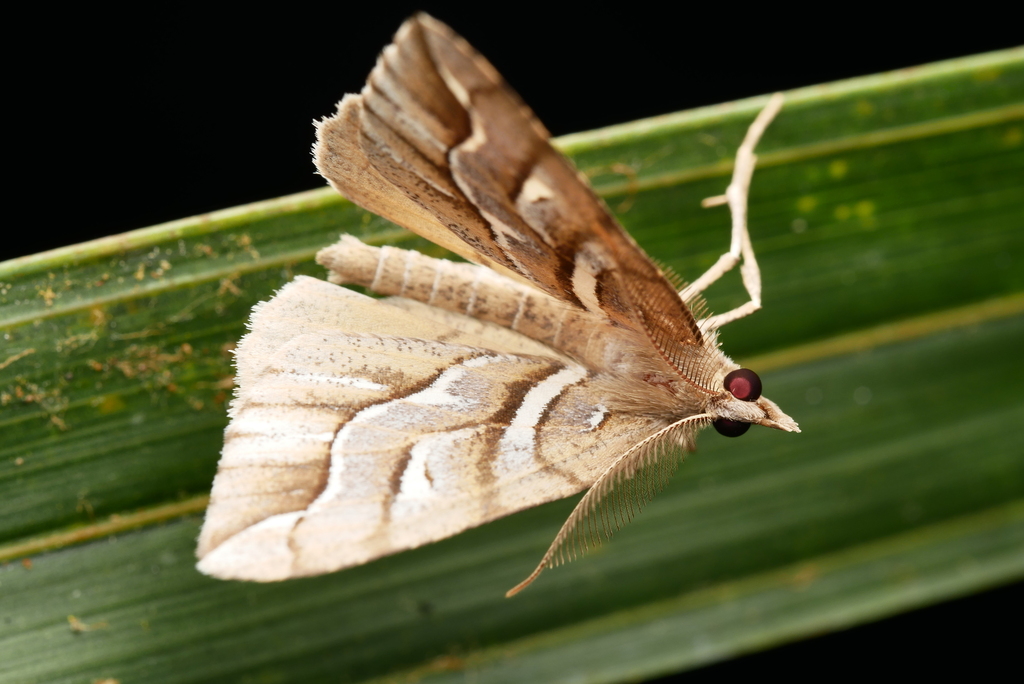
Silver Fern Looper
Chalastra aristarcha
Chalastra aristarcha, the silver fern moth, is a moth of the family Geometridae. This species was first described by Edward Meyrick in 1892. It is endemic to New Zealand and is found in the North Island. This species inhabits dense native forest. The larvae feed on the species host plant, the Silver fern, during spring. This species then pupates on top of leaf litter or moss on the ground. The pupation state lasts for approximately 6 weeks. Adult moths are on the wing from October until April but can sometimes also be seen during the winter months. Adults can be disturbed from silver ferns during the day or are seen on the wing at night particularly at Metrosideros perforata when in flower. Adults are attracted to light. It has been hypothesised that the range of C. aristarcha has restricted as a result of urban development and land conversion of its habitat.
From the article Chalastra aristarcha on Wikipedia (CC BY-SA), quoted section by section
Description
Hudson described the larva of this species as follows:
Prior to its last moult, it is pale green, with white sub-dorsal and lateral lines and conspicuous brown blotches on the sides of each segment, often meeting across the back. The full-grown larva is about 1-inch in length, stout, slightly attenuated towards the head; dull green mottled with white with the edges of the segments yellowish-brown; there are two conspicuous white sub-dorsal lines and two broad irregular white lateral lines, narrower at the segmental divisions; the spiracles are brown.
Meyrick described the adult male of this species as follows:
♂. 37mm. Head, palpi, thorax, abdomen, and legs pale ochreous, back of crown and anterior part of thorax darker; face whitish-tinged; palpi 2+1⁄4; abdomen and legs thinly sprinkled with dark fuscous. Antenntae whitish-ochreous, pectinations 12, apical 1⁄6 simple. …
Range & habitat
C. aristarcha is endemic to New Zealand. It is found throughout the North Island. D. E. Gaskin pointed out in 1966 that although Hudson regarded it as common in Wellington he had yet to collect it there. He was of the opinion that the range of this species had contracted as cultivation of land increased.
Wikipedia: “Distribution”
What it does
The larva feed during spring, are very sluggish and can observed on the silvery underside of its host plant. C. aristarcha pupates on the ground under its host plant and amongst leaf detritus and moss. It stays in that state for approximately 6 weeks. Adult moths are on the wing from October until April but can sometimes also be seen during the winter months. Gaskin believed there were two broods but was unsure at which life stage C. aristarcha passed winter as both adults and larvae are present in spring. Adults of this species have been collected by beating its host plant and have been observed in the evening at Metrosideros perforata when in flower. They are attracted to light.
Wikipedia: “Behaviour and life cycle”
Listen
Looking for field recordings…
Where it lives
Recorded sightings
—
geo-referenced records in GBIF, from museums, herbaria and field observers.
Drag the globe to turn it. Dots are where records exist, not a range map; darker means more records.
In the stacks
Searching the stacks…
Every page naming Chalastra aristarcha in the Biodiversity Heritage Library →
This page is assembled live from iNaturalist, GBIF, Wikipedia, the Source Library and the Internet Archive. It is not yet part of the hand-edited codex. iNaturalist taxon 387413.