- Animals
- ›Chordates
- ›Vertebrates
- ›Reptiles
- ›Snakes and Lizards
- ›Lizards
- ›Skinks and allies
- ›Skinks
- ›Social skinks
- ›Liopholis
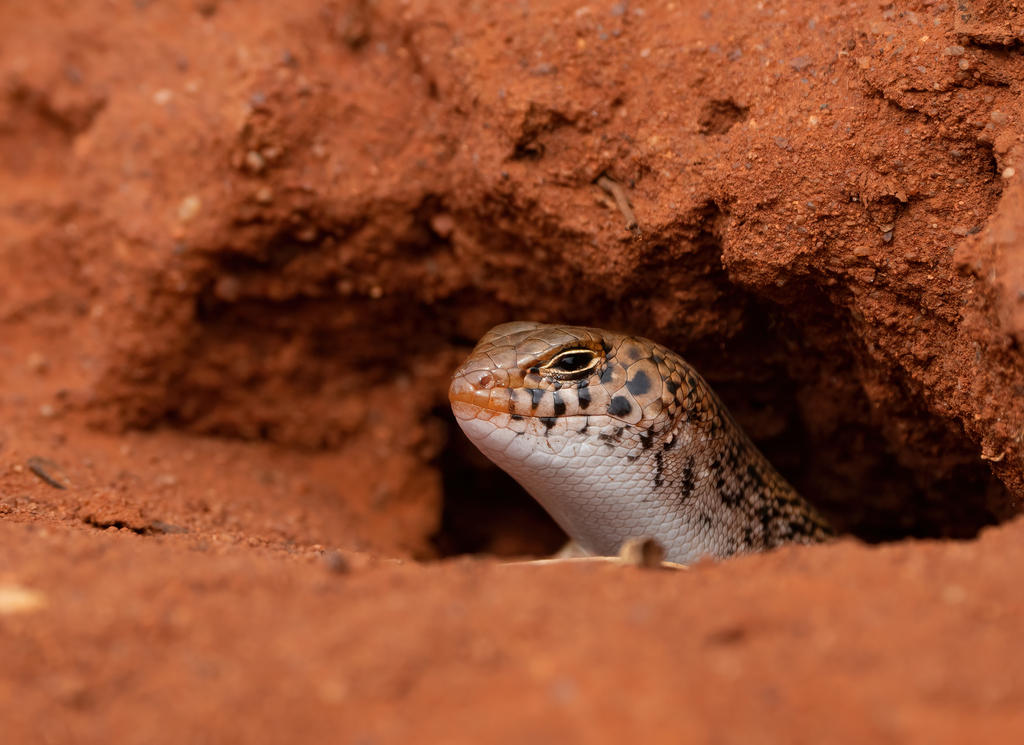
Desert Skink
Liopholis inornata
The desert egernia, unadorned desert-skink or desert skink (Liopholis inornata) is a species of skink, a lizard in the family Scincidae. The desert egernia is endemic to the continent of Australia, and is widespread, with populations recorded in all mainland states and territories except the Australian Capital Territory. The desert egernia is found in dry, desert areas with deep, uncompacted sandy/loamy soils and little significant vegetation cover.
From the article Desert egernia on Wikipedia (CC BY-SA), quoted section by section
Description
The desert egernia is a medium-sized terrestrial lizard. It has pale to reddish-brown colouring with cream coloured spots along the tips of the scales on its back and sides with scale colours often darkening towards the head. It has a pale, creamy white-to-yellow underside and white ventral area and its limbs are often paler than the rest of the body.
Like most burrowing lizard species, the desert egernia has a narrow body and strong, small legs to increase burrowing efficiency and reduce energy expenditure. The tail of the desert egernia is usually slightly longer than the snout-vent length of the lizard, is round and tapering, similarly coloured to the body with little variation. A defining feature of this species is the length of its fourth toe, which is substantially longer than the third toe. Adults usually measure between 75mm and 84mm snout-to-vent and 165mm to 184mm snout-to-tail. There is no significant size difference between male and female in this species. Unlike many other species within the skink family, the desert egernia has not been found to exhibit any pattern of colour pattern polymorphism (CPP). This may be due to the heterogenous nature of arid areas within Australia compared to areas with other climatic conditions, and species' effective camouflage against the soils of its habitat as a measure to avoid predators.
Range & habitat
The majority of the desert egernia's range falls within central Western Australia, most of inland South Australia, southern Northern Territory, south-west Queensland, western New South Wales and a small part of north-west Victoria. Due to its large range and relative abundance, the desert egernia has been assessed as being of 'Least Concern' of endangerment by the IUCN Red List. The desert egernia is protected by state legislation in Victoria, designated threatened due to its small range.
Wikipedia: “Distribution”
What it does
The desert egernia is a xerocole, having formed many adaptions to live in dry, arid areas. It is an obligate burrower, meaning that it exclusively habitates burrows of its own construction as an adaption to the harsh, arid climate it occurs in. It has mostly been observed to be crepuscular to nocturnal, but has been known to be active during the day at times, usually to bask or to take advantage of conditions in which termites are most active. The desert egernia typically resides in areas with deep, uncompacted sandy/loamy soils and is more likely to exist higher on sand ridges than close relatives occurring within a similar range, such as the Night Skink (Liopholis striata).
The burrow of the desert egernia is often uncomplicated compared to other xerocole lizard species. The burrow is usually between 30 cm-50 cm deep, and is characterised by a pattern of fanned sand surrounding at least one entrance or occasionally piled within a nearby clump of grass. In the most basic configuration, the burrow is constructed in a 'U' shape with two entrances, with one entrance exposed and the other entrance covered by a thin layer of soil. …
Wikipedia: “Ecology and habitat”
Where it lives
Recorded sightings
—
geo-referenced records in GBIF, from museums, herbaria and field observers.
Drag the globe to turn it. Dots are where records exist, not a range map; darker means more records.
In the stacks
Searching the stacks…
Every page naming Liopholis inornata in the Biodiversity Heritage Library →
This page is assembled live from iNaturalist, GBIF, Wikipedia, the Source Library and the Internet Archive. It is not yet part of the hand-edited codex. iNaturalist taxon 38624.