- Animals
- ›Arthropods
- ›Hexapods
- ›Insects
- ›Winged and Once-winged Insects
- ›Butterflies and Moths
- ›Geometrid and Swallowtail Moths
- ›Geometer Moths
- ›Carpet Moths
- ›Asaphodes
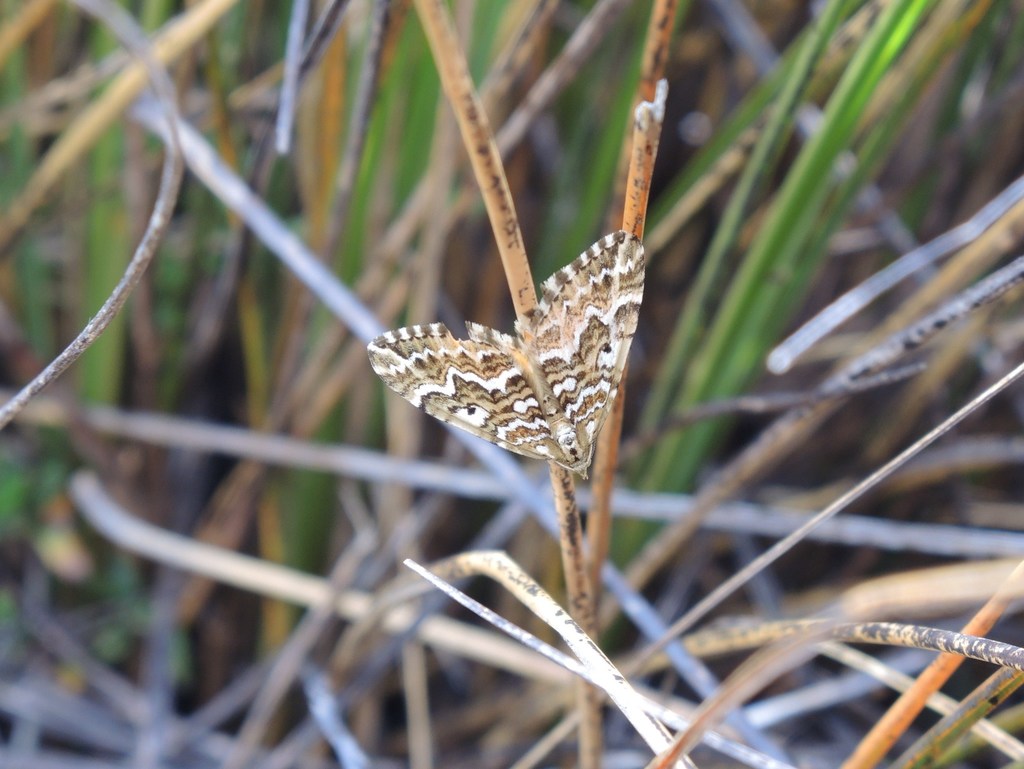
Large Striped Carpet
Asaphodes clarata
Asaphodes clarata, also known as the large striped carpet moth, is a species of moth of the family Geometridae. This species is endemic to New Zealand and has been found on the North and South Islands. The species inhabits open grassy areas, including tussock grasslands, in montane habitat. The larvae feed on the leaves of Ranunculus species. The adult moths are day flying and are on the wing from December to February and have been shown to pollinate Celmisia laricifolia and Hebe pinguifolia.
From the article Asaphodes clarata on Wikipedia (CC BY-SA), quoted section by section
Description
Hudson described the species as follows:
The expansion of the wings of the male is 1+1⁄2 inches, of the female 1+3⁄8 inches. The species differs from the preceding in the following respects : The ground colour of the forewings is brighter, the markings are less oblique and much more jagged; the large white central band is often broken up into several distinct oval patches, the costal edge is very slightly shaded with brown, and the transverse lines do not disappear before reaching the costa. The hind-wings are bright ochreous. The cilia of all the wings are white, strongly barred with yellowish-brown.This species varies in the colour intensity and the width of the white markings of its forewings.
Range & habitat
A. clarata is endemic to New Zealand. It is an upland species and occurs on the tussock covered slopes of ranges in both the North and South Islands. It has been recorded as being present in Otago and in Canterbury.
Wikipedia: “Distribution”
What it does
The adults of this species are on the wing from November to March. It is a day flying moth.
Wikipedia: “Behaviour”
Listen
Looking for field recordings…
Where it lives
Recorded sightings
—
geo-referenced records in GBIF, from museums, herbaria and field observers.
Drag the globe to turn it. Dots are where records exist, not a range map; darker means more records.
In the stacks
Searching the stacks…
Every page naming Asaphodes clarata in the Biodiversity Heritage Library →
This page is assembled live from iNaturalist, GBIF, Wikipedia, the Source Library and the Internet Archive. It is not yet part of the hand-edited codex. iNaturalist taxon 386109.