- Animals
- ›Arthropods
- ›Hexapods
- ›Insects
- ›Winged and Once-winged Insects
- ›Butterflies and Moths
- ›Pyralid and Crambid Snout Moths
- ›Crambid Snout Moths
- ›Grass-veneers and Allies
- ›Argyriini
- ›Argyria
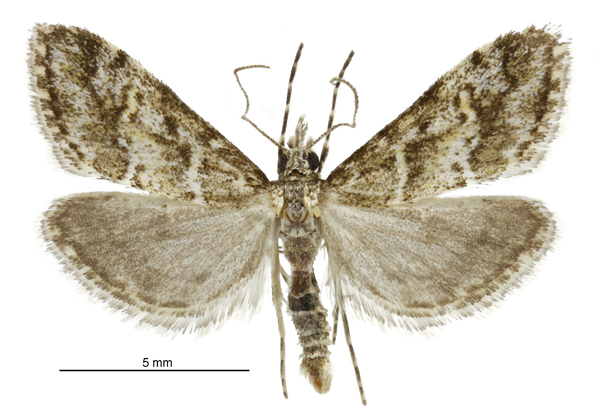
Argyria strophaea
Culladia strophaea is a species of moth in the family Crambidae. It is endemic to New Zealand. The taxonomy of this species is currently uncertain.
From the article Culladia strophaea on Wikipedia (CC BY-SA), quoted section by section
Description
Meyrick described this species as follows:
♂︎♀︎. 15-18 mm. Head and thorax ochreous-whitish, partially yellowish-tinged, and sprinkled with dark grey. Palpi 4, grey, darker-sprinkled, whitish above and towards base beneath. Antennae ochreous-whitish, obscurely ringed with dark fuscous. Abdomen ochreous-whitish irrorated with dark grey. Fore-wings elongate-triangular, costa gently arched, apex obtuse, termen slightly rounded, oblique, faintly waved; pale brassy-ochreous, suffusedly mixed with white, and irrorated with dark grey; subbasal line white, edged anteriorly with dark fuscous, angulated near costa, obsolete towards dorsum; first and second lines white, more or less edged with dark fuscous, first obtusely angulated above middle, second sinuate inwards towards dorsum, preceded on costa by a small dark fuscous spot; a small roundish dark fuscous spot in disc before middle; a narrow white transverse mark in disc beyond middle; a terminal series of dark fuscous lunulate marks: cilia whitish, with a fuscous subapical Hue, basal half barred with fuscous. Hind-wings grey, darker posteriorly; cilia as in fore-wings.
Range & habitat
This species is endemic to New Zealand. This species can be found in the North Island as well as in the provinces of Nelson and Westland in the South Island. Other than the type locality of Wellington, this species has also been found at Whakarewarewa, Raurimu, Whanganui, Haruru falls in the Bay of Islands, Lake Taupō, Bluff Hill in Napier, and at Lake Rotorua.
Wikipedia: “Distribution”
What it does
Larvae of this species have been found in soil. This species is on the wing in January. Specimens of this species have been collected with mercury vapour light traps and 15watt UV light traps. Alfred Philpott studied the male genitalia of this species in 1929.
Wikipedia: “Biology and behaviour”
Listen
Looking for field recordings…
Where it lives
Recorded sightings
—
geo-referenced records in GBIF, from museums, herbaria and field observers.
Drag the globe to turn it. Dots are where records exist, not a range map; darker means more records.
In the stacks
Searching the stacks…
Every page naming Argyria strophaea in the Biodiversity Heritage Library →
This page is assembled live from iNaturalist, GBIF, Wikipedia, the Source Library and the Internet Archive. It is not yet part of the hand-edited codex. iNaturalist taxon 386058.