- Animals
- ›Arthropods
- ›Hexapods
- ›Insects
- ›Winged and Once-winged Insects
- ›Butterflies and Moths
- ›Curved-horn Moths
- ›Twirler Moths
- ›Apatetrinae
- ›Pexicopiini
- ›Anisoplaca
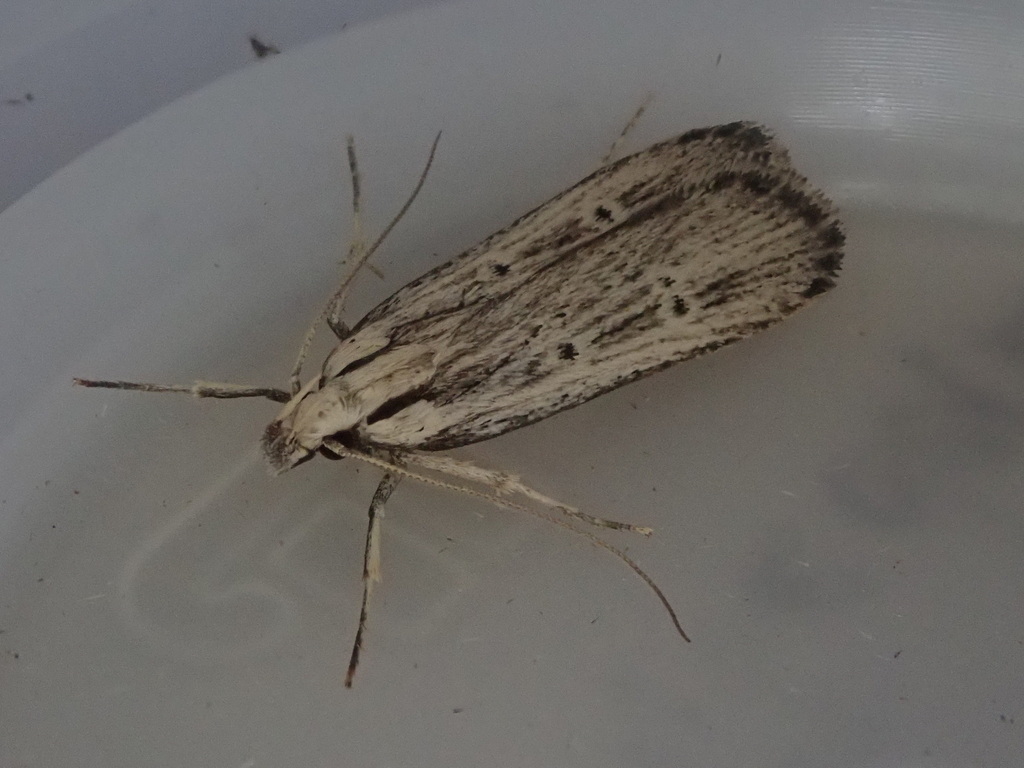
Anisoplaca ptyoptera
Anisoplaca ptyoptera is a species of moth in the family Gelechiidae. It was described by Edward Meyrick in 1885 and is endemic to New Zealand. This species is found throughout the North and South Islands and prefers habitat where its host plants are common. The larval hosts of this moth are species in the genus Carmichaelia and the larvae stem mine the host plant. However larvae have also been observed feeding on gorse species and as a result their potential as a biological control for gorse has been researched. This behaviour has only been recorded in the Canterbury and Otago regions. A. ptyoptera overwinters as larvae and while in that life stage can be parasitised by species of wasp in the genera Zealachertus and Diadegma. Pupation begins in October. Adult moths are on the wing from October until May with peak emergence occurring in January. The adult moths come in two size classes and should the size of the female be in the larger class fecundity is improved. It is likely that this species has only one brood a year.
From the article Anisoplaca ptyoptera on Wikipedia (CC BY-SA), quoted section by section
Description
Meyrick described the male adult of the species as follows:
Male. — 27 mm. Head, thorax, and abdomen very pale whitish ochreous, shoulders narrowly dark fuscous. Palpi ochreous-whitish, basal half of second joint and a spot at base of terminal joint fuscous. Antennae fuscous. Legs pale whitish-ochreous, irrorated with dark fuscous. Forewings elongate, narrow, posteriorly somewhat dilated, apex obtuse, hindmargin hardly rounded, oblique; very pale whitish-ochreous, with a few blackish scales, and irregularly irrorated with grey except towards costa and apex, and on two round patches surrounding discal spots; costa irrorated with grey towards base; a black dot beneath costa at 1⁄4; three small black discal dots, first at 1⁄3, the other two transversely placed close together beyond middle : cilia ochreous-whitish, with a grey line, basal third suffusedly barred with grey. Hindwings light grey; cilia whitish, with a grey basal fine.The mature larvae of this species is between 15.5 and 26 mm in length. The body is coloured a creamy yellow and the head is a uniform dark colour. The prothorax is wider and deeper than other thorax segments. Adults of this species appear to come in two size classes and the size of the female impacts fecundity with the larger females producing more eggs that the smaller sized moths.
Range & habitat
This species is endemic to New Zealand and in older literature is stated as being observed in the Canterbury Region, around Aoraki / Mount Cook and at Waiho Gorge. A more recent source states that the species can be found throughout the North and South Islands but that this species' larval association with gorse is restricted to the Canterbury and Otago regions.
Wikipedia: “Distribution”
What it does
Adults of A. ptyoptera are commonly on the wing from October until May with one period of emergence peaking in January. Larvae occur at all times during the year with pupation beginning in October. It is likely that this moth has only one brood a year.
Wikipedia: “Behaviour”
Listen
Looking for field recordings…
Where it lives
Recorded sightings
—
geo-referenced records in GBIF, from museums, herbaria and field observers.
Drag the globe to turn it. Dots are where records exist, not a range map; darker means more records.
In the stacks
Searching the stacks…
Every page naming Anisoplaca ptyoptera in the Biodiversity Heritage Library →
This page is assembled live from iNaturalist, GBIF, Wikipedia, the Source Library and the Internet Archive. It is not yet part of the hand-edited codex. iNaturalist taxon 385685.