- Animals
- ›Chordates
- ›Vertebrates
- ›Reptiles
- ›Snakes and Lizards
- ›Lizards
- ›Skinks and allies
- ›Skinks
- ›Eugongyline skinks
- ›Lampropholis
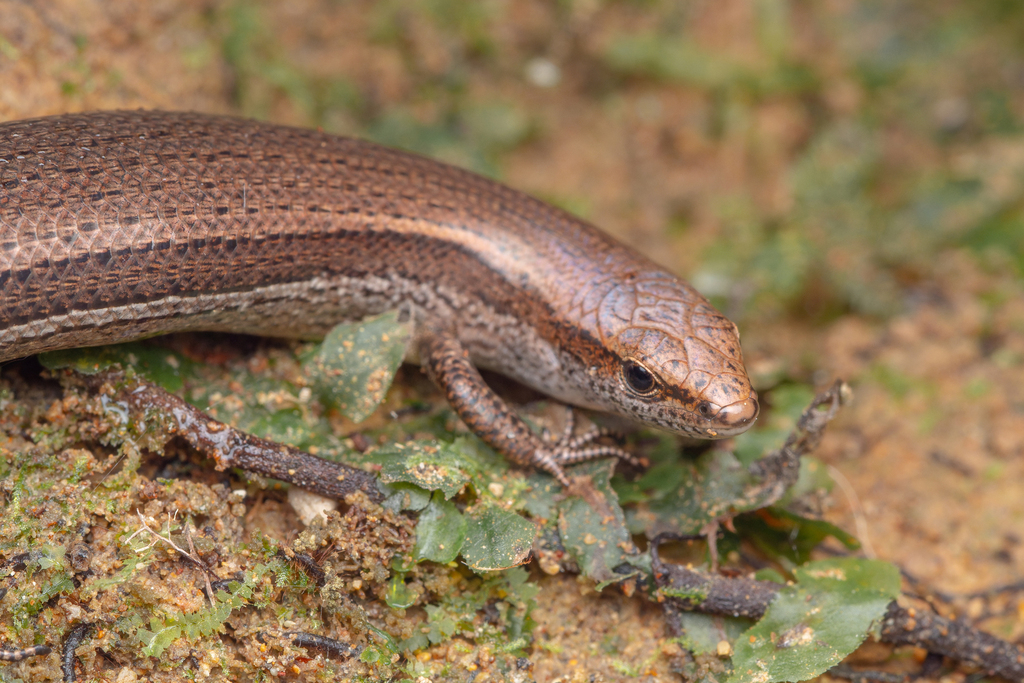
Dark-flecked Garden Sunskink
Lampropholis delicata
Lampropholis delicata, the delicate skink, dark-flecked garden sun skink, garden skink, delicate garden skink, rainbow skink or plague skink, or the metallic skink is native to Australia and invasive in New Zealand and Hawaii where it is commonly found in gardens. The species is known for their color dimorphism between males and females; striped morphs and non-striped morphs exist in this species, however the stripe is less pronounced in males. This species' diet consists of a wide range of prey, such as spiders, bees, larvae, and termites. Mating occurs in the late summer and generally one clutch of 2 to 4 eggs are laid per year by each female.
From the article Lampropholis delicata on Wikipedia (CC BY-SA), quoted section by section
Description
The delicate skink is more common in suburban gardens than in adjacent native bushland. It has a moderate body with a medium length, slender tail. Its scales are smooth. The back and sides are greyish-brown to rich brown, often with darker and paler flecks. A narrow yellowish-brown stripe is usually present on the outer edge of the back. The species can also have two distinct forms: a prominent white stripe and a less prominent white stripe. This dimorphism is not strictly distinguished by gender. Lampropholis delicata were accidentally introduced into Lord Howe Island, a remote oceanic island between Australia and New Zealand, in the 1980s and subsequently introduced into the Hawaiian islands. Upon introduction, these lizards have rapidly spread themselves across the islands. On Lord Howe Island specifically, they reside in low-elevation vegetation communities. They are a diurnal species whose activity varies seasonally, in which activity peaks during the months of November and December. Sexual dimorphism is present in L. delicata, in which males have broader, longer heads and females have larger abdomen and body sizes. Female reproduction takes place in the spring season and more commonly in the late summer, ranging between the months of September and February. …
Wikipedia: “Description and identification”
Range & habitat
Lampropholis delicata is a skink of the subfamily Lygosominae, originally from Eastern Australia. Accidentally introduced and invasive in New Zealand, Hawaii, and Lord Howe Island.
Phylogeographic divergence in eastern Australia. As a result of topographic and dry habitat barriers, Lampropholis delicata have evolved to demonstrate a complex mosaic of non-overlapping, geographically oriented clades and subclades. Since the accidental introduction of L. delicata into eastern Australian habitats, many biogeographic barriers and climatic oscillations have contributed to the evolutionary history of these lizards. They reside over a vast array of moist habitats, including woodland and heaths, sclerophyll forests, and rainforests, while also making appearances in suburban gardens near the eastern coast. L. delicata can be classified into nine main clades, which diverged during the late Miocene through Pliocene epochs. This divergence correlates to a period of a drying climate in the rainforest habitats, which restricted the rainforests to a series of disjunct remnants. L. delicata, which resides on the fringes of the rainforest, thus probably also encountered similar fragmentation and reduction. …
Wikipedia: “Habitat and distribution”
What it does
Lampropholis delicata can be classified as diurnal, terrestrial, arthropod feeders, and they consume a wide range of prey. An in depth analysis of L. delicata gut samples—taken from their foregut, hindgut, and stomach—reveals the wide variety of prey taxa and size classes incorporated into their diets. These gut samples are taken from L. delicata that reside in the Mumbulla State Forest, a region with a vast history of fires and logging. As a result of intense fires, several canopies and ground vegetation have ceased to sustain the lizard population, resulting in a primarily carnivorous diet. L. delicata primarily consumes spiders, insects, snails, and crustaceans. Gut analysis after a major fire in 1980 reveals that these lizards ate limited amounts of invertebrates, and they had a preference for bees, wasps, and springtails over beetles, termites, and ants relative to their related species L. guichenoti, which also reside in the Mumbulla State Forest. L. delicata are characterized as general feeders, and their prey can be described as aerial and arboreal (i.e. bugs, beetles), slow-moving (i.e. larvae), concentrated (i.e. termites, ants), concealed (i.e. crickets, cockroaches), and active (i.e. spiders). These lizards demonstrate foraging behavior and employ "active foraging" and "sit-and-wait" strategies to capture their prey. …
Wikipedia: “Diet and foraging behavior”
Where it lives
Recorded sightings
—
geo-referenced records in GBIF, from museums, herbaria and field observers.
Drag the globe to turn it. Dots are where records exist, not a range map; darker means more records.
In the stacks
Searching the stacks…
Every page naming Lampropholis delicata in the Biodiversity Heritage Library →
This page is assembled live from iNaturalist, GBIF, Wikipedia, the Source Library and the Internet Archive. It is not yet part of the hand-edited codex. iNaturalist taxon 38293.