On eBird ↗
Macaroni Penguin
Live sightings near you, the range map, bar charts of when it is seen, and Macaulay Library photos and recordings.
Macaroni Penguin
Eudyptes chrysolophus
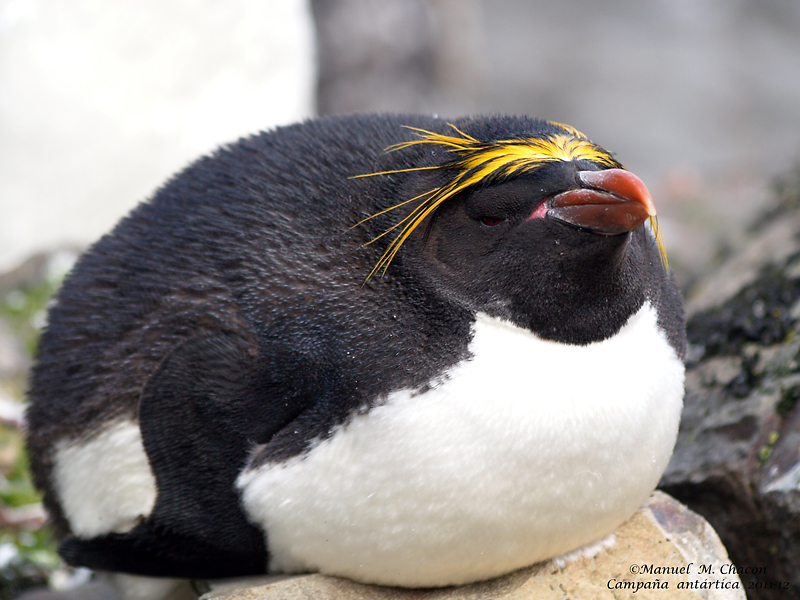
The macaroni penguin (Eudyptes chrysolophus) is a species of penguin found from the Subantarctic to the Antarctic Peninsula. One of eight species of crested penguin, it is very closely related to the royal penguin, and some authorities consider the two to be a single species. It bears a distinctive yellow crest on its forehead. Its face and upperparts are black and sharply delineated from the white underparts. Adults weigh on average 5.5 kg (12 lb) and are 70 cm (28 in) in length. The male and female are similar in appearance; the male is slightly larger and stronger with a larger bill. Like all penguins, it is flightless, with a streamlined body and wings stiffened and flattened into flippers for a marine life.
Its diet consists of a variety of crustaceans, mainly krill, as well as small fish and cephalopods; the species consumes more marine life annually than any other species of seabird. These birds moult once a year, spending about three to four weeks ashore, before returning to the sea. Numbering up to 100,000 individuals, the breeding colonies of the macaroni penguin are among the largest and densest of all penguin species. After spending the summer breeding, penguins disperse into the oceans for six months; a 2009 study found that macaroni penguins from Kerguelen travelled over 10,000 km (6,200 mi) in the central Indian Ocean.
From the article Macaroni penguin on Wikipedia (CC BY-SA), quoted section by section
Description
The macaroni penguin is a large, crested penguin, similar in appearance to other members of the genus Eudyptes. An adult bird has an average length of around 70 cm (28 in); the weight varies markedly depending on time of year and sex. Males average from 3.3 kg (7 lb) after incubating, or 3.7 kg (8 lb) after moult to 6.4 kg (14 lb) before moult, while females average 3.2 kg (7 lb) after to 5.7 kg (13 lb) before moult. Among standard measurements, the thick bill (from the gape) measures 7 to 8 cm (2.8 to 3.1 in), the culmen being around a centimetre less. The wing, from the shoulder to the tip, is around 20.4 cm (8.0 in) and the tail is 9–10 cm (3.5–3.9 in) long. The head, chin, throat, and upper parts are black and sharply demarcated against the white under parts. The black plumage has a bluish sheen when new and brownish when old. The most striking feature is the yellow crest that arises from a patch on the centre of the forehead, and extends horizontally backwards to the nape. The flippers are blue-black on the upper surface with a white trailing edge, and mainly white underneath with a black tip and leading edge. The large, bulbous bill is orange-brown. The iris is red and a patch of pinkish bare skin is found from the base of the bill to the eye. The legs and feet are pink. The male and female are similar in appearance; males tend to be slightly larger. …
Range & habitat
A 1993 review estimated that the macaroni was the most abundant species of penguin, with a minimum of 11,841,600 pairs worldwide. Macaroni penguins range from the Subantarctic to the Antarctic Peninsula; at least 216 breeding colonies at 50 sites have been recorded. In South America, macaroni penguins are found in southern Chile, the Falkland Islands, South Georgia and the South Sandwich Islands, and South Orkney Islands. They also occupy much of Antarctica and the Antarctic Peninsula, including the northern South Shetland Islands, Bouvet Island, the Prince Edward and Marion islands, the Crozet Islands, the Kerguelen Islands, and the Heard and McDonald Islands. While foraging for food, groups will range north to the islands off Australia, New Zealand, southern Brazil, Tristan da Cunha, and South Africa.
Wikipedia: “Distribution and habitat”
What it does
The diet of the macaroni penguin consists of a variety of crustaceans, squid and fish; the proportions that each makes up vary with locality and season. Krill, particularly Antarctic krill (Euphausia superba), account for over 90% of food during breeding season. Cephalopods and small fish such as the marbled rockcod (Notothenia rossii), painted notie (Lepidonotothen larseni), Champsocephalus gunneri, the lanternfish species Krefftichthys anderssoni, Protomyctophum tenisoni and P. normani become more important during chick-rearing. Like several other penguin species, the macaroni penguin sometimes deliberately swallows small (10– to 30-mm-diameter) stones; this behaviour has been speculated to aid in providing ballast for deep-sea diving, or to help grind food, especially the exoskeletons of crustaceans which are a significant part of its diet. Foraging for food is generally conducted on a daily basis, from dawn to dusk when they have chicks to feed. Overnight trips are sometimes made, especially as the chicks grow older; a 2008 study that used surgically implanted data loggers to track the movement of the birds showed the foraging trips become longer once the chick-rearing period is over. Birds venture out for 10–20 days during incubation and before the moult. …
Wikipedia: “Diet”
In human culture
Like most other penguin species, the macaroni penguin is a social animal in its nesting and its foraging behaviour; its breeding colonies are among the largest and most densely populated. Scientist Charles Andre Bost found that macaroni penguins nesting at Kerguelen dispersed eastwards over an area exceeding 3 million km2. Fitted with geolocation sensors, the 12 penguins studied travelled over 10,000 km (6,200 mi) during the six- to seven-month study period and spent their time largely within a zone 47–49°S and 70–110°E in the central Indian Ocean, not coming ashore. This area, known as the Polar Frontal Zone, was notable for the absence of krill.
Living in colonies results in a high level of social interaction between birds, which has led to a large repertoire of visual, as well as vocal, displays. These behaviours peak early in the breeding period, and colonies particularly quieten when the male macaroni penguins are at sea. Agonistic displays are those which are intended to confront or drive off or, alternatively, appease and avoid conflict with other individuals. Macaroni penguins, particularly those on adjacent nests, may engage in 'bill-jousting'; birds lock bills and wrestle, each trying to unseat the other, as well as batter with flippers and peck or strike its opponent's nape. …
Wikipedia: “Life history”
Listen
Looking for field recordings…
Where it lives
Recorded sightings
—
geo-referenced records in GBIF, from museums, herbaria and field observers.
Drag the globe to turn it. Dots are where records exist, not a range map; darker means more records.
In the stacks
Searching the stacks…
Every page naming Eudyptes chrysolophus in the Biodiversity Heritage Library →
This page is assembled live from iNaturalist, GBIF, Wikipedia, the Source Library and the Internet Archive. It is not yet part of the hand-edited codex. iNaturalist taxon 3825.