On eBird ↗
Royal Penguin
Live sightings near you, the range map, bar charts of when it is seen, and Macaulay Library photos and recordings.
Royal Penguin
Eudyptes schlegeli
The royal penguin (Eudyptes schlegeli) is a species of penguin, which can be found on the sub-Antarctic Macquarie Island and adjacent islands. The International Union for Conservation of Nature (IUCN) classifies the royal penguin as near threatened. The scientific name commemorates the German zoologist Hermann Schlegel.
From the article Royal penguin on Wikipedia (CC BY-SA), quoted section by section
Description
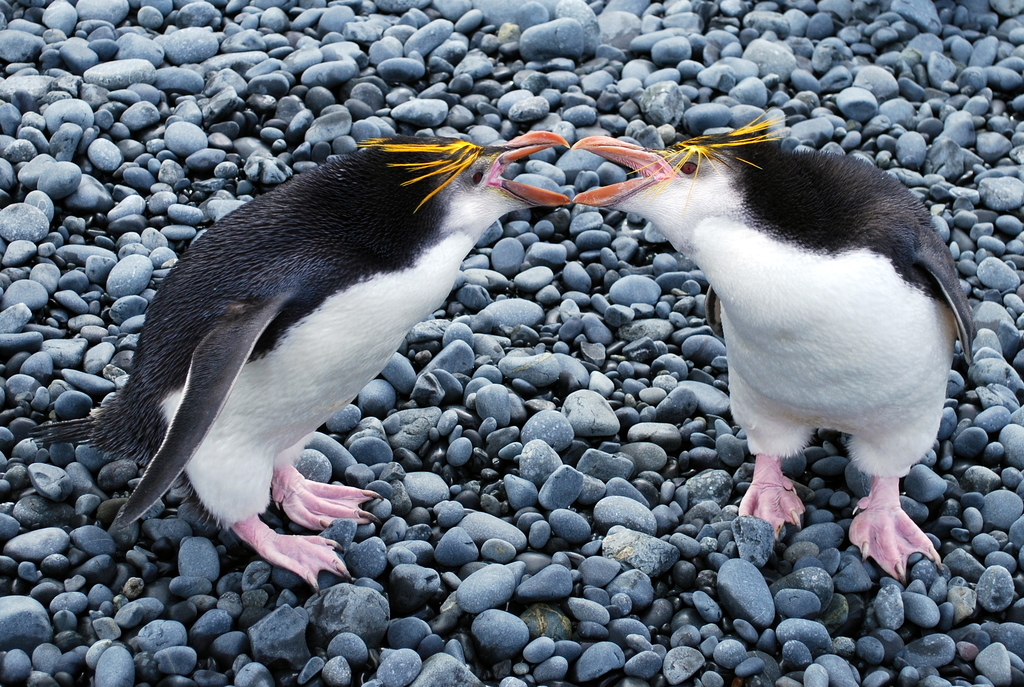
The royal penguin closely resembles the macaroni penguin (Eudyptes chrysolophus), from which it differs primarily in having a white or pale grey face and chin rather than black. Adults possess a black head, back, and flippers contrasted with white underparts, and bear long yellow-orange crest feathers extending from the forehead over the eyes. The bill is orange-brown with a dark tip, and the eyes are red-brown. Adults typically weigh between 11 and 17 lb, though body mass varies considerably throughout the breeding season. Males are generally slightly larger and heavier than females. Juveniles resemble adults but have duller plumage, shorter crests, and darker facial coloration. Chicks are covered in brown down during early development before molting into juvenile plumage prior to fledging.
Range & habitat
The royal penguin is endemic to the subantarctic Macquarie Island and the nearby Bishop and Clerk Islets in the Southern Ocean. Breeding colonies occur on beaches, coastal terraces, and vegetated slopes, sometimes extending inland and reaching elevations of over 490 ft above sea level. Colonies are often situated near access routes to the sea such as creeks or natural pathways through dense vegetation. Outside the breeding and moulting seasons, royal penguins are pelagic and spend most of their lives at sea in subantarctic waters surrounding Antarctica. Their non-breeding distribution remains incompletely known, though individuals are believed to disperse widely throughout the Southern Ocean.
Wikipedia: “Distribution and habitat”
What it does
The diet of the royal penguin consists primarily of crustaceans, especially krill such as Euphausia vallentini, E. similis, and Thysanoessa gregaria, as well as amphipods. Fish are also important prey items and include lanternfishes such as Krefftichthys anderssoni, Gymnoscopelus sp., Protomyctophum sp., and Electrona carlsbergi, in addition to barracudinas and notothens. Cephalopods, including Onykia sp., are also consumed. Diet composition varies seasonally. The krill Euphausia vallentini predominates during incubation and moulting periods, while the diet becomes more diverse during chick-rearing, with increased proportions of fish and cephalopods. Adults forage pelagically in offshore waters, likely capturing prey primarily through pursuit-diving. During the breeding season, royal penguins from neighboring colonies appear to forage within localized and partially segregated feeding areas, a behavior thought to reduce intercolony competition for prey resources.
Wikipedia: “Diet and feeding”
Listen
Looking for field recordings…
Where it lives
Recorded sightings
—
geo-referenced records in GBIF, from museums, herbaria and field observers.
Drag the globe to turn it. Dots are where records exist, not a range map; darker means more records.
In the stacks
Searching the stacks…
Every page naming Eudyptes schlegeli in the Biodiversity Heritage Library →
This page is assembled live from iNaturalist, GBIF, Wikipedia, the Source Library and the Internet Archive. It is not yet part of the hand-edited codex. iNaturalist taxon 3824.