- Animals
- ›Chordates
- ›Vertebrates
- ›Reptiles
- ›Snakes and Lizards
- ›Lizards
- ›Skinks and allies
- ›Skinks
- ›Sphenomorphine Skinks
- ›Lerista
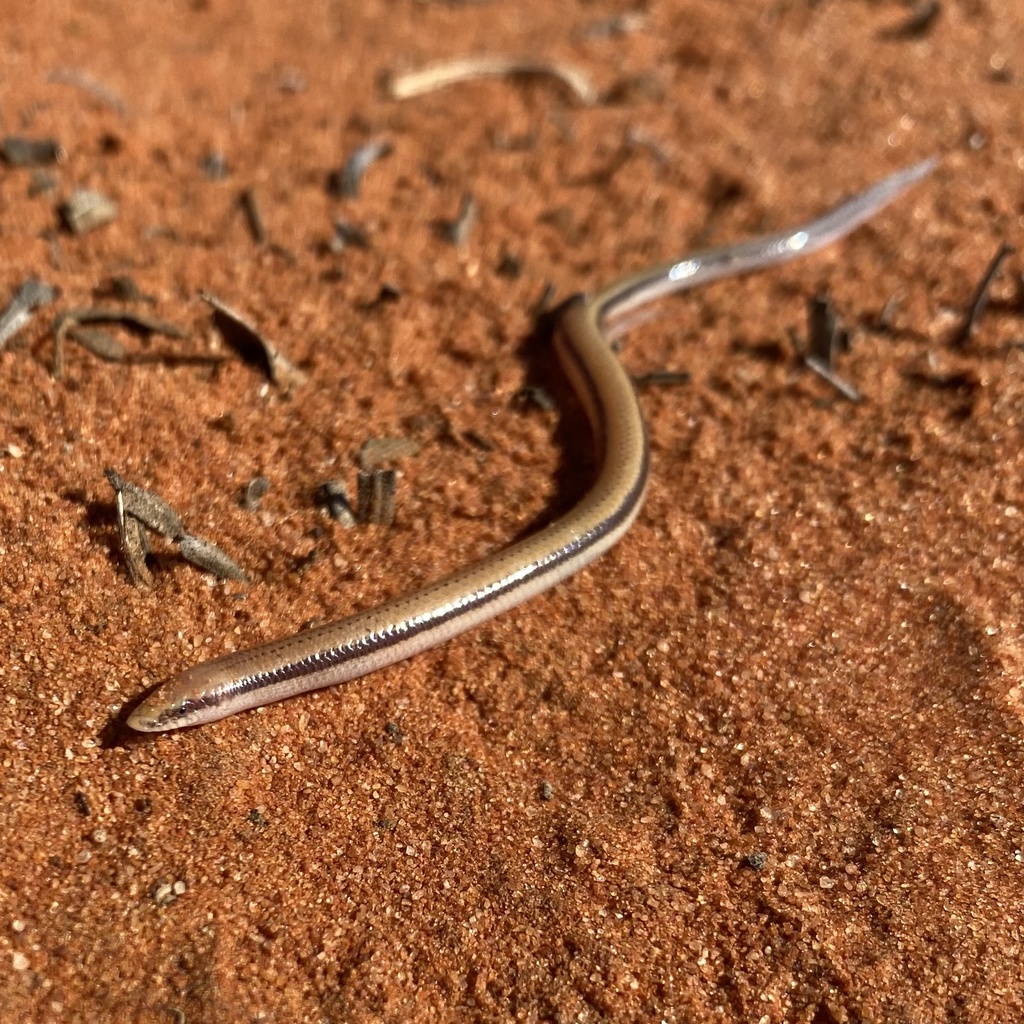
Southern Sandslider
Lerista labialis
The southern sandslider (Lerista labialis) is a species of skink or Scincidae. The species is endemic to Australia and widespread across the continent, being most commonly found within sandy termite mounds. This is where they take safe refuge from the harsh Australian climate and various ground predators.
From the article Lerista labialis on Wikipedia (CC BY-SA), quoted section by section
Description
The southern sandslider is a small skink, with a snake-like body and tail. It is red to brown in colour with a darker brown line on the side, being very similar to Lerista bipes. The skink has no fore limbs and the hind limbs are small. The southern sandslider has one supraocular (scales lying above the eyes) between the eyes and no supraciliaries (small scales along the outer margin of the upper eyelid). An adult female southern sandslider is generally much longer than an adult male. The females can reach approximately 38 to 60 mm (snout-to-vent) in length. The males only reach between 37 and 55 mm (snout-to-vent) in length.
Range & habitat
Southern sandsliders are found throughout the desert plains of Western Australia, the Northern Territory, Western Queensland and New South Wales. Southern sandsliders are most commonly found within the dune crests. This is mainly due to the suitability of this habitat in that it provides them with optimum temperatures, an adequate supply of food and the vegetation sparseness results in soft sandy areas that can aid in the reduction of energy costs (being able to move easily).
Wikipedia: “Distribution”
What it does
Southern sandsliders are fossorial, nocturnal (night-active), and terrestrial. They have a very narrow preferred body temperature range, ranging between 21–36 °C. They are found within dunes not only for the availability of food but for its thermoregulation. The southern sandslider swims through the loose sand of termite mounds. They are abundant in sandy deserts with vegetation cover that is sparse on dune crests. This benefits the species allowing for unrestrained burrowing. Dunes provide an optimum temperature for the survival of the skinks as well as providing their food source.
Wikipedia: “Ecology and habitat”
Where it lives
Recorded sightings
—
geo-referenced records in GBIF, from museums, herbaria and field observers.
Drag the globe to turn it. Dots are where records exist, not a range map; darker means more records.
In the stacks
Searching the stacks…
Every page naming Lerista labialis in the Biodiversity Heritage Library →
This page is assembled live from iNaturalist, GBIF, Wikipedia, the Source Library and the Internet Archive. It is not yet part of the hand-edited codex. iNaturalist taxon 38202.