- Animals
- ›Chordates
- ›Vertebrates
- ›Reptiles
- ›Snakes and Lizards
- ›Lizards
- ›Skinks and allies
- ›Skinks
- ›Sphenomorphine Skinks
- ›Lerista
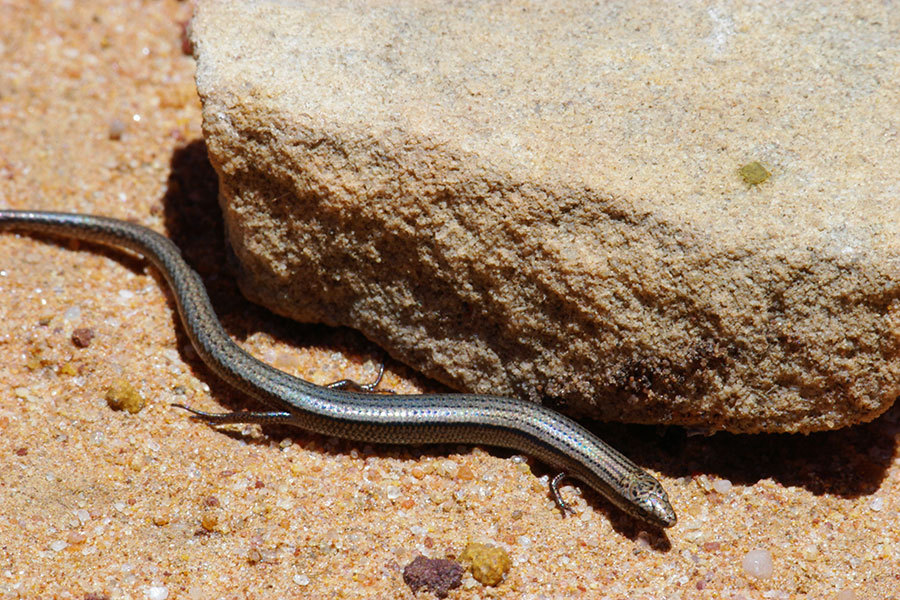
Wood Mulch Slider
Lerista muelleri
The wood mulch-slider (Lerista muelleri), also known commonly as Mueller's three-toed lerista and Mueller's three-toed slider, is a species of lizard belonging to the subfamily Sphenomorphinae of the extensive family Scincidae, a family containing over 1,500 species. The species is found in a diverse range of climates and habitats throughout Western Australia, Northern Territory, Queensland, New South Wales, South Australia and Victoria. Named after the German-born Australian naturalist Baron Ferdinand Jacob Heinrich Müller (1825–1896), the species has been the subject of much morphological and nomenclatural debate.
From the article Wood mulch-slider on Wikipedia (CC BY-SA), quoted section by section
Description
Lerista muelleri is a small terrestrial lizard typically reaching a maximum snout-to-vent length (SVL) of 50 mm (2.0 in), and reaching an adult total length (tail included) of up to 103 mm (4.1 in). A key distinguishing feature of the species is the presence of three digits on each of the forelimbs and hindlimbs. Scales are small, shiny, smooth-textured and illustrate a tight pattern of composition. The head is elongated, displaying a brown to black flecked pattern with recessed ears, and a pointed snout providing evidence of adaptive fossorial behaviour. Colouration is reflective of habitat, with the body commonly exhibiting brown, grey and bronze tones. In the western parts of the continent, lateral striping is often indeterminate. However, individuals in the east often present with clearly defined black longitudinal striping. The underside often demonstrates lighter colouration, incorporating a blotched pattern of brown spots. Juveniles are often identified by the presence of a reddish colour at the tail.
Range & habitat
Lerista muelleri is distributed throughout the Australian mainland ranging from the Northern Territory, Western Australia, Queensland, South Australia, NSW and Victoria. There are no records of the species being found in the state of Tasmania. Individuals are likely to be found in a variety of climatic and terrestrial conditions ranging from hot dry sandy deserts, to more temperate vegetated climates associated with the higher latitudes of the southern states of the continent.
Wikipedia: “Distribution”
What it does
Lerista muelleri is a fossorial diurnal species that occupy their time foraging for food during daylight hours. Similar to many other reptiles, they are ectothermic relying upon environmental conditions for body temperature regulation. Typically, individuals will begin the day in search of the sun to raise body temperatures to gain energy for foraging, and to aid with digestion. Like most ectotherms, when energy levels are adequate, individuals will often seek shelter beneath sand, or in the form of loose soil, fallen logs, and the cover of ground litter and debris. Habitats are varied and are ultimately reflective of direct environmental conditions. In hot arid regions of the continent, individuals may be found burrowed into sand, or under the cover of rocky outcrops. In more temperate regions of the continent, species are likely to be found in a variety of habitats from floodplains, grassy box woodlands, black box woodlands, and mallee woodlands.
Wikipedia: “Habitat and ecology”
Where it lives
Recorded sightings
—
geo-referenced records in GBIF, from museums, herbaria and field observers.
Drag the globe to turn it. Dots are where records exist, not a range map; darker means more records.
In the stacks
Searching the stacks…
Every page naming Lerista muelleri in the Biodiversity Heritage Library →
This page is assembled live from iNaturalist, GBIF, Wikipedia, the Source Library and the Internet Archive. It is not yet part of the hand-edited codex. iNaturalist taxon 38193.