On eBird ↗
Cape Gannet
Live sightings near you, the range map, bar charts of when it is seen, and Macaulay Library photos and recordings.
Cape Gannet
Morus capensis
The Cape gannet (Morus capensis) is a large seabird of the gannet family, Sulidae.
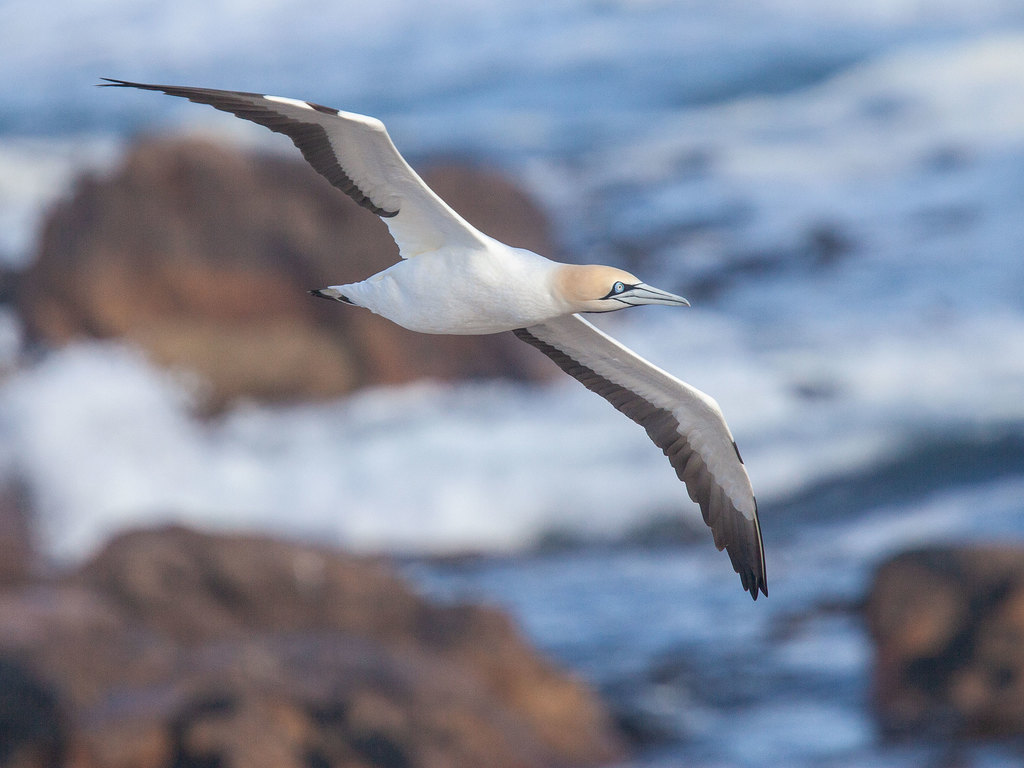
They are easily identified by their large size, black and white plumage and distinctive yellow crown and hindneck. The pale blue bill is pointed with fine serrations near the tip; perhaps because of the depth and speed of the gannet's dive when fishing (depending on altitude, gannets hit the water at speeds of between 40 and 86 km/h (25 and 53 mph)), its beak has no external nostrils into which the water might be forced. The widely mentioned maximum speed of 120 km/h has never been measured and published.
From the article Cape gannet on Wikipedia (CC BY-SA), quoted section by section
Description
When seen in flight the snow-white body with the black tail, primaries and secondaries, and dark bill makes them easy to identify. At closer range the distinctive golden crown and nape, which gradually becomes white on the neck, is noticeable. Juveniles and immatures are dark brown with a pale bill, and can resemble the dark-coloured boobies at first glance. Adults are about 84–94 cm (33–37 in) long and have a 171–185 cm (67–73 in) wingspan and weigh ca. 2.6 kg (5.7 lb). The Cape gannet is identified from the Australasian gannet by the all-black tail, a longer black stripe down the throat (from underneath the beak) and more extensive black on the face, but all of these features are difficult to identify unless at close proximity. The Cape gannet is also very similar to the northern gannet, but the latter differs from its entirely white tail and its wings, which are only black at the tip. It also is similar to the blue-footed booby (Sula nebouxii).
Range & habitat
The breeding range of the Cape gannet is restricted to southern Africa in three islands off Namibia and three islands off South Africa. They normally nest in large and dense colonies on flat islands or on flat ledges of the steeply sloping Mercury Island off Namibia. The world population was estimated in 1996 to number about 340,000 birds, with 12% in Namibia and 88% in South Africa. The largest colony of this bird, with over 140,000 birds, is found on Malgas Island, South Africa. Vagrant Cape gannets have been known to successfully breed with Australasian gannets at Australian breeding colonies. The non-breeding range of the Cape gannet extends from the coastal waters off the Gulf of Guinea on the west coast of Africa, to Mozambique on the east coast. They seldom occur farther offshore than 100 km, though records of birds more than 200 km offshore exist for both the Atlantic and Indian Oceans.
Wikipedia: “Breeding and non-breeding range”
What it does
Cape gannets are powerful fliers, using mainly a flap-gliding technique, which is more energy consuming than the dynamic-soaring favoured by albatrosses. As all Sulids, they are fish-eating birds that plunge-dive from considerable height.
Wikipedia: “Feeding”
Listen
Looking for field recordings…
Where it lives
Recorded sightings
—
geo-referenced records in GBIF, from museums, herbaria and field observers.
Drag the globe to turn it. Dots are where records exist, not a range map; darker means more records.
In the stacks
Searching the stacks…
Every page naming Morus capensis in the Biodiversity Heritage Library →
This page is assembled live from iNaturalist, GBIF, Wikipedia, the Source Library and the Internet Archive. It is not yet part of the hand-edited codex. iNaturalist taxon 3803.