- Animals
- ›Chordates
- ›Vertebrates
- ›Reptiles
- ›Snakes and Lizards
- ›Lizards
- ›Skinks and allies
- ›Skinks
- ›Eugongyline skinks
- ›Oligosoma
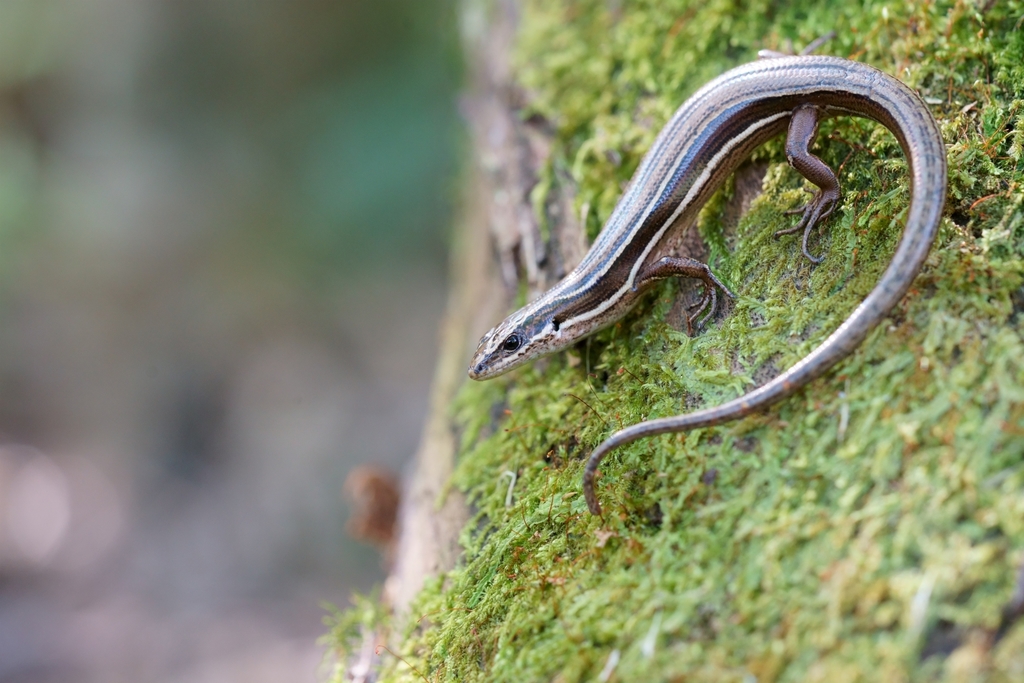
Moko Skink
Oligosoma moco
The moko skink (Oligosoma moco) is a species of lizard in the family Scincidae (skinks) that is endemic to New Zealand.
From the article Moko skink on Wikipedia (CC BY-SA), quoted section by section
Description
The colour and patterns are variable, but the overall colour is coppery or olive brown and it usually has an even edged dark brown stripe along the side, bordered cream or white on the top and bottom. Some individuals are very dark. It has distinctive long toes and tail, and grows to a maximum snout–vent length of 81 mm (3.2 in). The very long tail can make up over half the total body length. The species can be distinguished from the undescribed Whirinaki skink (also a member of Oligosoma) due to the Whirinaki skinks having a distinct teardrop marking below their eyes.
Range & habitat
It is endemic to New Zealand and is found throughout the northeastern part of the North Island, between North Cape and the Bay of Plenty, as well as numerous islands off the east coast of the North Island, where it is most commonly found. To help protect the species, skinks were released into the Rotoroa Island sanctuary in 2015.
Wikipedia: “Distribution”
What it does
Moko skinks are generally found in coastal environments. They are active mainly by day and are often seen basking on warm rocks. They are also found under logs and stones and in clay banks. They eat small insects, spiders and similar invertebrates. They often emerge from vegetation edges to hunt on beaches and open rocky areas.
Wikipedia: “Ecology”
Where it lives
Recorded sightings
—
geo-referenced records in GBIF, from museums, herbaria and field observers.
Drag the globe to turn it. Dots are where records exist, not a range map; darker means more records.
In the stacks
Searching the stacks…
Every page naming Oligosoma moco in the Biodiversity Heritage Library →
This page is assembled live from iNaturalist, GBIF, Wikipedia, the Source Library and the Internet Archive. It is not yet part of the hand-edited codex. iNaturalist taxon 37865.