- Animals
- ›Chordates
- ›Vertebrates
- ›Reptiles
- ›Snakes and Lizards
- ›Lizards
- ›Skinks and allies
- ›Skinks
- ›Eugongyline skinks
- ›Oligosoma
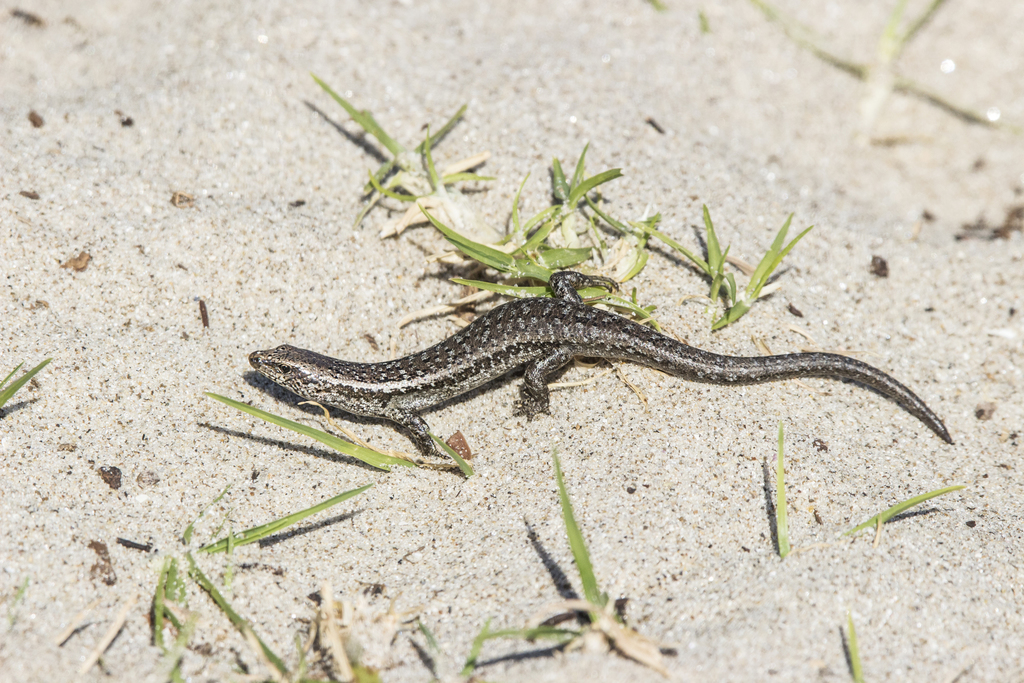
Shore Skink
Oligosoma smithi
The shore skink (Oligosoma smithi ), also commonly known as the short-tailed skink, Smith's ground skink, Smith's moco, and Smith's skink, is a species of skink native to the north half of the North Island of New Zealand.
From the article Oligosoma smithi on Wikipedia (CC BY-SA), quoted section by section
Description
Oligosoma smithi is small species of skink, growing to a snout-to-vent length (SVL) of 82 mm (3.2 in). It is well camouflaged, and may be found in a range of colours, with considerable variance seen between different populations, and within the same population groups. Individuals who tend to live in white sandy habitats tend to be lighter in colour, while those that live on offshore islands tending to be a glossy jet black colour. The species can be distinguished from Oligosoma suteri due to O. Smithi having smaller eyes, smaller feet and shorter toes, and less visible brow.
Range & habitat
The species is native to the northern half of the North Island of New Zealand, occurring on the eastern coast from the Aupōuri Peninsula in the north south to Gisborne. Closely-related skinks on the western shore of the North Island and the Three Kings Islands were formerly considered members of this species, but are now known as tātahi skinks (Oligosoma aff. smithi "Three Kings, Te Paki, Western Northland"). It is always found near the shoreline and prefers open areas such as around driftwood at the high tide mark.
Wikipedia: “Distribution and habitat”
What it does
Oligosoma smithi is diurnal (active during the day) and spends most of its time hunting or basking in the sun. It eats insects typically found along coastlines, and is known to occasionally eat fruit and scavenge birds and fish. Like most New Zealand skinks, it is viviparous (reproduces by giving birth to live young). The species typically mates around October, with between four and six young born each year between January and February.
Wikipedia: “Behaviour”
Where it lives
Recorded sightings
—
geo-referenced records in GBIF, from museums, herbaria and field observers.
Drag the globe to turn it. Dots are where records exist, not a range map; darker means more records.
In the stacks
Searching the stacks…
Every page naming Oligosoma smithi in the Biodiversity Heritage Library →
This page is assembled live from iNaturalist, GBIF, Wikipedia, the Source Library and the Internet Archive. It is not yet part of the hand-edited codex. iNaturalist taxon 37859.