On eBird ↗
Least Seedsnipe
Live sightings near you, the range map, bar charts of when it is seen, and Macaulay Library photos and recordings.
Least Seedsnipe
Thinocorus rumicivorus
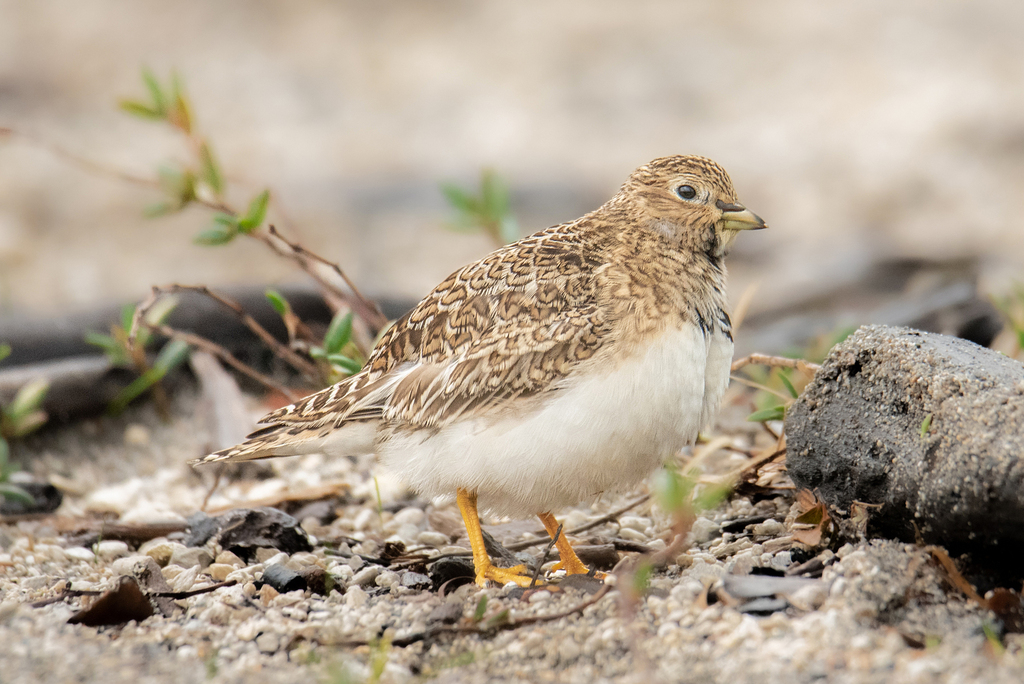
The least seedsnipe (Thinocorus rumicivorus) is a xerophilic species of bird in the Thinocoridae family.
It breeds in Argentina, Bolivia, Chile, and Peru. They are common across South America and have been recorded in Ecuador, the Falkland Islands, Uruguay, Brazil, and as far away as Antarctica. The range of the least seedsnipe is estimated to be about 1,300,000 km2.
From the article Least seedsnipe on Wikipedia (CC BY-SA), quoted section by section
Description
The least seedsnipe is the smallest member of the Thinocoridae family. They have short tails and long pointed wings. Their legs and toes are a dull greenish yellow. The beak of the least seedsnipe is an ashy color and is conical like that of a finch or a sand grouse. Adult males have a gray face, neck, and breast, and have black lines at the center of the throat that form an inverted "T" shape. The eyes are a dark gray color.
What it does
Male seedsnipe will commonly perch on a prominent bush or fence post to deliver nuptial calls that sound like a series of a "rapid pu-pu-pu-pu-pu"s, very similar to that of the Common Snipe. Seedsnipes are well-adapted to arid environments and show no increases in water loss between 20 and 36 °C. The thermoneutral zone extends from 33 to 38 °C in this species, but they have the capacity to dissipate heat through evaporative water loss up to 42 °C. Their metabolic rate is 38% lower than other non-passerine birds of similar body mass (~50 g), reducing the contribution to the total heat budget.
Nesting. Only the female incubates the eggs. The average clutch size of the least seedsnipe is four eggs laid in a simple nest scrape, which the female buries using her feet (rather than her bill, as is seen in some African Charadrii) whenever she leaves the nest. If loose, dry plant material is available, she will use this to cover the hatchlings until her return. This behavior appears to have arisen independently in Thinocoridae. The primary purpose for nest covering in Thinocorus rumicivorus is most likely concealment from predators, but thermoregulation probably also plays a factor.
Diet. As the common name suggests, least seedsnipes rely mostly on seeds, but they will also eat leaves and buds and as such are strictly vegetarian in their natural habitat. …
Wikipedia: “Behavior”
In human culture
The least seedsnipe was described in 1829 by Eschscholtz. The genus name comes from Greek thin-, thinos- (θινος) 'sand' or 'desert' and Latin 'corys' (from Greek κορυδος) 'lark'. The species name comes from Latin rumicis 'sorrel' and vorā 'eater'.
Wikipedia: “Etymology”
Listen
Looking for field recordings…
Where it lives
Recorded sightings
—
geo-referenced records in GBIF, from museums, herbaria and field observers.
Drag the globe to turn it. Dots are where records exist, not a range map; darker means more records.
In the stacks
Searching the stacks…
Every page naming Thinocorus rumicivorus in the Biodiversity Heritage Library →
This page is assembled live from iNaturalist, GBIF, Wikipedia, the Source Library and the Internet Archive. It is not yet part of the hand-edited codex. iNaturalist taxon 3779.