- Animals
- ›Chordates
- ›Vertebrates
- ›Reptiles
- ›Snakes and Lizards
- ›Lizards
- ›Skinks and allies
- ›Skinks
- ›Typical skinks
- ›Plestiodon
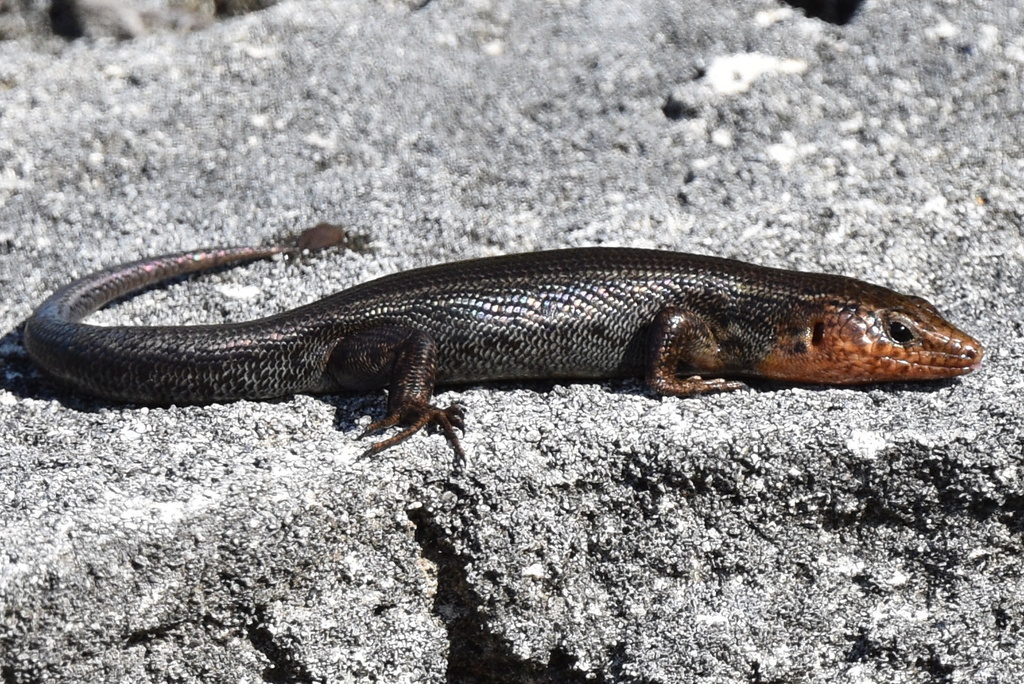
Bermuda Rock Lizard
Plestiodon longirostris
The Bermuda skink or rock lizard (Plestiodon longirostris, formerly Eumeces longirostris) is the only endemic terrestrial vertebrate of the Bermudas (ignoring marine turtles and the terrapins found in brackish ponds ). It is a relatively small skink (a kind of lizard): adults reach an average snout-to-vent length of about 8 cm (a bit more than 3 inches).
From the article Bermuda skink on Wikipedia (CC BY-SA), quoted section by section
Description
Adult Bermuda skinks (also known as "rock lizards") have dark brown or black backs and are pinkish or light gray on the underside. Juveniles are lighter in color and have black stripes running along the sides of their bodies, which fade with age. Females are thought to retain the stripes longer than males. Adult males have larger heads. Hatchlings have bright blue tails. All have salmon orange cheeks and throat. The Bermuda skink lives predominantly in rocky coastal areas. They feed on small invertebrates such as cockroaches or woodlice, but also on small terrestrial crustaceans. While being more active during summer, the Bermuda skink does not hibernate, because the frost free winters allow it to be active year-round.
Range & habitat
The species occurs only in Bermuda, and exists mainly on some of the smaller islands and nature reserves on the mainland, where the populations are fragmented into isolated pockets.
Wikipedia: “Distribution”
Where it lives
Recorded sightings
—
geo-referenced records in GBIF, from museums, herbaria and field observers.
Drag the globe to turn it. Dots are where records exist, not a range map; darker means more records.
In the stacks
Searching the stacks…
Every page naming Plestiodon longirostris in the Biodiversity Heritage Library →
This page is assembled live from iNaturalist, GBIF, Wikipedia, the Source Library and the Internet Archive. It is not yet part of the hand-edited codex. iNaturalist taxon 37783.