- Animals
- ›Chordates
- ›Vertebrates
- ›Reptiles
- ›Snakes and Lizards
- ›Lizards
- ›Skinks and allies
- ›Skinks
- ›Typical skinks
- ›Plestiodon
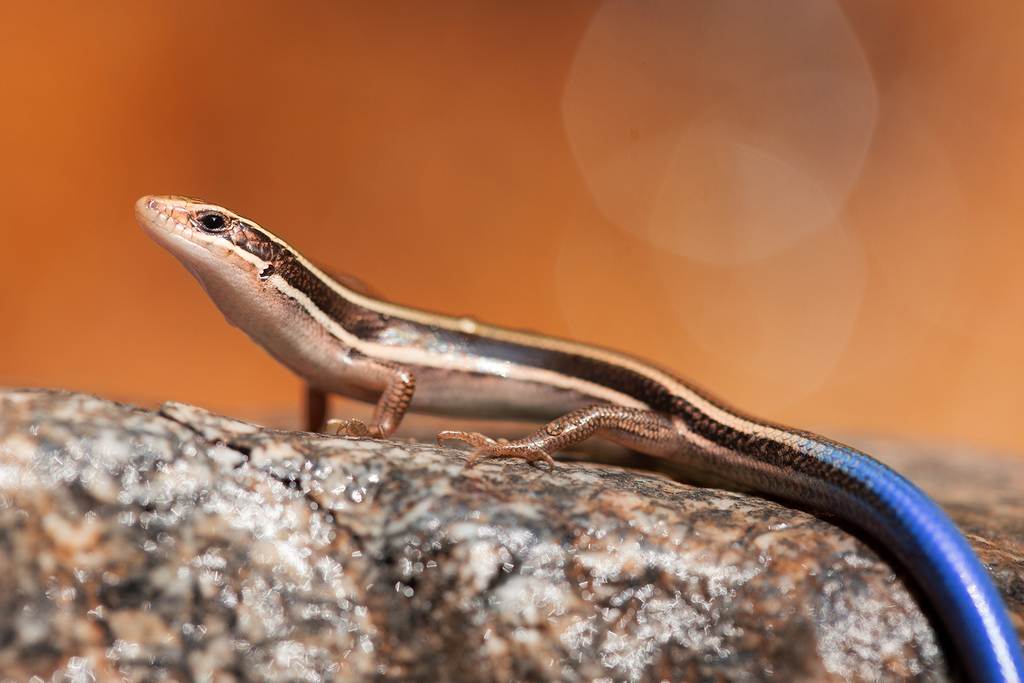
Western Skink
Plestiodon skiltonianus
The western skink (Plestiodon skiltonianus) is a species of small, smooth-scaled lizard with relatively small limbs. It measures about 100 to 210 mm (about 4 to 8.25 inches) in total length (body + tail). It is one of six species of lizards in Canada. They spend much of their day basking in the sun. Their diet ranges widely, including spiders and beetles. Western skinks will bite if grasped and will flee if they feel threatened. It is a common but secretive species whose range extends from southern British Columbia and throughout Washington, Oregon, Nevada, Utah, Idaho, and Wyoming and into western Montana and northern Arizona and Missouri. They can also live in some areas of Texas It is widespread in northern California but primarily restricted to the coast in central and southern California. Found in a variety of habitats, this lizard is most common in early successional stages or open areas of late successional stages. Heavy brush and densely forested areas are generally avoided. Western skinks are found from sea level to at least 2,130 m (7,000 ft). This diurnal reptile is active during the warm seasons.
From the article Western skink on Wikipedia (CC BY-SA), quoted section by section
Description
Adult western skinks have a broad brown stripe down their backs, edged with black and bordered on each side by a conspicuous whitish to beige dorsolateral stripe that begins on nose and extends over the eye and back alongside body onto the tail. A second pale stripe, starting on upper jaw, occurs low on each side and is separated from the first by a broad dark brown or black band originating on the side of head and usually extending well out onto the tail, though this band can be disrupted if the tail is lost and regrown. Juvenile skink's tails are bright blue, turning to grey in adulthood. In the breeding season reddish or orange color appears on the side of head and chin, and occasionally on the sides, tip, and underside of the tail. They usually have seven supralabial scales and four enlarged nuchals. Young skinks' colorations are more vivid than those of adults.
Range & habitat
Found in a variety of habitats from sea level to at least 2,130 m (7,000 ft), the western skink is commonest in early successional stages or open areas within habitats in which it occurs. Heavy brush and densely forested areas are generally avoided. The western skink seems to prefer a somewhat moist environment, although it can also be found on dry hillsides. Frequents grassland, broken chaparral, pinon-juniper and juniper-sage woodland, and open pine-oak and pine forests. The soil of its nest chambers is invariably moist. Standing water is apparently not required. Although western skinks avoid forests, they are found in dry areas within forested areas.
Wikipedia: “Habitat”
What it does
The western skink is a secretive and very agile lizard that forages actively through leaf litter and dense vegetation, preying upon small invertebrates including spiders, a variety of insects and sow bugs. Crickets, beetles, moths, grasshoppers, and other arthropods have been found in the stomachs of skinks. Prey is sometimes stalked and cannibalism has been reported. It is a good burrower and sometimes constructs burrows several times its own body length. Females take great care of their eggs. Western skink females construct nest chambers that are several centimeters deep in loose moist soil. Typically these chambers are located under surface objects, especially flat stones, logs, and sometimes in or near rock outcrops. The females remain guarding the nest until the young leave the nest. Female western skinks will defend their nests from predators, repair their nests, and even bask in the sun and then return to the nest to provide additional heat.
Wikipedia: “Behavior”
In human culture
This skink is diurnal during the period of warm-season activity. During summer most activity is concentrated in the morning and late afternoon. Where summer temperatures are not extreme, activity extends throughout the day. Adult skinks usually become inactive by early fall but juveniles extend their period of activity several weeks. The length of time they are inactive varies depending on the climate of the area. During their hibernation period, western skinks remain in communal dens. The reproductive season for this species varies geographically and from year to year depending on local conditions. Mating probably occurs in the spring soon after emergence. Males turn orange on the underside when they are breeding. Females lay 2–6 eggs during June and July. Western skinks' eggs hatch in the months of July and August; the exact time differs by geographic location. They reach sexual maturity at around 3 years, and live up to 9 years.
Wikipedia: “Life history”
Where it lives
Recorded sightings
—
geo-referenced records in GBIF, from museums, herbaria and field observers.
Drag the globe to turn it. Dots are where records exist, not a range map; darker means more records.
In the stacks
Searching the stacks…
Every page naming Plestiodon skiltonianus in the Biodiversity Heritage Library →
This page is assembled live from iNaturalist, GBIF, Wikipedia, the Source Library and the Internet Archive. It is not yet part of the hand-edited codex. iNaturalist taxon 37769.