- Animals
- ›Chordates
- ›Vertebrates
- ›Reptiles
- ›Snakes and Lizards
- ›Lizards
- ›Skinks and allies
- ›Skinks
- ›Sphenomorphine Skinks
- ›Saiphos
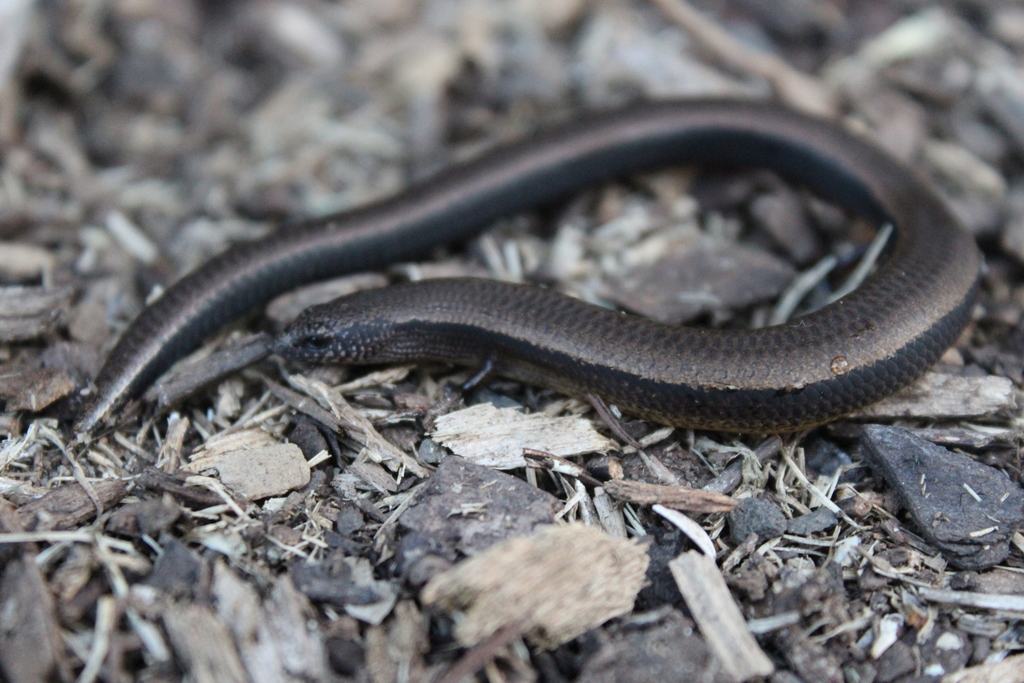
Yellow-bellied Three-toed Skink
Saiphos equalis
Saiphos equalis, commonly known as the yellow-bellied three-toed skink or simply three-toed skink, is a species of burrowing skink found in eastern Australia. It is the only species classified under the genus Saiphos.
The lizard has attracted scientific attention due to its dual reproduction habits of producing young via eggs in coastal populations, or via live young in colder mountain regions.
From the article Saiphos on Wikipedia (CC BY-SA), quoted section by section
Description
Saiphos equalis grows to a length of 18 cm (7.1 in) including the tail. It has a brown back and an orange belly. The skink is active at night, and feeds on insects. Along the coastal lowlands of Australia, the skink has been observed laying eggs and giving birth to live young for reproduction. Individuals of the species in the lowlands lay eggs (oviparous), while its neighbors to the north in the mountains are almost exclusively giving birth to live young (viviparous).
Range & habitat
Saiphos equalis are common in New South Wales and Queensland of eastern Australia.
Wikipedia: “Distribution and habitat”
What it does
Saiphos equalis includes populations of three main reproductive modes: oviparous with long (15 days) incubation periods, viviparous with no incubation period (0 days), and intermediate populations that are oviparous with short (~5 days) incubation periods. No populations of this skink exhibit normal scincid oviparity behavior with greater-than-30-day incubation periods, which could further indicate this skink is truly making the transition to exclusively viviparity. In a study, published in 2001, of coastal Saiphos equalis populations, mitochondrial nucleotide sequences (ND2 and cytochrome b) were used to organize the relationships among the various populations. According to Smith et al. the analysis suggests that the long incubation period oviparous lineage is the sister group to the other short-period oviparous and viviparous populations. These clades are consistent and correspond to variation in reproductive modes as well as geographic location according to latitude and altitude. Lizards from high elevation sites (greater than 1,000 m (3,300 ft)) in north-eastern New South Wales are viviparous, while low-elevation populations from northern and southern in New South Wales exhibit short-period oviparity, an intermediate between viviparity and typical oviparous behaviors. …
Wikipedia: “Reproduction”
Where it lives
Recorded sightings
—
geo-referenced records in GBIF, from museums, herbaria and field observers.
Drag the globe to turn it. Dots are where records exist, not a range map; darker means more records.
In the stacks
Searching the stacks…
Every page naming Saiphos equalis in the Biodiversity Heritage Library →
This page is assembled live from iNaturalist, GBIF, Wikipedia, the Source Library and the Internet Archive. It is not yet part of the hand-edited codex. iNaturalist taxon 37725.