- Animals
- ›Chordates
- ›Vertebrates
- ›Reptiles
- ›Snakes and Lizards
- ›Lizards
- ›Skinks and allies
- ›Skinks
- ›Social skinks
- ›Tiliqua
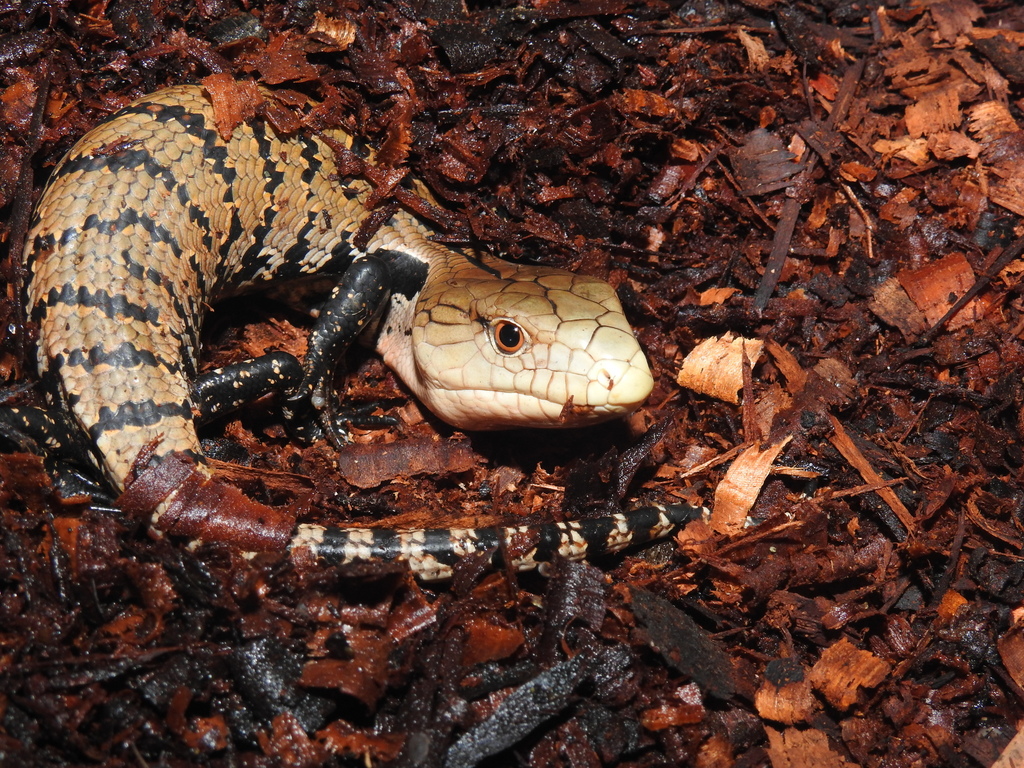
Giant Bluetongue
Tiliqua gigas
Tiliqua gigas (Indonesian blue-tongued skink) is a close relative of the Eastern blue-tongued lizard. They are endemic to the island of New Guinea and other various surrounding islands. They are found typically in the rainforest, and in captivity, require high humidity. As opposed to Tiliqua scincoides, they are fairly lean. They're also accompanied by long tails (60–90% of their SVL). There are currently three subspecies of Tiliqua gigas. First subspecies to be recognized is Tiliqua gigas...
From the article Indonesian blue-tongued skink on Wikipedia (CC BY-SA), quoted section by section
Description
Tiliqua gigas has an elongated body and very small limbs, which is typical of most skinks of the genus. They typically get up to 46-61 centimetres (18-24 inches) in length and weigh up to 1 kilogram (2.2 pounds). They are known for their thinner, elongated tails, and avoiding participation in seasonal brumation as they regulate their breeding cycle on a wet and dry season. The subspecies T. gigas gigas is the most tropical and known for having the skinniest tail. They have solid, dark, or near solid dark limbs. Tiliqua gigas evanescens are easily recognized for having slightly more colored speckling on their limbs, a single, centered stripe on the back of their neck, and not always but most often, having very thin body banding. They also have the longest tail. Tiliqua gigas keyenesis is known for is all-over body speckling, including speckling all over the face. The Australian northern blue-tongued skink (Tiliqua scincoides intermedia) is recognized as the largest of all the species and subspecies. Not enough studies have been conducted to give that title to any of the Tiliqua gigas subspecies. What is irrefutable is that T. gigas evanescens is the longest of all the blue tongues, often reaching lengths that exceed 75 centimetres (30 inches) from snout to tip of tail.
Where it lives
Recorded sightings
—
geo-referenced records in GBIF, from museums, herbaria and field observers.
Drag the globe to turn it. Dots are where records exist, not a range map; darker means more records.
In the stacks
Searching the stacks…
Every page naming Tiliqua gigas in the Biodiversity Heritage Library →
This page is assembled live from iNaturalist, GBIF, Wikipedia, the Source Library and the Internet Archive. It is not yet part of the hand-edited codex. iNaturalist taxon 37468.