- Animals
- ›Chordates
- ›Vertebrates
- ›Reptiles
- ›Snakes and Lizards
- ›Lizards
- ›Skinks and allies
- ›Skinks
- ›Social skinks
- ›Tiliqua
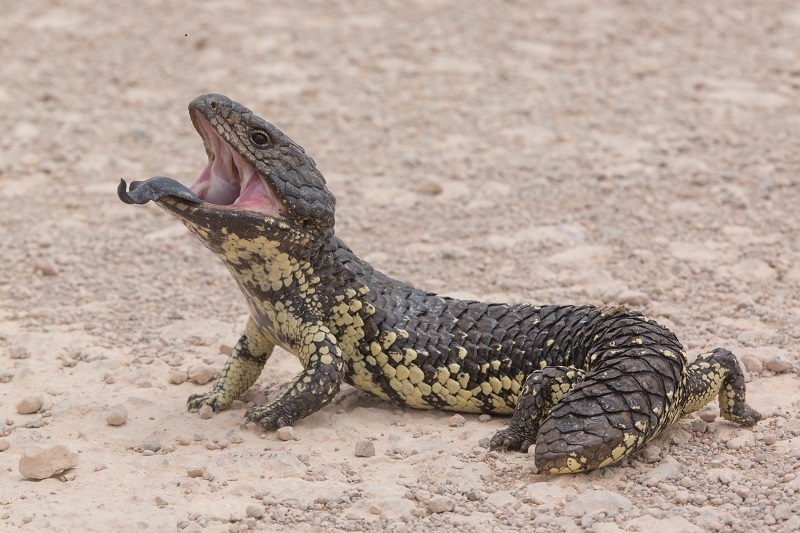
Shingleback
Tiliqua rugosa
Tiliqua rugosa, most commonly known as the shingleback skink, shingleback lizard, bobtail lizard, and the two-headed skink (often simply shingleback or bobtail); is a short-tailed, slow-moving species of blue-tongued skink (genus Tiliqua) endemic to Australia. Three of its four recognised subspecies are found in Western Australia, where the bobtail name is most frequently used. The fourth subspecies, T. rugosa asper, is the only one native to eastern Australia, where it goes by the common name of the eastern shingleback.
Apart from bobtail and shingleback, a variety of other common names are used in different states, including two-headed skink, stumpy lizard, stumpy-tailed lizard, pinecone lizard, bogeye or boggi, and less commonly: sleepy lizard. The Noongar Aboriginal people refer to T. rugosa as yoorn in their language.
From the article Tiliqua rugosa on Wikipedia (CC BY-SA), quoted section by section
Description
Tiliqua rugosa has a heavily armoured body and can be found in various colours, ranging from dark brown to cream. Its snout–vent length varies from 260 to 310 mm (10 to 12 in), and it is very heavy-bodied for its length. Their eyes are small with a reddish-brown and grey colour.
It has a triangular head and a bright blue tongue, inside a bright pink mouth. Its short, stumpy tail is similar in shape to its head. This is probably a defence mechanism to confuse predators although it also stores fat and has led to the common name of "two-headed skink". Unlike many skinks, shinglebacks do not exhibit autotomy and cannot shed their tails. The average lifespan for these skinks is 10 to 15 years, but some individuals have been known to live for as much as 50 years in the wild.
The species normally shed their skin as a whole, including the eye covering. This takes up to several hours, during which the lizard rubs against objects to help the process. The species exhibits sexual dimorphism, with males being stockier than females and having a larger head although females generally grow larger than males.
Range & habitat
The species is widely distributed in arid to semiarid regions of southern and western Australia. The range extends from Broome, Western Australia, across the southernmost regions of the country to the coast, then north into Queensland. Four subspecies are found in Western Australia, including one at Rottnest Island. It also lives in the eastern states of Victoria and New South Wales, but does not reach coastal areas in these states. The habitat of the species includes shrub lands, eucalyptus forests, desert grasslands, and sandy dunes. They often shelter in the bush under low foliage. Being cold-blooded, these skinks are well known to have a strong preference for sun basking in open areas, and are often seen along roadsides, paddock edges or other cleared areas in its range. On average, individuals have a home range of four hectares, and can move up to 500 metres per day. These lizards show strong home range site stability for up to several years and often multiple lizards can utilise the same burrow. As conditions become hotter and drier these lizards tend to share the burrows. During the spring time and given an adequate source of food that season and normal mating behaviour, males can often overlap each other's ranges. This can lead to territoriality and agonistic behaviour.
Wikipedia: “Distribution and habitat”
What it does
T. rugosa is an omnivore that eat snails, insects, carrion, vegetation and flowers. Since they are slow-moving, they tend to eat other slow moving species. This is perhaps why T. rugosa has a stronger preference for plants than other blue-tongue skink species. They can easily crush through the shells of snails with their strong jaws. As they overlap with human habitation and settlement, they have also been known to eat human food, such as sausage and chicken, as well as fruits such as strawberries, banana and passionfruit.
Wikipedia: “Diet”
In human culture
The species was first described by John Edward Gray in 1825 as Trachydosaurus rugosus. It is now classified as Tiliqua rugosa. Some herpetologists claim this species has more common names than any other lizard.
Wikipedia: “Etymology and taxonomy”
Where it lives
Recorded sightings
—
geo-referenced records in GBIF, from museums, herbaria and field observers.
Drag the globe to turn it. Dots are where records exist, not a range map; darker means more records.
In the stacks
Searching the stacks…
Every page naming Tiliqua rugosa in the Biodiversity Heritage Library →
This page is assembled live from iNaturalist, GBIF, Wikipedia, the Source Library and the Internet Archive. It is not yet part of the hand-edited codex. iNaturalist taxon 37460.