- Animals
- ›Chordates
- ›Vertebrates
- ›Reptiles
- ›Snakes and Lizards
- ›Lizards
- ›Skinks and allies
- ›Skinks
- ›Eugongyline skinks
- ›Cryptoblepharus
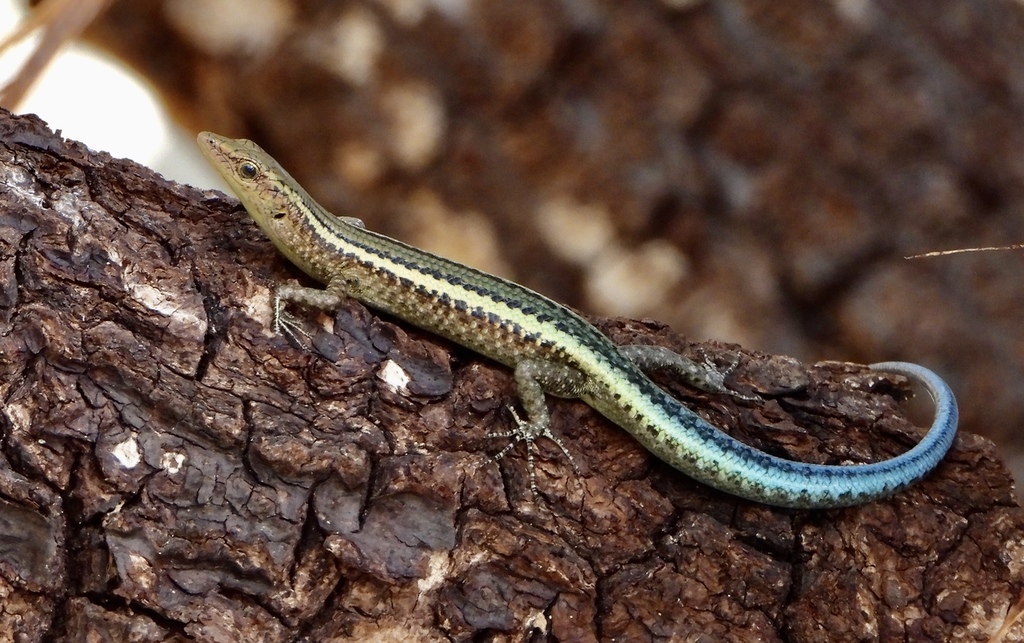
Blue-tailed Snake-eyed Skink
Cryptoblepharus egeriae
Cryptoblepharus egeriae, also known commonly as the blue-tailed shinning-skink, the Christmas Island blue-tailed shinning-skink, and the Christmas Island blue-tailed skink, is a species of lizard in the family Scincidae that was once endemic to Christmas Island. The Christmas Island blue-tailed skink was discovered in 1888. It was formerly the most abundant reptile on the island, and occurred in high numbers particularly near the human settlement. However, the Christmas Island blue-tailed skink began to decline sharply outwardly from the human settlement by the early 1990s, which coincided with the introduction of a predatory snake and also followed the introduction of the yellow crazy ant (Anoplolepis gracilipes) in the mid-1980s. By 2006, the Christmas Island blue-tailed skink was on the endangered animals list, and by 2010 the Christmas Island blue-tailed skink was extinct in the wild. From 2009 to 2010, Parks Australia and Taronga Zoo started a captive breeding program, which has prevented total extinction of the species.
From the article Cryptoblepharus egeriae on Wikipedia (CC BY-SA), quoted section by section
Description
The Christmas Island blue-tailed skink typically grows to a snout-to-vent length (SVL) of 4–5 cm (1.6–2.0 in). It can be identified by its small black body with two yellow stripes running down the skink's back and onto its vibrant blue tail. The skink can use its blue tail to draw a predator's attention away from its body by separating its tail from its body. The bright color of the skink's tail means predators are much more likely to notice the tail than the skink's black body.
Range & habitat
Until the late 1990s, the Christmas Island blue-tailed skink was endemic to Christmas Island and could be found all over the island. It currently exists in captive populations on Christmas Island, at Taronga Zoo, and on a small island (Pulu Blan) in the Cocos (Keeling) Islands where it has been released as part of an assisted colonization trial.
Wikipedia: “Distribution”
What it does
The Christmas Island blue-tailed skink is a forager known as an insectivore. Its diet primarily consists of crickets, beetles, flies, grasshoppers, spiders, and earthworms. It will occasionally eat some vegetation, though insects remain its primary source of food. Because of its small size, the Christmas Island blue-tailed skink forages for its food on the ground, over exposed rocks and low-lying vegetation, and will generally only eat prey that are slower moving.
Wikipedia: “Diet”
Where it lives
Recorded sightings
—
geo-referenced records in GBIF, from museums, herbaria and field observers.
Drag the globe to turn it. Dots are where records exist, not a range map; darker means more records.
In the stacks
Searching the stacks…
Every page naming Cryptoblepharus egeriae in the Biodiversity Heritage Library →
This page is assembled live from iNaturalist, GBIF, Wikipedia, the Source Library and the Internet Archive. It is not yet part of the hand-edited codex. iNaturalist taxon 37170.