- Animals
- ›Chordates
- ›Vertebrates
- ›Reptiles
- ›Snakes and Lizards
- ›Lizards
- ›Skinks and allies
- ›Skinks
- ›Sphenomorphine Skinks
- ›Ctenotus
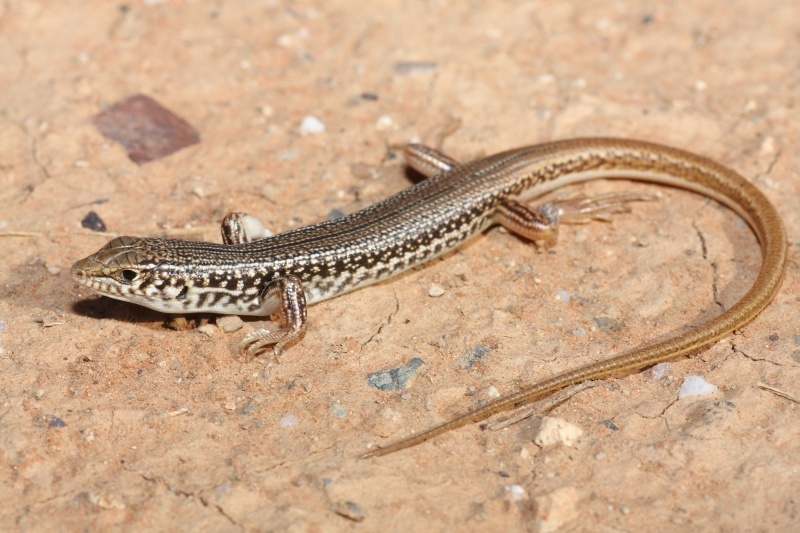
Olympic Ctenotus
Ctenotus olympicus
Ctenotus olympicus, the olympic ctenotus, spotted ctenotus or saltbush ctenotus, is a species of skink endemic to the arid shrublands of central and southern Australia.
From the article Ctenotus olympicus on Wikipedia (CC BY-SA), quoted section by section
Description
The olympic ctenotus is a small terrestrial lizard of the Scincidae family, native to arid areas of inland Australia. Olympic ctenotus individuals can display a range of colourations, from beige to medium brown, and this is often complimented by a metallic lustre. A dark vertebral stripe is almost always apparent from the nape to the hips. A pale dorsolateral stripe is usually apparent, extending continuously from the forelimbs and becoming a more broken line along the body. The upper flank of the lizard is generally of a darker hue, with 3-4 rows of white spots highly noticeable. Individuals always display a white undersurface, and limbs are reddish brown with dark streaks. There are usually 29 midbody scales, although this can range between 28 and 32. These characteristics are displayed in the first figure. Ctenotus olympicus individuals generally grow to lengths of between 60 and 72mm, and this small size benefits a tendency to shelter underneath rocks and logs, or within small burrows.
Range & habitat
The olympic ctenotus is predominantly distributed across central and northern South Australia, stretching into the Northern Territory, and adjacent areas of western New South Wales and Queensland. It has also been recorded sporadically in the eastern interior of Western Australia. This distribution encompasses notable land forms and features such as the Lake Eyre and Lake Torrens basins, northern reaches of the Flinders Ranges, and the Olary Plains of South Australia.
The habitat of C. olympicus is restricted to arid regions, although within these confines it has been known to reside in gibber deserts, chenopod shrublands, and arid scrubs. It thrives on heavy, stony soils and is commonly found around rock outcrops and other stony habitats. On plains, it will typically burrow under rocks or bushes and logs, while on gibber rises it shelters in holes and natural spaces beneath rocks. The ground cover in C. olympicus habitat is consistently dominated by chenopods, such as saltbush, and it may coexist with other Ctenotus species in many of these areas.
Wikipedia: “Distribution and habitat”
What it does
The olympic ctenotus shares a multitude of lifestyle characteristics and behaviours with C. orientalis and other small skinks endemic to arid southern central Australia.
Diet. Although limited data is available, it has been established that C. olympicus is a generalist insectivore, feeding primarily on a range of insects and spiders. There is a possibility that they may resort to vegetation consumption in extreme situations. It is this relatively unspecialised diet which ensures the persistence of individuals through periods of limited resource availability and enables them to take advantage of favourable conditions when they occur.
Reproduction. Like most lizards, C. olympicus reproduces oviparously (i.e. lays eggs), and breeds throughout the summer season. Anywhere between 2 and 7 eggs may be laid, depending on factors such as resource availability and other environmental conditions. Read proposes "low reproductive effort may be an attempt to increase survival during dry seasons when recruitment success is likely to be poor or may simply reflect insufficient resources to allow much reproductive effort. Survival of adults is typically high in Ctenotus, except in years of high reproductive effort".
Behaviour. Ctenotus activity has not been known to decrease on hot days, and coupled with summer breeding, this shows a tendency to thrive in hot weather. …
Wikipedia: “Ecology”
Where it lives
Recorded sightings
—
geo-referenced records in GBIF, from museums, herbaria and field observers.
Drag the globe to turn it. Dots are where records exist, not a range map; darker means more records.
In the stacks
Searching the stacks…
Every page naming Ctenotus olympicus in the Biodiversity Heritage Library →
This page is assembled live from iNaturalist, GBIF, Wikipedia, the Source Library and the Internet Archive. It is not yet part of the hand-edited codex. iNaturalist taxon 37078.