- Plants
- ›Vascular Plants
- ›flowering plants
- ›Dicots
- ›Soapberries, Cashews, Mahoganies, and Allies
- ›soapberry family
- ›Diploglottis
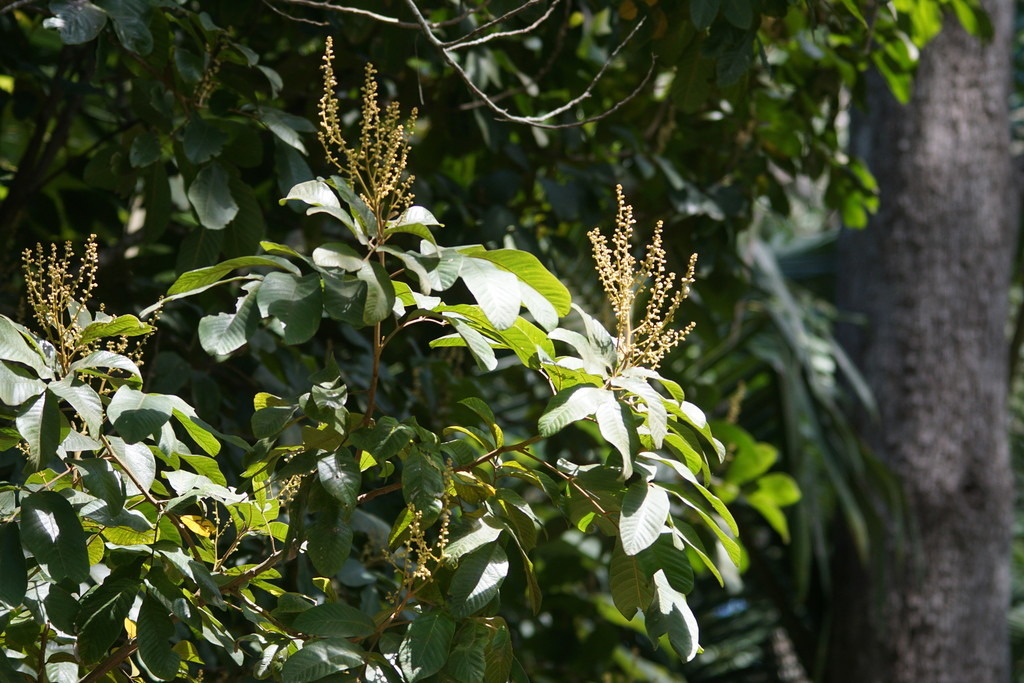
Diploglottis obovata
Diploglottis obovata, commonly known as blunt-leaved tamarind, is a plant in the family Sapindaceae endemic to central eastern Queensland, Australia. Until 1987 it was considered to be a form of the very closely related Diploglottis diphyllostegia.
From the article Diploglottis obovata on Wikipedia (CC BY-SA), quoted section by section
Description
The blunt-leaved tamarind is a small to medium-sized, spreading, evergreen tree growing up to 25 m (82 ft) high. It is very similar to Diploglottis diphyllostegia with branchlets, leaves and subdivisions covered in a dense light brown indumentum. The compound leaves have 2 or 3 pairs of leaflets either side of the midrib and no terminal leaflet, measuring overall about 20 cm (7.9 in) long. The leaflets are obovate to elliptic and measure up to 16 cm (6.3 in) long by 7 cm (2.8 in) wide. The inflorescence is a panicle up to 19 cm (7.5 in) long and 10 cm (3.9 in) wide, with both staminate (functionally male) and pistillate (functionally female) flowers in the same inflorescence. Individual flowers have 5 petals with one petal usually reduced, measure about 5 mm (0.20 in) wide, and are held on a pedicel up to 3 mm (0.12 in) long. The fruit is very similar to that of D. diphyllostegia, a 2- or 3-lobed capsule measuring up to 1.6 cm (0.63 in) long by 3 cm (1.2 in) wide with one seed per lobe, which is enveloped in an orange or red aril.
Range & habitat
The blunt-leaved tamarind is endemic to coastal and sub-coastal areas of central Queensland, from the area around Proserpine to near Bee Creek, southwest of Sarina. It grows in rainforest, most commonly on creek banks in notophyll vine forest.
Wikipedia: “Distribution and habitat”
In human culture
The genus name Diploglottis comes from the Neo-Latin words diplo- meaning double, combined with glottis meaning tongue, and refers to the two tongue-like scales on the petals. The species epithet obovata refers to the obovate shape of the leaflets.
Wikipedia: “Etymology”
Where it lives
Recorded sightings
—
geo-referenced records in GBIF, from museums, herbaria and field observers.
Drag the globe to turn it. Dots are where records exist, not a range map; darker means more records.
In the stacks
Searching the stacks…
Every page naming Diploglottis obovata in the Biodiversity Heritage Library →
This page is assembled live from iNaturalist, GBIF, Wikipedia, the Source Library and the Internet Archive. It is not yet part of the hand-edited codex. iNaturalist taxon 370610.